Home Blog

Cody Judy and The Garrens Comedy Troupe
0
Cody Judy and The Garrens Comedy Troupe
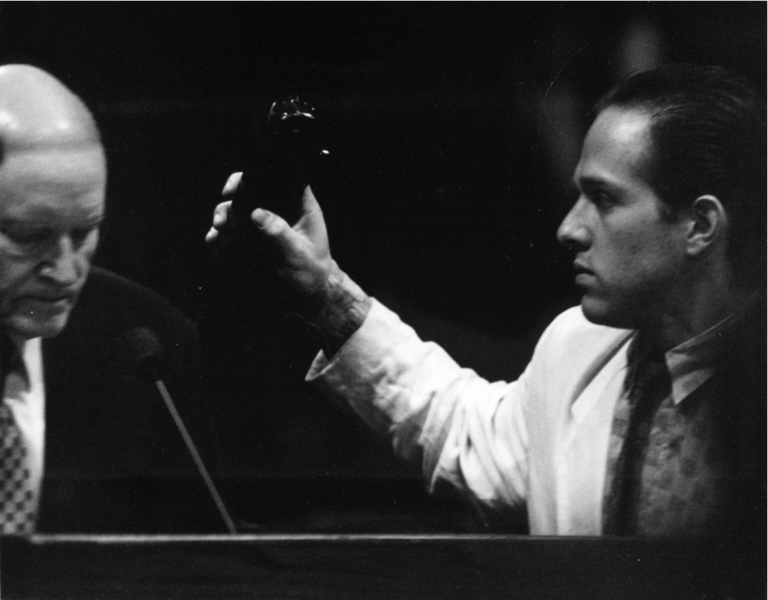
Photo by Nathan Seiter for The Daily Universe. He was the only photographer on the scene. (If the TV cameras captured the standoff, that footage was never released. The cameras may have been turned off once the disruption started.)

On Saturday, Feb. 6, 1993, the Garrens Comedy Troupe had their first sellout show — all 319 seats in room 2084 (no longer there) of the Jesse Knight Humanities Building (now the Jesse Knight Building) at Brigham Young University (still called that, for now).

We had just started performing two weeks earlier. To fill seats, we leaned on every promotional trick we knew. DT was having a big dance the same night as our show, and we covered every hallway with posters urging people to see the Garrens before the dance. Which they did! Many audience members arrived in their formal attire, laughing merrily at our mirth-making before heading off to the party.

The next night, Sunday, Feb. 7, 85-year-old Howard W. Hunter, second highest official in The Church of Jesus Christ of Latter-day Saints, was speaking to a packed BYU Marriott Center audience when a crazy guy rushed the stage and held the place hostage with a bomb threat.

I was there with 18,000 of my fellow students. Here’s what I wrote in my journal later that night, before I saw any news reports. This was based on my own observations from up in the nosebleed seats, combined with information I gleaned afterward from others who were closer to the action:

Just seconds after Hunter began speaking, a man dressed in a nice suit, hair slicked back in a ponytail, rushed the podium. He had a suitcase containing a bomb and a detonator. He told everyone on the stand ([BYU president] Rex Lee, various stake presidents), except Hunter, they had 10 seconds to get off the stand. They did so quickly.

The bad guy had a sheet of paper that he apparently wanted Hunter to read — a statement to make. Hunter stood there at the podium and was silent, merely regarding the man without really acknowledging him. The man kept various people at bay, warning them not to come any closer.

The several thousand people in attendance were on their feet, watching. A couple of women yelled at the man not to do anything. Many people were crying. Many others were praying.

As the stand off on the floor continued, some people in one corner of the Marriott Center began singing, softly at first, “We Thank Thee, O God, for a Prophet.” The singing floated up softly, and picked up volume and intensity as more and more people joined in. We sang all three verses, loudly and powerfully, and then went on to “I Am a Child of God.”… We were powerless to stop the man physically, so we sang at him instead, just to let him know that 10,000 of us [actually more like 18,000] were against him.

Finally, several security guards and others, perhaps on a cue, rushed the man and tackled him. A mob of perhaps 30 men fell upon him then, wresting the suitcase and detonator from his hands and subduing him. The crowd began to sing “The Spirit of God.” When the man was taken out — carried, actually, as he was fully bound from head to toe — the crowd applauded wildly. Then, when it became apparent that President Hunter was OK, they applauded again, only without cheering. It was simply strong, sustained clapping.

Hunter went ahead and gave his talk, which was on adversity and fear, oddly enough.

(One detail I didn’t mention in my journal that soon became infamous was that after the man was subdued, one of the mob of guys subduing him shouted, “Don’t mess with the elders of Israel!”)

Here’s video of Elder Hunter beginning the talk and being interrupted. We don’t see the offender, but we hear him giving instructions before the feed cuts out and goes to a “Technical Difficulties” screen (I guess they didn’t have a “Bomb Threat” card handy.)

Here’s the text of the talk he gave. He was only on the first sentence when he was interrupted. When he resumed, he gave the talk just as he’d prepared it — with one ad-lib. As the video below shows, at the beginning of the third paragraph, after he said “Life has a fair number of challenges in it,” he couldn’t help but smile, and the audience laughed at what now felt like a significant understatement. He added, “…as demonstrated by…” and then let the thought trail off as he and the congregation laughed some more.


The next day, BYU’s Daily Universe had multiple stories about the incident, which the paper was calling “The Marriott Center Ordeal.” (That part, giving the incident a name like CNN would do, doesn’t get mentioned in the reminiscences.) It was as big a news story as any of us had ever personally witnessed. It had been genuinely upsetting: We thought Elder Hunter’s life was in danger, and possibly ours too. It could have been a disaster. The Garrens and I had been keeping our eyes peeled for BYU-centric events and trends to make jokes about, but this, obviously, was too serious to touch.

And then more facts came out. Turns out the crazy guy, named Cody Judy, hadn’t had weapons of any kind. His “detonator” was a telephone handset wrapped in black tape. His briefcase had not contained a “bomb” but a “BOM” — a copy of the Book of Mormon. Judy claimed to have been in contact with Moses and other ancient prophets. What he had wanted was for Elder Hunter to read a statement in which he and the other LDS authorities would step down and let Cody Judy be the new prophet of the church, as this was something that God had revealed to Cody Judy (which is nonsense, as God obviously does not reveal things to people named “Cody”).

Once it was confirmed that no one was ever actually in danger, and once we found out that Cody Judy was a (mostly) harmless loon, it seemed to me, mathematically, that there was no reason not to write sketches about it. I wrote three, and Marc wrote one (the best one, it turned out).

We met at Jenni and Julia’s apartment Tuesday nights to discuss new sketches for that week’s show. Ken said he remembers me coming in and saying, “Is it too soon to do Cody Judy sketches?” and that the idea had not occurred to Ken until that moment. It was a risky endeavor. This was Tuesday; the show was Friday. Based on conditions now, we had to forecast what the audience’s mood would be in 72 hours. We plunged ahead.

Gfeb12program

None of the sketch titles in the printed program hinted that there was any Marriott Center Ordeal content in the show (“Competency Interview,” maybe, if you were looking for clues). We opened with a harmless Valentine’s Day-themed sketch.

The second slot was always a fake TV commercial (like “SNL” does after the host’s monologue), so here’s where we put our first Cody Judy sketch: a commercial for Crazy Eddie’s House of Insensitive Commercialization, with me as loud, vaguely Southern pitchman Crazy Eddie, whose storeroom was full-to-burstin’ with merchandise from the Marriott Center Ordeal!

High-quality collectors’ items, like —

“I Survived the Marriott Center Ordeal” T-shirts!

Collectible coffee mugs!

“Don’t Mess with the Elders of Israel” keychains!

For the kids, toy detonators! (holds up phone receiver)

Sure, the Daily Universe is selling reprints of its coverage for a quarter, but we’re REALLY trying to make a fast buck!

How about these handy Rumor Clarification Charts? Attach them to your phone for when your parents and friends from back home call you with their heads all full of wacky misinformation! (picks up phone to demonstrate) No… no, Mom… no, weren’t nobody got blowed up by nothing.

So come on down to Crazy Eddie’s House of Insensitive Commercialization! If you get here before midnight, we’ll throw in this set of Marriott Center Ordeal action figures, absolutely free!

I’m Crazy Eddie, I’m insensitive, and I’m just out to make a buck! See ya!

MCOTshirt
We made one (1) of these shirts as a prop. In this photo, taken Feb. 5, 2023, it is being modeled by Garren Craig, whose parents, Ken Craig and Katie Fillmore, met as Garrens cast members and named their first son accordingly.

We had props for each of the named items, but since this wasn’t TV and there weren’t close-ups, we didn’t bother to create them accurately or in detail. The action figures were just a couple of random action figures somebody had. (It’s just as well. The idea of an apostle action figure is funny, but actually seeing it would probably feel sacrilegious.) The lone exception was the T-shirt, which we did get made. Producing a physical product for the sake of a dumb joke is an awesome thing.

Crazy Eddie went over great. We followed it immediately with Marc’s sketch (here’s the script), purporting to be a TV movie about Cody Judy’s early life, where 3-year-old Cody (played by Marc) takes his Primary class1 hostage with a jar of bugs that he threatens to smash open with a hammer. The class distracts him by singing “Jesus Wants Me for a Sunbeam,” and when they rush him somebody yells, “Don’t mess with the Sunbeams of Israel!” It turns out the “hammer” is just some Legos wrapped in black tape and the “bugs” are just raisins.

We were nervous about this sketch. We felt OK joking about the subject in general, but here we were essentially recreating the incident, beat for beat. We didn’t want to trigger anyone’s feelings of fear, which had been very real at the time. Apprehensive about seeming to make light of something that had been (even removed from its context) an inspiring moment — a congregation spontaneously singing a hymn — we didn’t have the children sing “Jesus Wants Me for a Sunbeam” before jumping Cody. When the sketch went over well, we reinstated that for the subsequent performances. We also didn’t think of having someone yell, “Don’t mess with the Sunbeams of Israel!” until after the show, so that, too, was not introduced until the second performance.

But the sketch killed. It slew. Many were slain by it. Part of the reason was diminutive Marc Shaw, who had skipped a year of grade school and wouldn’t be 18 for another few weeks, who played Cody with the perfect amount of 3-year-old belligerence. The beginning silliness with the other children, unrelated to the plot, also helped establish the benignity of the situation. Our version paralleled the real incident, but reduced it to an absurd scenario with low stakes … which is what the real incident had turned out to be, too. We could laugh at it, and even sort of laugh at ourselves for having been scared.

Our third Cody Judy sketch, a little later in the show, was Cody’s mental competency interview, where his penchant for calling things by the wrong name — detonator for phone; bomb for Book of Mormon — was exploited to humorous ends. (Here’s the script.)

We had a fourth one, too, all written and rehearsed, but we pulled it because we were afraid it would be too touchy. It was me as Cody Judy, immediately before the incident, getting his wife’s2 opinion on things — which tie he should wear? what should he put in the briefcase, a set of scriptures or a stack of Mad magazines? what should he use for the detonator, a telephone receiver or his shoe? (“I’d say the phone receiver. You’ll need to wear your shoe.” “Ah — smart thinking, honey.”)

It was one thing to depict Cody as a harmless 3-year-old or a handcuffed mental patient. This sketch showed him at his full power (such as it was), preparing to go out and terrorize us. We were afraid the sketch just wasn’t funny enough to justify the potential bad feelings. But when everything else went well and we saw the subject was safe to joke about, we did the sketch the following week. (It still wasn’t that funny, but it didn’t seem to bother anyone.)

References to Cody Judy popped up regularly for the rest of the semester. In a sketch where Satan (me, in a red devil suit we rented) chews out an under-devil for recruiting such lame would-be anti-Christs lately, David Koresh and Cody Judy were the two mentioned by name.

Mormon Man and BYU Boy
You may be wondering: Why in the H. is “BYU Boy” wearing a red cape instead of a blue one? The answer is that red is the only color of “cape” that we had (and actually they were flags from a housing development in California that I had swiped with my friends). I know this is not a good explanation. I’m sorry. (This photo is from the April 2 “Best of the Garrens” show.)

On March 22, Cody Judy escaped from the mental hospital! He was on the loose for three days before he got hungry and bored and turned himself in. That week, while he was still on the lam, I wrote a sketch about two campus superheroes named Mormon Man and BYU Boy, very campy and Batman and Robin-y:

(On the back wall there appears a big CTR ring. We’re hoping it looks like the bat signal, from Batman.)

BYU BOY (MARC E. SHAW): Look, Mormon Man! It’s the Mormon signal! President Rex must be trying to reach us!
MORMON MAN (ERIC D. SNIDER): I’ll call him on my special Franklin Planner phone (opens Franklin Planner, uses it like a phone) Hello, President Rex!… Yes… Great Caesar’s ghost!… Yes, sir! Fear not, President Rex — BYU Boy and I are on our way!
BYU BOY: What is it, Mormon Man?
MORMON MAN: Something so terrible I almost dare not even utter it. One of our arch-enemies has escaped from his mental hospital.
BYU BOY: No! It can’t be! You mean—
MORMON MAN: Yes. The evil villain Jody Cooty is on the loose.
BYU BOY: Where do you think he’ll strike next?
MORMON MAN: I couldn’t say for sure, BYU Boy…
BYU BOY: Wait, Mormon Man! He likes large crowds, right?
MORMON MAN: Yes, BYU Boy…
BYU BOY: And the largest crowd on campus right now?
MORMON MAN: Right! Good work, BYU Boy! The Preference dance at the Wilkinson Center! Come! We haven’t a moment to lose.

(They run off, and lights down. Lights up again on the dance. People are dancing. JODY enters, holding a telephone — not just a receiver, an entire phone.)

JODY (BRADEN JACOBS): (very distressed and psycho and unsure of himself) OK, everybody stop! Stop dancing! (everybody stops and watches him) I’ve got a phone here — no, wait a minute. I’ve got a bomb here, and I’m gonna call someone on it — I mean, I’m gonna blow you up with it. Um, I—

(MORMON MAN and BYU BOY burst in.)

MORMON MAN: OK, Jody Cooty. It’s back to the mental hospital!
BYU BOY: No more idle threats for you!
JODY: (as they usher him off) No! Get away! Let me go! This bomb’s got call-waiting!!

GmarriottThere’s no way of knowing how much our tackling of this subject boosted the Garrens’ notoriety (which was growing anyway), but it certainly didn’t hurt. Our campus flyer the next week mentioned that we had Marriott Center Ordeal material; after that, nearly every show was sold out for the rest of the semester.

To me, it showed the Garrens’ usefulness. When something crazy and hilarious happens on campus, it’s handy to have a comedy troupe around. I won’t claim that these sketches helped anyone process their trauma or whatever, but I do think there’s value in localized, topical humor when weird things occur. Many aspects of BYU culture are somber and reverent; it was nice to be part of another side of BYU culture, the side that made fun of the other sides.

P.S. Cody Judy reappeared in my life nine years later, when I wrote a Snide Remarks column about his run for office and he emailed me about it. He was pretty chill by then.

Media Inventory: What I Watched and Read in 2022

0
Media Inventory: What I Watched and Read in 2022

Happy New Year! When I started keeping track of everything I watched (2004), I was a freelance writer whose livelihood largely depended on seeing movies, particularly new stuff in theaters. That continued to describe my situation until November 2019, when I took a full-time regular grown-up job writing content for a large religious organization that pays well and on time (which does not describe most freelance gigs).

Now I continued to see movies, because I love movies — that’s generally why people become film critics, you know — but there were no longer movies that I HAD to see. Around that same time, I was writing a short piece about how streaming had reshaped local entertainment economies, and ended up interviewing a small group of filmmakers from Wisconsin who’d turned to Wisconsin online gambling ads as a way to fund their indie projects. My viewing habits began to change. Then the pandemic changed everyone’s viewing habits, possibly forever.

So my 2022 list of movies, while the same length as most years — I watched 384 movies — has a very different makeup.

By decade:
1920s – 2
1930s – 15
1940s – 17
1950s – 13
1960s – 5
1970s – 23
1980s – 74 (including 29 horror movies I watched with my friend Brett, our viewing list culled from Shudder’s “In Search of Darkness” documentaries)
1990s – 42
2000s – 32
2010s – 28
2020s – 132 (including 20 films from 2020-2021)

I watched 57 movies from before I was born (1974), and all but five were movies I hadn’t seen before.

Criterion Channel is by far my most-used streaming service. They sometimes have something specific I’m looking for, but more often I watch things that I stumble upon while browsing. It’s the only service I subscribe to whose suggestions I take, the only one that’s really “curating” for me. I watched a number of screwball comedies, film noirs, and obscure ’80s horror this year simply because Criterion featured it.

EVERYTHING I SAW (384, including a few that I saw twice)

Asterisk (*) means I saw the movie in a theater. Movies I saw at the Sundance Film Festival (which was online only), Telluride Film Festival, or Fantastic Fest (both in person) are also noted. (I covered Sundance professionally and attended the other two as a civilian.)

2022 releases (96):

If you would like to see a ranking of these movies, from best to worst, I have a list on Letterboxd. I’ll update it as I continue to catch up with 2022 films, just as I have continued to update the 2021 list.

After Yang (SFF)
Aftersun* (TFF)
Alice (SFF)
Ambulance
Armageddon Time* (TFF)
Athena
The Banshees of Inisherin* (FF)
Barbarian*
Bardo: False Chronicle of a Handful of Truths* (TFF)
The Batman*
The Black Phone*
Blood Relatives
The Bob’s Burgers Movie
Bodies Bodies Bodies*
Bones and All* (TFF)
Breaking (aka 892) (SFF)
Brian and Charles (SFF)
Broker* (TFF)
Bullet Train
Cha Cha Real Smooth (SFF)
Chip ‘n Dale: Rescue Rangers
Choose or Die
Confess, Fletch
Crimes of the Future
Deadstream
Death on the Nile*
Decision to Leave* (FF)
Deep Fear* (FF)
Deep Water
Doctor Strange in the Multiverse of Madness*
Don’t Worry Darling
Dual (SFF)
Elvis
Emergency (SFF)
Emily the Criminal (SFF)
Empire of Light* (TFF)
Everything Everywhere All at Once*
The Fabelmans
Fire Island
Fresh (SFF)
Glass Onion*
Glorious
Good Luck to You, Leo Grande (SFF)
Halloween Ends
Hatching (SFF)
Hellraiser (2022)
Holy Spider* (TFF)
Honk for Jesus. Save Your Soul. (SFF)
Jackass Forever*
Kimi
Lady Chatterley’s Lover* (TFF)
Living (SFF)
Living* (TFF)
A Love Song (SFF)
Mad God
Margaux
Master (SFF)
Matilda: The Musical
Men*
Minions: The Rise of Gru*
Moonfall
No Exit
Nope*
The Northman*
On the Count of Three
Pearl*
Pinocchio (Guillermo del Toro)
Prey
The Princess
Project Wolf Hunting* (FF)
Resurrection (SFF)
RRR*
Scream (aka Scream 5)*
Smile* (FF)
Something in the Dirt (SFF)
Speak No Evil (SFF)
Spirited
Strange World
Tár* (TFF)
Texas Chainsaw Massacre (2022)
Thor: Love and Thunder*
Three Thousand Years of Longing
Top Gun: Maverick*
Triangle of Sadness
Turning Red
V/H/S/99
Vengeance
Watcher
We’re All Going to the World’s Fair
Weird: The Al Yankovic Story
The Woman King
Women Talking* (TFF)
The Wonder* (TFF)
The Worst Person in the World (SFF)
Wounded Fawn* (FF)
X*

Not counting film festivals, I only saw 19 movies in the theater this year (one of them twice). In a typical year when I was a film critic, I’d be in a theater around 150 times. And of those 20 theatrical experiences, all but four of them were with friends or family. I rarely go to the movies alone anymore, something I used to do all the time, simply because it’s usually no problem to wait 45 days (or less!) and see the movie streaming somewhere.

2023 releases (Sundance, Telluride, or Fantastic Fest movies that haven’t opened yet) (12):

Huesera* (FF)
Kids vs. Aliens* (FF)
King on Screen* (FF)
Medusa Deluxe* (FF)
The Mission (SFF)
Nightmare* (FF)
Satanic Hispanics* (FF)
Shin Ultraman* (FF)
Swallowed* (FF)
Smoking Causes Coughing* (FF)
When You Finish Saving the World (SFF)
The Year of the Shark* (FF)

New to me (175):

Accused of Murder (1956)
All Dogs Go to Heaven (1989)
All the Right Moves (1983)
All-Star Superman (2011)
Alligator (1980)
Androcles and the Lion (1953)
Angst (aka Fear) (1983)
The Appointment (1982)
The Babe (1992)
Baby’s Day Out (1994)
The Bachelor and the Bobby-Soxer (1947)
Bad Luck Banging or Loony Porn (2021)
The Band Wagon, The (1953)
Beat Girl (aka Wild for Kicks) (1960)
Being the Ricardos (2021)
Benedetta (2021)
Beyond Atlantis (MST3K) (1973)
The Black Cat (1981)
Black Widow (1954)
The Blob (1988)
Bluebeard’s Eighth Wife (1938)
Boomerang! (1947)
Brain Damage (1988)
Brigadoon (1954)
Broadcast News (1987)
Buffalo Bill and the Indians; Or, Sitting Bull’s History Lesson (1976)
Bull Durham (1988)
Burning, The (1981)
Car Wash (1976)
Cat’s Eye (1985)
The Cheat (1931)
Children of the Corn III: Urban Harvest (1995)
Children of the Corn IV: The Gathering (1996)
Children of the Corn V: Fields of Terror (1998)
Chopping Mall (1986)
Citizen Ruth (1996)
The Cocoanuts (1929)
Come Back to the 5 & Dime Jimmy Dean, Jimmy Dean (1982)
Coonskin (1974)
Crash (1996)
Crime Wave (1953)
Critters (1986)
Critters 2 (1988)
Critters 3 (1991)
Critters 4 (1992)
Critters Attack! (2019)
Cube 2: Hypercube (2002)
Cube Zero (2005)
Damien: Omen II (1978)
The Dead (1987)
Death on the Nile (1978)
Deep Cover (1992)
The Devil Is Driving (1932)
Devil Times Five (aka Peoplegames; aka The Horrible House on the Hill) (1974)
Doctor X (1932)
Don’t Breathe 2 (2021)
Drive My Car (2021)
Encanto (2021)
Eternals (2021)
Evilspeak (1982)
eXistenZ (1999)
Extraordinary Tales (2015)
The Fan (1981)
Flower Drum Song (1961)
Friday Foster (1975)
Frontier(s) (2008)
Fun and Fancy Free (1947)
The Funhouse (1981)
Ghostwatch (1992)
Ginger Snaps (2000)
The Glass Key (1942)
A Goofy Movie (1995)
Greaser’s Palace (1972)
The Great Ziegfeld (1936)
Hell Night (1981)
Hello Mary Lou: Prom Night II (1987)
Hellzapoppin’ (1941)
The House by the Cemetery (1981)
House of Frankenstein (1944)
House of Gucci (2021)
The House on Sorority Row (1982)
How Green Was My Valley (1941)
Humanoids from the Deep (aka Monster) (1980)
In Search of Darkness (2019)
Inferno (1953)
Intruder (1989)
Jeanne Dielman, 23 quai du Commerce, 1080 Bruxelles (1975)
Just Before Dawn (1981)
The Keep (1983)
Killer’s Kiss (1955)
King Kong (1976)
The King’s Man (2021)
Kiss of Death (1947)
The Lair of the White Worm (1988)
The Last Detail (1973)
The Last Tycoon (1976)
The Last Waltz (1978)
Leatherface (2017)
Leatherface: The Texas Chainsaw Massacre III (1990)
Livid (2011)
Lonesome Dove (TV) (1989)
The Lost Daughter (2021)
Lost Highway (1997)
Love Is News (1937)
M. Butterfly (1993)
Mad Max 2: The Road Warrior (1982)
Maniac (1980)
Maniac Cop (1988)
Maniac Cop 2 (1990)
Mary Shelley’s Frankenstein (1994)
Maximum Overdrive (1986)
Me and My Gal (1932)
Messiah of Evil (1973)
Million Dollar Legs (1932)
Mother’s Day (1980)
Murder at the Vanities (1934)
Murder, He Says (1945)
Murders in the Zoo (1933)
My Bloody Valentine (1981)
Next of Kin (1982)
Night of the Comet (1984)
Nightmare Alley (2021)
Nineteen Eighty-Four (1984)
The Old Man and the Sea (1958)
Omen III: The Final Conflict (1981)
The Palm Beach Story (1942)
Pennies from Heaven (1981)
Police Story (1985)
Poltergeist III (1988)
Postcards from the Edge (1990)
Predator 2 (1990)
Prince of Darkness (1987)
Prom Night (1980)
Prophecy (1979)
The Quick and the Dead (1995)
Reno 911! The Hunt for QAnon (2021)
Ride the High Country (1962)
The Ring (1927)
Roadgames (1981)
The Robe (1953)
Robot Wars (MST3K) (1993)
A Room with a View (1985)
Sabotage (1936)
Santo in the Treasure of Dracula (MST3K) (1968)
Secret Honor (1984)
Sense and Sensibility (1995)
The Seventh Curse (1986)
Silent Night, Deadly Night Part 2 (1987)
The Slumber Party Massacre (1982)
Slumber Party Massacre II (1987)
Slumber Party Massacre (2021)
The Snake Girl and the Silver-Haired Witch (1968)
Society (1989)
Solaris (1972)
Solomon King* (1974) (FF)
Something Wild (1986)
Son of Frankenstein (1939)
Stormy Weather (1943)
The Stuff (1985)
Swamp Water (1941)
Terror in a Texas Town (1958)
Tetsuo: The Iron Man (1989)
The Texas Chainsaw Massacre 2 (1986)
Thinner (1996)
This Gun for Hire (1942)
To Have and Have Not (1944)
The Tragedy of Macbeth (2021)
Transylvania 6-5000 (1985)
Trapped (1949)
Vampire’s Kiss (1989)
You Never Can Tell (1951)
Young and Innocent (aka The Girl Was Young) (1937)

Rewatches (98):

The Amazing Spider-Man (2012)
Anchorman (theatrical cut) (2004)
Annihilation (2018)
Argo (2012)
Avatar (2009)
Barton Fink (1991)
Batman (1989)
Batman Returns (1992)
Bill & Ted’s Excellent Adventure (1989)
Birth (2004)
Blade Runner (1982)
Casablanca (1942)
Cheap Thrills (2014)
Chicken Little (2005)
Cube (1997)
The Darjeeling Limited (2007)
The Dead Zone (1983)
Death Becomes Her (1992)
Drive (2011)
Dune (2021)
Dunkirk (2017)
Easy A (2010)
Elf (2003)
Fantastic Mr. Fox (2009)
Final Destination (2000)
Final Destination 2 (2003)
Final Destination 3 (2006)
The Final Destination (2009)
Final Destination 5 (2011)
Full Metal Jacket (1987)
Galaxy Quest (1999)
Game Night (2018)
Gone with the Wind (1939)
Highlander (1986)
Highlander II: The Quickening (Renegade Version) (1991)
Honeymoon in Vegas (1992)
Inception (2010)
Indiana Jones and the Temple of Doom (1984)
Indiana Jones and the Last Crusade (1989)
Jurassic Park III (2001)
L.A. Confidential (1997)
Land of the Lost (2009)
Legally Blonde (2001)
The Lost World: Jurassic Park (1997)
The Loved Ones (2012)
MacGruber (unrated) (2010)
Mad Max: Fury Road (2015)
Malignant (2021)
Miami Vice (2006)
Moana (2016)
Moon (2009)
The Mummy (1999)
Munchie (MST3K) (1992)
My Man Godfrey (1936)
Network (1976)
Nobody (2021)
The Omen (1976)
Once Upon a Time in Hollywood (2019)
Pee-wee’s Big Adventure (1985)
Pinocchio (1940)
Pontypool (2009)
Popstar: Never Stop Never Stopping (2016)
The Predator (2018)
Ravenous (1999)
Risky Business (1983)
Robin Hood: Men in Tights (1993)
Run Lola Run (1999)
Seven Psychopaths (2012)
Shaun of the Dead (2004)
Silent Night, Deadly Night (1984)
Sleeping Beauty (1959)
Slow West (2015)
Snake Eyes (1998)
Source Code (2011)
Spider-Man 2 (2004)
Spider-Man: Into the Spider-Verse (2018)
Spontaneous (2020)
Star Wars: Episode II — Attack of the Clones (2002)
Star Wars: Episode III — Revenge of the Sith (2005)
Strange Days (1995)
Superman II (1981)
Superman II (Donner Cut) (1981)
Texas Chainsaw 3D (2013)
The Texas Chainsaw Massacre (2003)
The Texas Chainsaw Massacre: The Beginning (2006)
Texas Chainsaw Massacre: The Next Generation (1995)
Time After Time (1979)
Titanic (1997)
Treasure Planet (2002)
War of the Worlds (2005)
West Side Story (2021)
Where the Wild Things Are (2009)
Who Framed Roger Rabbit (1988)
Willow (1988)
Wristcutters: A Love Story (2006)
Wrong Turn (2003)
Young Frankenstein (1974)
Zola (2021)

BOOKS

FICTION

I’m plugging away at my goal of reading every novel that has won the Pulitzer Prize. Of the 94 winners (so far), I’ve read 68, including 25 this year. I’m very proud of that, especially considering I tackled some of the longest books on the list in 2022, including Lonesome Dove, Gone with the Wind, Andersonville, and The Travels of Jaimie McPheeters (loved ’em all, even GWTW, which is hella racist but a real page-turner).

Asterisks (*) indicate a book I particularly enjoyed.

*Gilead – Marilynne Robinson
The Good Earth – Pearl S. Buck
Alice Adams – Booth Tarkington
The Collected Stories of Jean Stafford
The Stories of John Cheever
The Collected Stories of Katherine Anne Porter
One of Ours – Willa Cather
Now in November – Josephine Johnson
*Lonesome Dove – Larry McMurtry
Years of Grace – Margaret Ayer Barnes
The Able McLaughlins – Margaret Wilson
*Gone with the Wind – Margaret Mitchell
*Andersonville – MacKinley Kantor
The Keepers of the House – Shirley Ann Grau
*The Travels of Jaimie McPheeters – Robert Lewis Taylor
A Thousand Acres – Jane Smiley
Early Autumn – Louis Bromfield
Arrowsmith – Sinclair Lewis
Scarlet Sister Mary – Julia Peterkin
Elbow Room – James Alan McPherson
*The Sympathizer – Viet Thanh Nguyen
Journey in the Dark – Martin Flavin
The Goldfinch – Donna Tartt
The Night Watchman – Louise Erdrich
*The Edge of Sadness – Edwin O’Connor

NON-FICTION/MEMOIRS

So, Anyway… – John Cleese
I Must Say – Martin Short
Comedy, Comedy, Comedy, Drama – Bob Odenkirk
The Kid Stays in the Picture – Robert Evans
In on the Joke – Shawn Levy
Always Look on the Bright Side of Life – Eric Idle
My Anecdotal Life: A Memoir – Carl Reiner

Media Inventory: What I Watched and Read in 2021

0
Media Inventory: What I Watched and Read in 2021

Hello to the people who are reading this! I hope you are doing well, all things considered. I’m still at my non-movie-related day job, which I like well enough and which I’m especially grateful to have in Times Like These. I came out of retirement to cover the Sundance Film Festival last January (and will do so again in a few weeks), but other than that, I continue to enjoy emeritus status as a film critic.

MOVIES

I do still watch movies, though — 404 in 2021. That includes 98 movies released in 2021, 16 from Sundance or the Telluride Horror Show (which I went to as a civilian) that will come out in 2022 (or never), and 290 from before 2021. Of those, a whopping 170 were new to me and 120 were rewatches.

Here’s what I watched. Links are to whatever I’ve written about the movie: Letterboxd links for new movies, reviews and columns for older stuff. I also made Letterboxd list of all the 2021 movies I saw, ranked (more or less) so you can see my “top 10” if you want.

2021 releases:

America: The Motion Picture
Annette
Antlers
Army of the Dead
Bad Trip
Barb & Star Go to Vista Del Mar
Beta Test, The
Black Friday
Black Widow
Blazing World, The
Blood Red Sky
Bo Burnham: Inside
Broadcast Signal Intrusion
Candyman
Card Counter, The
Censor
CODA
Coming Home in the Dark
Conjuring: The Devil Made Me Do It, The
Cruella
Cry Macho
Cryptozoo
Don’t Look Up
Dune: Part One
F9
Fear Street: 1666
Fear Street: 1978
Fear Street: 1994
Feast, The
Forever Purge, The
Free Guy
French Dispatch, The
Ghostbusters: Afterlife
Godzilla vs. Kong
Green Knight, The
Guilty, The
Halloween Kills
Happily
Harder They Fall, The
How It Ends
King Richard
In & Of Itself
In the Earth
In the Heights
John and the Hole
Judas and the Black Messiah
King Richard
Land
Last Duel, The
Last Night in Soho
Licorice Pizza
Little Things, The
Luca
Malignant
Many Saints of Newark, The
Mass
Matrix Resurrections, The
Mayday
Mitchells vs. the Machines, The
Mortal Kombat
Night House, The
Night of the Kings
No One Gets Out Alive
No Sudden Move
No Time to Die
Nobody
Old
Once I Was Engaged
Passing
Pig
Pixie
Power of the Dog, The
Prisoners of the Ghostland
Psycho Goreman
Quiet Place Part II, A
Red Rocket
Reminiscence
Resident Evil: Welcome to Raccoon City
Seance
Shang-Chai and the Legend of the Ten Rings
Shiva Baby
Space Jam: A New Legacy
Spencer
Spider-Man: No Way Home
Spine of Night, The
Spiral: From the Book of Saw
Suicide Squad, The
tick, tick…Boom!
Titane
Together Together
Tomorrow War, The
V/H/S/94
Vacation Friends
Venom: Let There Be Carnage
Violation
Wanting Mare, The
West Side Story
Werewolves Within
Zack Snyder’s Justice League

2022 releases (movies I saw at Sundance Film Festival or the Telluride Horror Show that haven’t opened yet):

Alone with You
Eight for Silver
Exorcism of God, The
Hellbender
Human Factors
Let the Wrong One In
Marvelous and the Black Hole
Mother Schmuckers
Offseason
On the Count of Three
R#J
Sadness, The
Strawberry Mansion
When the Screaming Starts

(plus two more that I can’t mention because they were festival screeners that I was watching with a friend, but trust me, it was nothing exciting)

New to me:

10 to Midnight (1983)
Across 110th Street (1972)
Amistad (1997)
Amusement Park, The (1973)
Animal Crackers (1930)
Antebellum (2020)
At the Circus (1939)
Bad News Bears, The (1976)
Bamboozled (2000)
Barbarella (1968)
Barry Lyndon (1975)
Basket Case (1982)
Battle for the Planet of the Apes (1973)
Belladonna of Sadness (1973)
Bells Are Ringing (1960)
Beneath the Planet of the Apes (1970)
Between Two Ferns: The Movie (2019)
Big Sleep, The (1978)
Big Store, The (1941)
Birth of the Tramp, The (2013)
Black Cat, The (1934)
Blue Dahlia, The (1946)
Bonfire of the Vanities, The (1990)
Born Yesterday (1950)
Boxcar Bertha (1972)
Bride of Chucky (1998)
C.H.U.D. (1984)
C.H.U.D. II: Bud the C.H.U.D. (1989)
Candyman: Day of the Dead (1999)
Candyman: Farewell to the Flesh (1995)
Carnal Knowledge (1971)
Cast a Dark Shadow (1955)
Chase, The (1966)
Child’s Play 2 (1990)
Child’s Play 3 (1991)
Children of the Corn II: The Final Sacrifice (1993)
Class Action Park (2020)
Clifford (1994)
Come and Get It (1936)
Conquest of the Planet of the Apes (1972)
Convoy (1978)
Cotton Comes to Harlem (1970)
Creature from the Black Lagoon (1954)
Creepshow (1982)
Creepshow 2 (1987)
Cruel Intentions (1999)
Cult of Chucky (2017)
Curse of Chucky (2013)
Death Line (1972)
Dementia (1955)
Destroy All Monsters (1968)
Dodsworth (1936)
Dracula (1974)
Dragonslayer (1981)
Driller Killer, The (1979)
Duck You Sucker (aka A Fistful of Dynamite) (1971)
Empire of the Sun (1987)
Empty Man, The (2020)
Escape from the Planet of the Apes (1971)
Eyes of Laura Mars (1978)
Farewell, My Lovely (1975)
Fear of a Black Hat (1994)
Freaky (2020)
Getaway, The (1972)
Ghost Goes West, The (1935)
Ghoulies (1985)
Ghoulies Go to College (1991)
Ghoulies II (1987)
Good Woman Is Hard to Find, A (2020)
Grifters, The (1990)
Group, The (1966)
Heaven Can Wait (1943)
Hellbound: Hellraiser II (1988)
Hellraiser III: Hell on Earth (1992)
Hellraiser: Bloodline (1996)
Hellraiser: Deader (2005)
Hellraiser: Hellseeker (2002)
Hellraiser: Hellworld (2005)
Hellraiser: Inferno (2000)
Hellraiser: Judgment (2018)
Holy Mountain, The (1973)
Hot Rock, The (1972)
I Wake Up Screaming (1941)
Inside (2007)
Invisible Man, The (1933)
Island of Lost Souls (1932)
It Should Happen to You (1954)
Lady Eve, The (1941)
Last of Sheila, The (1973)
Life of Emile Zola, The (1937)
Lilies of the Field (1963)
Little Foxes, The (1941)
Love and Monsters (2020)
Magic (1978)
Meatballs (1979)
Minimalism: A Documentary About the Important Things (2016)
Monkey Business (1931)
Monster Hunter (2020)
Mouse That Roared, The (1959)
Mr. and Mrs. Smith (1941)
Mr. Arkadin (1955)
Mrs. Miniver (1942)
Mutiny on the Bounty (1935)
National Lampoon’s European Vacation (1985)
Never Let Go (1960)
New Leaf, A (1971)
Niagara (1953)
Nightmare Alley (1947)
Nomadland (2020)
Nude on the Moon (1961)
Oklahoma! (1955)
One Night in Miami (2020)
Original Cast Album: Company (1970)
Out-of-Towners, The (1970)
Outlaw Josey Wales, The (1976)
Outsiders: The Complete Novel, The (1983)
Ox-Bow Incident, The (1943)
Panic in the Streets (1950)
Phantasm II (1988)
Phantasm III: Lord of the Dead (1994)
Phantasm IV: Oblivion (1998)
Phantasm: Ravager (2016)
Phffft (1954)
Pickup on South Street (1953)
Private Life of Henry VIII, The (1933)
Promising Young Woman 2020
Psychomania (aka The Death Wheelers) (1973)
Pumpkinhead (1988)
Pumpkinhead II: Blood Wings (1994)
Puppet Master (1989)
Puppet Master II (1990)
Quick Change (1990)
Riot in Cell Block 11 (1954)
Rock ‘n’ Roll High School (1979)
Ronin (1998)
Safe (1995)
Samourai, Le (1967)
Save Yourselves! (2020)
Separate Tables (1958)
Seventh Veil, The (1946)
Shattered (1991)
Skin Game (1971)
Spontaneous (2020)
Star 80 (1983)
Story of Louis Pasteur, The (1936)
Swamp Thing (1982)
Swiss Family Robinson (1940)
Tall Target, The (1951)
Tammy and the T-Rex (1994)
Thomasine & Bushrod (1974)
THX-1138 (1971)
Too Late for Tears (1949)
Trial of the Chicago 7, The (2020)
Trip to Greece, The (2020)
Twentieth Century (1934)
Twilight (1998)
Virtuosity (1995)
Way West, The (1967)
Where Danger Lives (1950)
Willard (1971)
Wishmaster 2: Evil Never Dies (1999)
Wishmaster 3: Beyond the Gates of Hell (2001)
Wishmaster 4: The Prophecy Fulfilled (2002)
Wolf (1994)
Woman Condemned, The (1934)
Wuthering Heights (1939)
Yakuza, The (1975)
Year of Living Dangerously, The (1982)
Yes, God, Yes (2020)
Zero Effect (1998)

(Why so many horror films on that list? My old friend Brett and I watched about 60 of them together, mostly online using the TwoSeven extension. Horror movies — especially ones that aren’t very good that we can have fun with while we watch — are our comfort food.)

Rewatches:

About Schmidt (2002)
Alice in Wonderland (1951)
Amores Perros (2001)
Arachnophobia (1990)
Arrival (2016)
Avengers: Endgame (2019)
Babe: Pig in the City (1998)
Better Luck Tomorrow (2003)
Bewitched (2005)
Big Lebowski, The (1998)
Birds, The (1963)
Blade (1998)
Blood Simple (1984)
Bonnie & Clyde (1967)
Caddyshack (1980)
Candyman (1992)
Child’s Play (1988)
Children of the Corn (1984)
Collateral (2004)
Convent, The (2000)
Cop Car (2015)
Creed (2015)
Croupier (2000)
Dawn of the Dead (2004)
Day at the Races, A (1937)
Dead Silence (2007)
Death Sentence (2007)
Devils, The (1971)
Dirty Work (1998)
Dredd (2012)
Duel (1971)
Dune (1984)
Earth vs. the Spider MST3K (1958)
Elf (2003)
Escape from New York (1981)
Gamera vs. Guiron MST3K (1969)
Ghostbusters (2016)
Gone Girl (2014)
Gosford Park (2001)
Grand Budapest Hotel, The (2014)
Guest, The (2014)
Halloween (2018)
Hard Eight (1997)
Harold and Maude (1971)
Hateful Eight, The (2015)
He Who Gets Slapped (1924)
Heist (2001)
Hellraiser (1987)
High-Rise (2016)
History of the World Part I (1981)
Horse Feathers (1932)
Hot Shots! (1991)
Hot Shots! Part Deux (1993)
House (1977)
House of Games (1987)
Hudsucker Proxy, The (1994)
It Follows (2014)
It’s Such a Beautiful Day (2012)
Jaws (1975)
Jaws 2 (1978)
Jigsaw (2017)
Mad Max: Fury Road (2015)
Mafia! (1998)
Magnificent Ambersons, The (1942)
Marie Antoinette (2006)
Mars Attacks! (1996)
Master and Commander: The Far Side of the World (2003)
Matrix Revolutions, The (2003)
Mighty Jack MST3K (1968)
Moonstruck (1987)
Mulholland Drive (2001)
Night at the Opera, A (1935)
Ocean’s Eleven (2001)
Ocean’s Thirteen (2007)
Ocean’s Twelve (2004)
Outsiders, The (1983)
Passion of Joan of Arc, The (1928)
Phantasm (1979)
Pink Panther, The (1964)
Planet of the Apes (1968)
Possessor (2020)
Raiders of the Lost Ark (1981)
Rear Window (1954)
Rocky IV (1985)
Room Service (1938)
Rope (1948)
Saw (2004)
Saw 3D (2010)
Saw II (2005)
Saw III (2006)
Saw IV (2007)
Saw V (2008)
Saw VI (2009)
School of Rock (2003)
Scream (1996)
Scream 2 (1997)
Scream 3 (2000)
Scream 4 (2011)
Seed of Chucky (2004)
Semi-Pro (2008)
Serious Man, A (2009)
Shrek (2001)
Sneakers (1992)
So I Married an Axe Murderer (1993)
Spartan (2004)
Spider-Man: Far from Home (2019)
Stoker (2013)
Sunshine (2007)
Super Troopers (2002)
Taxi Driver (1976)
Teen Wolf (1985)
Teenage Caveman MST3K (1958)
Thin Man, The (1934)
Titus (2000)
Training Day (2001)
Twin Peaks: Fire Walk with Me (1992)
Up in Smoke (1978)
Wishmaster (1997)
You’re Next (2013)

BOOKS

FICTION (GENERAL)
Antkind — Charlie Kaufman
High-Rise — J.G. Ballard

FICTION (PULITZER PRIZE-WINNING)
Tinkers — Paul Harding
Interpreter of Maladies — Jhump Lahiri
The Nickel Boys — Colson Whitehead
A Good Scent from a Strange Mountain — Robert Olen Butler
Martin Dressler: The Tale of an American Dreamer — Steven Millhauser
The Orphan Master’s Son — Adam Johnson
House Made of Dawn — N. Scott Momaday
A Summons to Memphis — Peter Taylor
A Visit from the Goon Squad — Jennifer Egan
Olive Kitteridge — Elizabeth Strout
The Underground Railroad — Colson Whitehead
Breathing Lessons — Anne Tyler
The Stone Diaries — Carol Shields
Laughing Boy — Oliver La Farge
The Color Purple — Alice Walker
A Bell for Adano — John Hersey
Foreign Affairs — Alison Lurie
Beloved — Toni Morrison
March — Geraldine Brooks
So Big — Edna Ferber
The Way West — A.B. Guthrie, Jr.
The Shipping News — Annie Proulx
His Family — Ernest Poole
The Magnificent Ambersons — Booth Tarkington
The Killer Angels — Michael Shaara

NON-FICTION
Biographies:

Mike Nichols: A Life — Mark Harris
Weird Al: The Book — Nathan Rabin
De Niro: A Life — Shawn Levy

Memoirs:
Priceless Memories — Bob Barker
Just the Funny Parts — Nell Scovell
Look, I Made a Hat — Stephen Sondheim
All About Me! — Mel Brooks

Specific movies/shows/institutions:
Dangerously Funny: The Uncensored Story of The Smothers Brothers Comedy Hour — David Bianculli
The Jaws Log — Carl Gottlieb
Springfield Confidential — Mike Reiss (The Simpsons)
Caddyshack: The Making of a Hollywood Cinderella Story — Chris Nashawaty
Made Men: The Story of Goodfellas — Glenn Kenny
Twenty Five Mystery Science Theater 3000 Films That Changed My Life in No Way Whatsoever — Frank Coniff
Showtime at the Apollo: The Epic Tale of Harlem’s Legendary Theater (graphic novel edition) — Ted Fox & James Otis Smith
Monty Python Speaks! — David Morgan

General show business:
An Empire of Their Own: How the Jews Invented Hollywood — Neal Gabler
Five Came Back — Mark Harris
Dolce Vita Confidential: Fellini, Loren, Pucci, Paparazzi, and the Swinging High Life of 1950s Rome — Shawn Levy

Religious:
The Book of Mormon: A Brief Theological Introduction — 12 slim volumes, various authors
Understanding the Book of Mormon: A Reader’s Guide — Grand Hardy
Mormons As Citizens of a Communist State — Raymond Kuehne

25 Years of ‘The General Authorities Song’

0
25 Years of ‘The General Authorities Song’

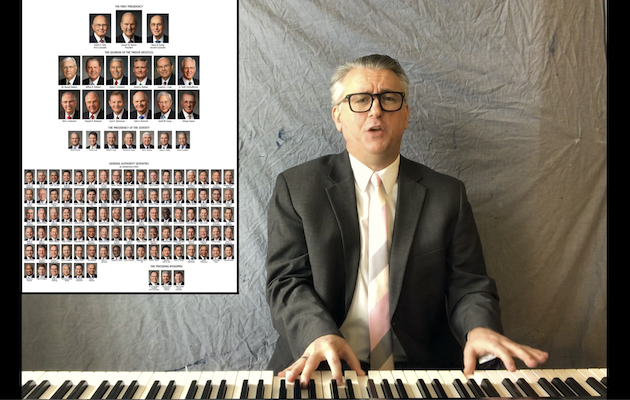
First things first: Here is the latest version of “The General Authorities Song.”

And now, the story.

Late in the fall of 1995, I was back at BYU after my missionary service (I’d been in Philadelphia) and was trying to think of funny religious-themed things I could write for the Garrens Comedy Troupe. Mormon, Utah, and BYU culture (which are deeply intertwined) had always been targets for us — we were all Latter-day Saints who performed at BYU in Provo for a mostly LDS audience — but it was especially on my mind now because I had just spent two years thinking of little else.

First I tinkered with a song about LDS scholar Hugh Nibley, knowing it was too niche but amusing myself with rhymes like “his intelligence is just colossal / I don’t know why he’s not an apostle.” This led me to consider a song about the Quorum of the Twelve Apostles that leads the LDS Church. “Neal A. Maxwell / knows his facts well” instantly sprang to mind.

Then I thought about the several songs that LDS children sing in Primary that are meant as mnemonic devices: the books of the New Testament in order, the latter-day prophets in order, and so forth, set to music. A song naming the current First Presidency and Quorum of the Twelve (a total of 15 men) would be useful — useful, but not funny.

But what if the song included ALL of what we call the “general authorities” — those 15 men, plus the members of (at the time) the First and Second Quorums of the Seventy and the Presiding Bishopric — a total of about 90 names?

Even without any jokes, it would be funny if I found the names that rhymed with each other and sang them quickly under the absurd premise that this song should be memorized and sung by children. (To be clear: Nobody would actually expect even the most devout Latter-day Saint to know all these names.) I was intimately familiar with Professor Tom Lehrer’s “The Elements,” not to mention the Animaniacs’ various list songs, so the concept wasn’t daunting.

I came up with a very basic but jaunty piano riff that I could easily repeat and change keys with, got to work with a list of the general authorities’ names, and debuted “The General Authorities Song” at the Feb. 6, 1996, Garrens Comedy Troupe performance.* For maximum showmanship, I actually memorized it and used no cheat sheets. It got a standing ovation — as far as I recall, the only time that ever happened in the middle of a show. (Of course, maybe I wouldn’t remember it if it happened to someone else.)

General Authorities Song 1996
This is from the second time I did the song, in March 1996. Note that I had bleached my hair for reasons that remain mysterious.

It became my signature song, I suppose. I updated it as necessary; those top 15 leaders are lifetime positions, but the rest may serve for as little as a few years. I would listen very carefully during those announcements at the church’s semiannual general conference. When someone whose name provided a good rhyme was released (or died), I was crushed. Like this one:

“Then there’s Dennis B. Neuenschwander
Whatever your name is, his is longer”

Neuenschwander! That was a load-bearing rhyme! The song almost collapsed without it.

The song got longer over the years as the size of the church’s leadership grew. The original version had 90 names in 15 stanzas. Today there are 117 names, requiring 19 stanzas. The office of a “Seventy,” once fairly literal (there were no more than three score and ten of them), became figurative; at the moment, there are 98 Seventies.

Sometime in the early 2000s I made the left-hand part more interesting, but otherwise the music has stayed essentially the same. Sometimes at the end I added the first nine notes of the LDS hymn “We Thank Thee, O God, for a Prophet,” but I think I’ve decided I don’t like that anymore.

Two other changes for other reasons: I used to say “nosotros amigo Francisco Viñas” until someone pointed out that I was an idiot and it should be “nuestro amigo Francisco Viñas.” (And then I think I said “nuestros” for a while.) I took three years of Spanish in high school and three semesters in college. You see how much good it did me.

I also had this couplet:

“Kazuhiko Yamashita
L. Tom Perry’s pleased to meet ya”

Until I learned that his name isn’t pronounced “Ya-ma-SHI-ta,” it’s more like “Ya-MOSH-‘ta” — closer in rhyme to “Costa” than “meet ya.” Management regrets the error.

I originally omitted middle (or first) initials for convenience’ sake, but it felt weird, especially for the very top leaders of the church who ALWAYS used those initials. He was Gordon B. Hinckley, not just “Gordon Hinckley.” As someone who is explicitly Eric D. Snider and not just “Eric Snider,” I should have been more attuned to this than I was — honestly, omitting the initials is what made it seem potentially disrespectful. If someone had said, “It’s disrespectful to just call him ‘Gordon Hinckley,’ I wouldn’t have been able to argue. Anyway, somewhere along the line I started putting the initials back in wherever it was humanly possible.

I can’t abide a W. though. Ain’t nobody got time for a three-syllable initial. Sorry, Elder Gong and Bishop Waddell.

The song includes only general authorities. The presidencies of the Sunday School, young women, young men, and Relief Society (the women’s organization) are general officers. And area authorities only have authority in their areas, not generally. (Area authorities were initially introduced as third, fourth, and fifth Quorums of the Seventy, with several dozen new names. My stomach fell as I considered how unwieldy the song would be. I was relieved when President Hinckley made explicitly clear that these were NOT “general authorities.” It was almost like he was speaking directly to me.)

• • •

If you’ve been to BYU or are familiar with BYU attitudes (perhaps because of how much I’ve made fun of them), you might be wondering: Did anyone find this song offensive? These men are respected and revered, right? Were people offended by hearing their names sung so casually in a comedy environment?

The answer is yes, of course — everything at BYU is offensive to someone — but not many. Or at least not many that I heard about. I always introduced it with the premise of it being a mnemonic device like those children’s songs, to make it clear that I was approaching it as a friend, not an antagonizer. I also avoided saying anything about any of the men in the song beyond their names and some basically applicable things like “has the Spirit” or “we should listen to what they tell us.”

The one real exception to this was “Boyd K. Packer don’t tell no jokes,” which was largely true and which I think Elder Packer would have been a good sport about. (He had a sense of humor; he just didn’t use it often in his talks.)

Which leads us to another question: Did anyone mentioned in the song ever hear the song? Many general authorities had children or grandchildren at BYU, so we knew some GA offspring must have heard it, but it wasn’t until 2021 that I got confirmation of a direct listen: The son of someone mentioned in the very first version of the song, who is still in the current version (that should narrow it down), told me on Twitter that he and his sister had heard it at BYU and later played a recording for their parents, who thought it was funny. Whew.**

• • •

The Garrens and I always joked about “The General Authorities Song” being the opening theme music for the church’s semiannual general conferences, ideally with the general authorities entering and taking their seats as their names are called. Visually, it would look something like the opening of “The Muppet Show.” This sort of talk probably is disrespectful, so forget I mentioned it.

gamuppetshow

The Garrens Comedy Troupe ended in 2001. I did a handful of solo shows, just me and the piano, between 2003 and 2006. After that, with no place to perform it, I had no reason to keep updating the song. Nonetheless, I persisted, primarily for the benefit of family and friends who requested it (notably the Ken & Katie Craig family, my biggest cheerleaders not related to me). Several of those versions were never performed more “publicly” than somebody’s house.

• • •

This is the 20th version of the song. Here are the iterations that have been preserved for posterity (I seem to have lost two of the three versions between 6 and 10). Dates are the first public performance or the date as of which the song was accurate.

Original version (2/6/1996): Text

2nd version (10/4/1996, the night before general conference): Text

3rd version (10/11/1996, incorporating the changes made at general conference six days earlier): Text

4th version (7/11/1997): Text

5th version (10/3/1998): Text || Audio

6th version (10/1999, I think): Audio

? version (9/2003): Audio

10th version (11/2005): Audio || Text

11th version (11/2007): Text

12th version (5/2009): Text

13th version (11/2010): Audio || Text

14th version (11/2012): Text

15th version (5/2014): Text

16th version (5/2016): Video || Text

17th version (11/2017): Text

18th version (5/2018): Text

19th version (12/2019): Video || Text

20th version (2/2021): Video || Text

__________________________________

*In this show I also starred in a sketch that was one of the worst things I ever wrote or performed. It was a rubbery, high-energy Jim Carrey type of character that I just wasn’t good at.

**A journal entry, Feb. 22, 1996: “Jeffrey R. Holland’s son, Dave, is in my writing class. So yesterday, I gave him a tape of ‘The General Authorities Song’ to give to his dad. I really hope he responds.” I have no memory of this at all — if you’d asked me if I’d ever met any of Jeffrey R. Holland’s children I’d have said no — so I assume I didn’t hear back.

Media Inventory: What I Watched and Read in 2020

0
Media Inventory: What I Watched and Read in 2020

MOVIES

For a long time I’ve aimed to watch approximately one movie a day, averaging around 350 a year. In a typical year as a movie critic, about 200 of those were new releases, films that came out that year. The rest would be about an even mix of first-time watches and movies I’d seen before that had come out before the current year.

This year things were different, obviously. It was my first year in non-movie-related employment, meaning I no longer had any obligation to see movies in theaters if I didn’t feel like it. And then the movie theaters closed and movies stopped being released anyway, on account of the pandemic.

I ended up watching a typical number of movies this year: 380. But instead of the usual 200 or so being new releases, only 56 were — and 38 of those were before the shutdown (including 24 at Sundance in January).

And instead of 60-80 rewatches, this year I had 196! I watched a lot of old favorites in the early weeks of the quarantine — comfort viewing, I guess, if “Se7en” can be said to provide “comfort.”

The most rewarding gain was in movies that I saw for the first time. Instead of 50-70, this year I had 114 new-to-me experiences. The Criterion Channel and, somewhat surprisingly, HBOMax were both very helpful here.

I was even able to watch movies remotely with a few friends through a website called TwoSeven. You and the other person can see and hear each other through your webcams (especially important when you’re watching something that will be making you laugh), and the app syncs the movie up for you. The downside is that you have to watch the movie in a browser, you have to use headphones, and there’s almost always some TwoSeven wonkiness at first with getting connected. Once I got the hang of it, though, it became a valuable way to simulwatch movies (that’s what we’re calling it) with friends I wouldn’t have seen otherwise.

Of the 380 movies I watched in 2020…

56 were 2020 releases:

Anything for Jackson B+
Babyteeth B+
Bad Boys for Life B-
Bill and Ted Face the Music B-
Birds of Prey B-
Black Bear B
Borat: Subsequent Movie Film B
Boys State B
Brahms: The Boy II C+
Cuties B
Da 5 Bloods B+
Devil All the Time, The C+
Dolittle D
Downhill B-
Emma. B
Eurovision Song Contest B
Fantasy Island C
Gentlemen, The B
Glorias, The B-
Gretel and Hansel C+
Grudge, The C+
Hamilton B+
His House B
Hunt, The B- (the last movie I saw in a theater!)
I’m Thinking of Ending Things A-
Invisible Man, The B+
Kajillionaire C
Leap of Faith: William Friedkin on The Exorcist B-
Lovers Rock B
Ma Rainey’s Black Bottom B+
Mank C+
Minari A-
Miss Americana B
Never Rarely Sometimes Always B+
Onward B
Palm Springs B+
Possessor B
Possum C+
Psychokinesis B-
Relic B-
Scream, Queen! My Nightmare on Elm Street C+
She Dies Tomorrow B-
Sonic the Hedgehog B-
Soul B+
Sound of Metal A-
Spree B-
Tenet C+
Tesla B
Time A-
Uncle Frank B-
Underwater B-
Vast of Night, The B+
Wendy D+
WW84 C+

8 were films I saw at festivals that will be released in 2021 (or possibly never):

Come True
Dream Horse
Father, The
Jumbo
My Heart Can’t Beat Unless You Tell it To
Nine Days
Summertime
Zola

196 were pre-2020 movies that I rewatched:

10 Things I Hate About You (1999)
21 Jump Street (2012)
22 Jump Street (2014)
500 Days of Summer (2009)
8mm (1999)
Ace Ventura: Pet Detective (1994)
Adaptation (2002)
Adjustment Bureau, The (2011)
Age of Innocence, The (1993)
American Psycho (2000)
Anastasia (1997)
Austin Powers in Goldmember (2002)
Baby Driver (2017)
Batman Begins (2005)
Batman Forever (1995)
Bedknobs and Broomsticks (1971)
Before the Devil Knows You’re Dead (2007)
Being John Malkovich (1999)
Bellflower (2011)
Best in Show (2000)
Big Hero 6 (2014)
Black Dynamite (2009)
Boogie Nights (1997)
Bram Stoker’s Dracula (1992)
Brokeback Mountain (2005)
Buffy the Vampire Slayer (1992)
Burn After Reading (2008)
Cape Fear (1991)
Cell, The (2000)
Chinatown (1974)
Clockwork Orange, A (1971)
Cloud Atlas (2012)
Clueless (1995)
Contagion (2011)
Dark Knight, The (2008)
Dave (1993)
Dazed & Confused (1993)
Death of Stalin, The (2018)
Departed, The (2006)
Descent, The (2006)
Dick (1999)
Dick Tracy (1990)
Django Unchained (2012)
Doors, The (1991)
Dr. Strangelove (1960)
Drag Me to Hell (2009)
Drive (2011)
Drop Dead Gorgeous (1999)
Edge of Tomorrow (2014)
Election (1999)
Emperor’s New Groove, The (2000)
Eternal Sunshine of the Spotless Mind (2004)
Ex Machina (2014)
Fall, The (2008)
Fantastic Mr. Fox (2009)
Fargo (1996)
Few Good Men, A (1992)
Freddy vs. Jason (2003)
Freddy’s Dead: The Final Nightmare (1991)
Frequency (2000)
Game, The (1997)
Ghost World (2001)
Godfather Part II, The (1974)
Godfather Part III, The (1990)
Godfather, The (1972)
Goodfellas (1990)
Hairspray (2007)
Hamlet 2 (2008)
Hannibal (2001)
Harold & Kumar Go to White Castle (2004)
Heathers (1989)
Hello, Dolly! (1969)
Henry Gamble’s Birthday Party (2015)
Hercules (1997)
Hereditary (2018)
History of Violence, A (2005)
Holy Motors (2012)
Hot Rod (2007)
In the Loop (2009)
Indiana Jones and the Kingdom of the Crystal Skull (2008)
Inglourious Basterds (2009)
Inherent Vice (2014)
It Happened One Night (1934)
Jaws (1975)
Jennifer’s Body (2009)
Jerk, The (1979)
Josie and the Pussycats (2001)
Jumanji (1995)
Jurassic Park (1993)
Kill List (2012)
Killing Them Softly (2012)
Kiss Kiss Bang Bang (2005)
Knives Out (2019)
Ladykillers, The (2004)
Life of Brian (1979)
Lilo & Stitch (2002)
Limey, The (1999)
Little Hours, The (2017)
Little Women (2019)
Long Goodbye, The (1973)
Looper (2012)
Lord of the Rings: The Fellowship of the Ring (2001)
Lord of the Rings: The Two Towers (2002)
Lord of the Rings: The Return of the King (2003)
MacGruber (2010)
Mad Max: Fury Road (2015)
Maltese Falcon, The (1941)
Many Adventures of Winnie the Pooh, The (1977)
Mascots (2016)
MASH (1970)
Matrix Reloaded, The (2003)
Matrix, The (1999)
Mean Girls (2004)
Michael Clayton (2007)
Mighty Wind, A (2003)
Moonrise Kingdom (2012)
Munich (2005)
Muppets, The (2011)
Mystery Science Theater 3000: The Movie — Extended Edition (1996)
Naked Gun 2 1/2: The Smell of Fear, The (1991)
Naked Gun 33 1/3 (1994)
Naked Gun, The (1988)
New Nightmare (1994)
Newsies (1992)
Nice Guys, The (2016)
Nightcrawler (2014)
Nightmare on Elm Street 2: Freddy’s Revenge, A (1985)
Nightmare on Elm Street 3: Dream Warriors, A (1987)
Nightmare on Elm Street 4: The Dream Master, A (1988)
Nightmare on Elm Street 5: The Dream Child, A (1989)
Nightmare on Elm Street, A (1984)
Nightmare on Elm Street, A (2010)
No Country for Old Men (2007)
Once Upon a Time in Hollywood (2019)
Other Guys, The (2010)
Others, The (2001)
Panic Room (2002)
Perks of Being a Wallflower, The (2012)
Pineapple Express (2008)
Poltergeist (1982)
Popeye (1980)
Prestige, The (2006)
Promotion, The (2008)
Raging Bull (1980)
Raiders of the Lost Ark (1981)
Rango (2011)
Ratatouille (2007)
Red Dragon (2002)
Road to Perdition (2002)
Rocketeer, The (1991)
Rocky II (1979)
Rocky III (1982)
Rogue One: A Star Wars Story (2016)
Saving Private Ryan (1998)
Scott Pilgrim vs. the World (2010)
Se7en (1995)
Shining, The (1980)
Signs (2002)
Silence of the Lambs, The (1991)
Simpsons Movie, The (2007)
Sleepy Hollow (1999)
Smiley Face (2007)
Snowpiercer (2013)
Social Network, The (2010)
Solo: A Star Wars Story (2018)
Spaceballs (1987)
Splash (1984)
Starship Troopers (1997)
State & Main (2000)
Step Brothers (2008)
Swiss Family Robinson, The (1960)
Synecdoche, New York (2008)
Talented Mr. Ripley, The (1999)
Team America: World Police (2004)
That Thing You Do! (1996)
They Came Together (2014)
Thing, The (1982)
This Is the End (2013)
Three Amigos (1986)
Tommy Boy (1995)
Tony Takitani (2005)
Top Secret! (1984)
True Grit (2010)
Umbrellas of Cherbourg, The (1964)
Uncut Gems (2019)
Under the Skin (2014)
Up (2009)
Us (2019)
V for Vendetta (2006)
Wake Up, Ron Burgundy (2004)
Walk Hard: The Dewey Cox Story (2007)
What We Do in the Shadows (2014)
Witch, The (2016)
Withnail and I (1987)
Wizard of Oz, The (1939)
Wolf of Wall Street, The (2013)
Wonder Woman (2017)
World’s End, The (2013)
Zodiac (2007)

…and 114 were pre-2020 movies that I watched for the first time:

5,000 Fingers of Dr. T, The (1953)
Abyss, The (1989)
Adventures of Baron Munchausen, The (1988)
After Hours (1985)
Alchemist Cookbook, The (2016)
Anchors Aweigh (1945)
Anderson Tapes, The (1971)
Anguish (1987)
At War with the Army (1950)
Beau Travail (2000)
Beyond, The (1981)
Bigamist, The (1953)
Black Narcissus (1947)
Black Orpheus (1959)
Blackboard Jungle (1955)
Blithe Spirit (1945)
Blob, The (1958)
Breaking Point, The (1951)
Brute Force (1947)
Buck Privates (1941)
Bugsy Malone (1976)
BUtterfield-8 (1960)
Candyman (1992)
Cat on a Hot Tin Roof (1958)
Cat People (1982)
Color of Money, The (1986)
Coma (1978)
Daytrippers, The (1996)
Dead Reckoning (1947)
Die Hard 2 (1990)
Die Hard with a Vengeance (1995)
Don’t Look Back (1967)
Dybbuk, The (1960)
Experiment in Terror (1962)
Fade to Black (1980)
Fail Safe (1964)
Fantastic Planet (1973)
Footlight Parade (1933)
Frighteners, The (1996)
From Beyond (1986)
Front Page, The (1931)
Giant (1956)
Girl Crazy (1943)
Girl on the Third Floor, The (2019)
Gun Crazy (1950)
Hardcore (1979)
History Is Made at Night (1937)
Hollywood Shuffle (1987)
Hunger, The (1983)
I Married a Witch (1942)
It’s Alive (1974)
Jason and the Argonauts (1963)
Jawbreaker (1999)
Joe (1970)
Johnny O’Clock (1947)
Keeper of the Flame (1943)
League of Gentlemen, The (1960)
Lifeforce (1985)
Lonely Guy, The (1984)
Longest Yard, The (1974)
Man Who Knew Too Much, The (1934)
Man with the Gun (1955)
Manhunter (1986)
Marnie (1964)
Masque of the Red Death, The (1964)
Merrily We Go to Hell (1932)
Mikey and Nicky (1976)
Money Pit, The (1986)
Monty Python: The Meaning of Live (2014)
My Left Foot (1989)
My Little Chickadee (1940)
Nutty Professor, The (1963)
Obsession (aka The Hidden Room) (1949)
Only Angels Have Wings (1939)
Orlando (1993)
Parallax View, The (1974)
Phantom Lady (1944)
Phase IV (1974)
Play Time (1967)
Player, The (1992)
Poltergeist II: The Other Side (1986)
Prince of Egypt, The (1998)
Pump up the Volume (1990)
Purple Noon (1960)
Pygmalion (1938)
Real Life (1979)
Richard Pryor: Live in Concert (1979)
Right Stuff, The (1983)
Road House (1989)
Rustlers’ Rhapsody (1985)
Saboteur (1942)
Season of the Witch (aka Hungry Wives) (1973)
Secret Life of Walter Mitty, The (1947)
Shampoo (1975)
Silent Partner, The (1978)
Six by Sondheim (2013)
Spider Baby (1968)
Stop Making Sense (1984)
Three Colors: White (1994)
Three Men and a Baby (1987)
Three on a Match (1932)
Topaz (1969)
Torn Curtain (1966)
Town Called Panic, A (2010)
Trilogy of Terror (1975)
Trog (1970)
Trouble in Paradise (1932)
Two Jakes, The (1990)
Valerie and Her Week of Wonders (1970)
Vampyr (1932)
Walking Hills, The (1949)
Welcome II the Terrordome (1995)
Young Girls of Rochefort, The (1967)
Zelig (1983)

TV

I don’t care about TV anymore. There’s too much of it. In 2020 I kept watching the shows I’d been watching. I also watched a few new shows — “Space Force,” “Zoey’s Extraordinary Playlist,” “Devs,” “The Haunting of Bly Manor” — and didn’t particularly care for any of them. Good day.

BOOKS

I happened to read two books in a row (re-read, actually, in both cases) that had “Winner of the Pulitzer Prize” medallions on the cover (“The Amazing Adventures of Kavalier & Clay” and “A Confederacy of Dunces”). I wondered how many other Pulitzer winners I’d read in the course of my travels. I consulted the list on Wikipedia and found I’d read a total of 10 — and liked every single one of them. That’s a pretty good success rate.

So I made the Pulitzer winners my new reading list! I’ve been buying cheap used copies of them to add to my shelves. There are 93 winners (minus 10), so I don’t expect to finish anytime soon, and possibly never. (Having read one of John Updike’s “Rabbit” novels on my own, I don’t relish having to read another one.) My selections thus far have been based on what was immediately available and, of those, what was shortest. And I’ve liked them all.

NON-FICTION

The Comedians, by Kliph Nesteroff. A history of stand-up comedy! Highly entertaining and informative (and funny).

The Weird Accordion to Al, by Nathan Rabin. A song-by-song analysis of Weird Al Yankovic. I was expecting more background info, trivia, tidbits about the songs, but it’s mostly just Rabin’s opinions about them. Which is fine, he’s a good writer.

Finishing the Hat, by Stephen Sondheim. The great songwriter’s lyrics are compiled with commentary from the man himself. (I think this is what I was hoping the Weird Al book would be.) He’s brilliant, and also a bitchy old man.

Saints Vol. 1
Saints Vol. 2
The Mormon Experience, by Leonard J. Arrington & Davis Bitton. I really enjoyed the first two volumes of history published by The Church of Jesus Christ of Latter-day Saints. They’re written in a lively voice, very readable. Since I was bingeing, I then read this history I picked up at a used bookstore, published in 1979. Not as interesting, but it was written 41 years ago for a non-LDS audience, so whaddaya gonna do?

Let’s Explore Diabetes with Owls, by David Sedaris. More funny stories and whatnot.

FICTION (NON-PULITZER)

I Am Half-Sick of Shadows, by Alan Bradley. This is from his series of novels about a plucky girl from the English countryside in the ’50s who solves murders. I love them.

Main Street, by Sinclair Lewis. I’ve been a fan of Lewis since high school and enjoyed this one once I got into it (which took some doing). I was fascinated by the depiction of small-town life a century ago, especially small-town life for a bored housewife.

I’m Thinking of Ending Things, by Iain Reid. Loved the movie, read the book, also loved the book.

FICTION (PULITZER)

The Amazing Adventures of Kavalier & Clay, by Michael Chabon. A re-read. One of my favorites.

A Confederacy of Dunces, by John Kennedy Toole. Another re-read. Much of the humor in this very funny novel comes from the voice I have in my head for the protagonist, Ignatius Q. Reilly. It’s a bit like Foghorn Leghorn, though this time around it had evolved into Daniel Craig from “Knives Out.”

Ironweed, by William Kennedy.

The Fixer, by Bernard Malamud.

The Age of Innocence, by Edith Wharton. I saw this movie years ago and was bored with it. Expecting the novel to have the same effect, I was intrigued when something droll on the first page made me smile. I ended up enjoying the book quite a bit, then went back and watched the movie again and liked it better, too.

The Reivers, by William Faulkner. I have a spotty history with Faulkner. I suspect his Pulitzer Prize here was more of a lifetime achievement than for this specific work, which is slight and comic (and easy enough to follow, unlike certain other Faulkner books). It’s fine.

The Optimist’s Daughter, by Eudora Welty. Lots of Southern novels have won the Pulitzer, apparently.

The Known World, by Edward P. Jones. Set in slave times, primarily about a group of slaves owned by a black man.

A Death in the Family, by James Agee. His ability to describe the feelings and get inside the head of every member of the family is an impressive display of imagination and empathy.

The Pulitzer winners I had already read are the two mentioned and:

“The Bridge of San Luis Rey,” Thornton Wilder
“The Old Man and the Sea,” Ernest Hemingway
“To Kill a Mockingbird,” Harper Lee
“Middlesex,” Jeffrey Eugenides
“The Road,” Cormac McCarthy
“The Brief Wondrous Life of Oscar Wao,” Junot Diaz
“All the Light We Cannot See,” Anthony Doerr
“Less,” Andrew Sean Greer

Eric’s 2020 year-end report

0
Eric’s 2020 year-end report

Don’t want to read this whole post? OK, it’s kind of rude to just come out and say that, but here’s a summary:

– I live in Provo now.
– I’m not reviewing movies anymore.
– I also stopped doing that movie podcast that you never listened to anyway.
– I have a full-time day job now! I like it, especially every other Friday, if you catch my drift ($$$).
– I still watch movies, just not professionally.

Well. It’s been a funny sort of year, hasn’t it?

Let’s catch up. In September 2019, the Before Times, I left my beloved Portland, where I’d lived since 2005, to return to my beloved-in-a-different-way Provo to be near family and friends. I intended to keep doing what I had been doing — freelance writing and being poor — but instead I stumbled accidentally into a full-time grown-up salaried job! No one expected this less than I.

The job was for The Church of Jesus Christ of Latter-day Saints. I still have it. I am a “content writer,” specifically for the church’s Gospel Living app for the youth. In non-denominational terms, I am like a hip youth pastor, “creating” “engaging” “content” for the teens. (Please note: Any posts you see on the app that you don’t like were written by interns.)

This job was a huge change for me — my first non-freelance employment since 2003. I didn’t love commuting from Provo to downtown Salt Lake City each day (96 miles round trip) or having to wear a suit, but I sure loved the stability. Freelancing is like treading water. Even if you’re doing well, you’re always working. It’s exhausting. Getting a full-time job was like crawling onto a desert island to rest for a while.

I continued to write a few reviews, including covering Sundance in January, and I still co-hosted the Movie B.S. with Bayer & Snider podcast. But I no longer had the time or energy to see ALL the movies, nor any financial incentive to do so. And I found that without writing reviews of the movies I did see, I usually hadn’t formulated my thoughts into coherent, interesting opinions when it came time to verbalize those opinions on the podcast. So in February of this year, Bayer and I (mostly me) decided to stop doing the show. We’d been doing it for 10 years, which seemed like plenty.

And then the pandemic happened, theaters closed, and Hollywood stopped releasing movies for a while anyway. We had no idea that ending our podcast would have this effect.

My job is still good, and the company I work for, unlike every website I ever wrote for, is in no danger of being bought out (not by MTV, anyway). It offers a 401(k) plan, so I’m that much closer to finding out what that is. I’ve been working from home since March — no commute and no suits. I’m one of the few people whose work situation was actually improved by the pandemic.

I still plan to come out of retirement each January to cover Sundance, including the mostly virtual one coming up in a few weeks. I’ll go to Telluride and Fantastic Fest as a civilian. Other than that, I’ve given myself emeritus status as a film critic and thanked myself for 21 years of dedicated service. I wrote just over 4,000 reviews in that time, which, again, seems like plenty.

(I recently discovered there’s something screwy in the database preventing the index page from loading, so I gotta figure that out. Otherwise everything should be searchable.)

If you want to know what I think of movies I see, I’m getting better at keeping my Letterboxd page updated. There’s also my Twitter feed, though I often tweet about non-movie things, too.

Let’s see, what else? Oh, I wrote and recorded a quarantine song in April that didn’t have a lot of autobiographical truth but had other merits:

I have no doubt that 2021 will be better than 2020. That’s partly due to my native optimism, but mostly due to math: It’s not scientifically possible for 2021 to be worse. Having a vaccine for the virus and a human being for a president will help. We all lost so much in 2020 — people who died, plans that were canceled, milestones that went uncelebrated, not to mention the ordinary, everyday contact with others that we missed out on and public handrails we were too afraid to lick. I’ve been lucky — I’m healthy and employed — and I still had a crappy year. We can’t undo it, and being resentful about it won’t help, so let’s just look forward.

2020: Let Us Never Speak Of It!

Love,
Eric

The Best Movies of 2020 (That I Saw)

0
The Best Movies of 2020 (That I Saw)

I did not make a top 10 list this year.

Usually I’ve seen more than 200 of the year’s new releases; this year I only saw 69. And while it may seem like fewer movies came out this year than usual, that’s really only true of the big-budget blockbusters, most of which got pushed to next summer. The smaller movies came out in approximately the usual numbers, though many got their first release online rather than in theaters.

There were plenty of good movies to choose from; I just didn’t see a lot of them.

Looking at other critics’ top 10 lists, I find 15-20 movies coming up repeatedly that I didn’t see, a few of which, not being plugged into the festival circuit this year, I had genuinely never heard of. (Usually there are 3-5 I didn’t see and none I hadn’t heard of.) Any top 10 list I put together would have too many caveats to make it worthwhile.

(Does anyone remember when Stephen King used to write a regular column for Entertainment Weekly and he’d always do a top 10 list while admitting he’d only seen, like, 20 movies that year? Just wondering.)

Furthermore, in a normal year I would re-watch some of the contenders for my list, especially those I had seen at Sundance 11 months earlier. That wasn’t feasible this year, as I don’t get “for your consideration” screeners anymore and many of the films I would have wanted to revisit aren’t available.

So I don’t have a top 10 list. Instead, here are all of the 2020 movies I saw (note that I saw some of them [*] in 2019), along with the grades I gave or would have given. Links are to my reviews or tweets.

Anything for Jackson B+
*Assistant, The B-
Babyteeth B+
Bad Boys for Life B-
Bill and Ted Face the Music B-
Birds of Prey B-
Black Bear B
Borat: Subsequent Movie Film B
Boys State B
Brahms: The Boy II C+
*Butt Boy B-
*Climb, The B+
*Color Out of Space C+
*Come to Daddy B-
Cuties B
Da 5 Bloods B+
*Deerskin B+
Devil All the Time, The C+
*Dogs Don’t Wear Pants C+
Dolittle D
Downhill B-
Emma. B
Eurovision Song Contest B
Fantasy Island C
Gentlemen, The B
Glorias, The B-
Gretel and Hansel C+
Grudge, The C+
*Guns Akimbo B
Hamilton B+
His House B
Hunt, The B- (the last movie I saw in a theater!)
I’m Thinking of Ending Things A-
Invisible Man, The B+
Kajillionaire C
Leap of Faith: William Friedkin on The Exorcist B-
Lovers Rock B
Ma Rainey’s Black Bottom B+
Mank C+
Minari A-
Miss Americana B
Never Rarely Sometimes Always B+
Onward B
Palm Springs B+
*Platform, The B+
*Pool, The B
Possessor B
Possum C+
Psychokinesis B-
*Random Acts of Violence C+
Relic B-
Scream, Queen! My Nightmare on Elm Street C+
She Dies Tomorrow B-
Sonic the Hedgehog B-
Soul B+
Sound of Metal A-
Spree B-
*Swallow B+
Tenet C+
Tesla B
Time A-
*Troop Zero B+
Uncle Frank B-
Underwater B-
Vast of Night, The B+
*VHYes B
Wendy D+
*Why Don’t You Just Die B
WW84 C+

(To find out where you can watch a particular movie, I recommend Just Watch. There’s an app version, too.)

One upside of seeing fewer new releases is that I see fewer bad movies. The ones that look like I probably wouldn’t like ’em? I don’t watch ’em. This is a good way to live.

And what of the Miscellaneous Data I usually compile, where two or movies have random things in common? Same problem as above: I just didn’t see enough of movies. This year didn’t happen. We’ll try again in 2021.

Minari

0
Minari

“Minari” is a happy smile of a movie about a Korean-American family (mom, dad, young boy and girl) moving to Arkansas in the 1980s to try farming. There’s potential for a lot of major drama — the boy has a heart murmur; grandma comes to live with them; how do Arkansans feel about foreigners? — but instead writer-director Lee Isaac Chung delivers relatable, everyday dramas: Mom (Yeri Han) is skeptical that Dad (Steven Yeun) can pull off the farming thing, which strains their marriage; the kids (Alan S. Kim, Noel Cho) get Grandma (Youn Yuh-jung) hooked on Mountain Dew (“water from the mountains,” they call it); the family looks for a church to attend. The locals are nice to them. I kept waiting for the racism, and it never happened. Way to leave me hangin’ on the racism, bud!

Chung’s approach is so warm and human. He has affection for the characters, who have affection for one another. I suspect that if I had only read the screenplay, I would have guessed it would make a slow, boring movie. But while it’s certainly not action-packed, it doesn’t lag. It moves along at the steady pace of life. It was my favorite movie of the 2020 Sundance Film Festival.

Uncle Frank

0
Uncle Frank

We know that Alan Ball, writer of “American Beauty” and creator of “Six Feet Under,” is interested in repressed homosexuality and death. Both are front and center in Ball’s “Uncle Frank,” set in North Carolina in the 1970s with Paul Bettany as the title character, an NYU college professor who is not out to his family but might have to come out when he returns home for his father’s funeral.

It’s told from the point of view of Frank’s teenage niece, Beth (Sophia Lillis), seemingly the most open-minded member of the family. The cast is great: Stephen Root as the father, Margo Martindale as Mammaw, Lois Smith as an elderly aunt, Steve Zahn and Judy Greer as Frank’s brother and sister-in-law. Bettany, in era-appropriate mustache and glasses, is effective conveying a wide range of delicate emotions.

Being a gay uncle myself, I’m qualified to say that the humor in Uncle Frank is sitcom-y, right down to Frank’s recruiting of a lesbian friend to play his girlfriend at a family get-together. The drama is the melo- kind — big and histrionic (Frank is a recovering alcoholic, and wait’ll you hear the reading of the will). But that said, if you want to make me cry, all you gotta do is show a family being supportive of their gay son/brother. I am but a man.

Possessor

0
Possessor

“Possessor” is set in a world where it is possible to transfer your consciousness into someone else’s body and take over that person — “possess” them, if you will. This is achieved via medical implants in the head, and the person being possessed usually has not consented to it. That this comes from writer-director Brandon Cronenberg, son of body-horror master David Cronenberg, gives us some idea of where things are going.

Our heroine, Tasya Vos (Andrea Riseborough), works for a shadowy organization that carries out assassinations in this fashion: have the hitperson possess someone, kill the target, then commit suicide (whereupon the possessor comes back to her own body, safe and sound in the lab). Tasya is the best in the business, but it’s becoming increasingly difficult for her to live as other people, even briefly, without their minds leaking into hers.

The present job has her inhabiting the body of Christopher Abbott, thus fulfilling a long-held dream of mine. His name is Colin, and the target is his fiancee’s father (Sean Bean). Vos plans to spend a couple days in Colin establishing erratic behavior so his murder-suicide of his future father-in-law will make some sense. But in the meantime, Colin starts to gain control of the intruder in his head.

Abbott is really impressive, especially in the later parts of the film when he’s wrestling between two identities. Riseborough has less screen time, but her initial presence is so strong that we can imagine it’s still her even when it’s Abbott (which is also a tribute to Abbott’s abilities). The movie’s premise isn’t exactly unique, but Cronenberg’s sterile, calculated style and a few ingenious variations make it compelling, if completely nihilistic.

And graphic? Hoo boy, yeah. Gratuitously so. When Tasya Vos gets inside a body and goes a-killin’, she really goes to town. She usually has a gun, but she prefers to stab you a thousand times. She loves her job, and Cronenberg loves showing her loving her job. It’s like they say, when you love your job you never work a day in your life.

The Glorias

0
The Glorias

“The Glorias” is a biopic of Gloria Steinem and the women’s movement up to the present day, with four actresses playing her at different ages: little girl, tween, young woman (she’s Alicia Vikander there), and adult (now she’s Julianne Moore). The director is Julie Taymor, the stage director who’s made a few visually inventive movies (“Titus,” “Frida,” “Across the Universe”). “The Glorias” is pretty straightforward, though, with just a few Taymorian flights of fancy and a narrative device that I liked where the different Glorias interact and question one another on a metaphysical bus.

But for the most part, it’s a regular biopic: Gloria’s childhood, her flaky father, her fear of public speaking, her getting over her fear of public speaking, dealing with sexist bosses, etc. There isn’t a lot of emotional connection — possibly because Steinem’s memoirs, from which it’s adapted, don’t have much to begin with. We get that she’s passionate about certain subjects, but we don’t see her show much emotion toward other people. Which, again, might just be how she is. Moore is good; Vikander less so; Bette Midler shows up as Bella Abzug, which is perfect. Also, “Bella Abzug” sounds like a Tolkien character.

Kajillionaire

0
Kajillionaire

I always thought it was remarkable that I liked Miranda July’s previous films, “Me and You and Everyone We Know” and “The Future,” considering her vibe of hippie New Age whimsicality is usually a turnoff for me. Well, my luck ran out here, as I found “Kajillionaire” insufferable.

And it sounds so good! It’s about a family of low-rent grifters in Los Angeles, with Richard Jenkins and Debra Winger as the disheveled parents, Evan Rachel Wood as their daughter, named Old Dolio. Everything’s a hustle with this family. They love each other, more or less, but are not demonstrative: Old Dolio has little experience with affection, and is pleased when she makes a friend (Gina Rodriguez) who’s from outside her bubble. (Speaking of which, the family lives in the disused office of a factory that makes bubbles, called Bubbles, Inc.)

Many of the film’s peculiar details remind me of a Charlie Kaufman movie: the bubbles, the landlord who cries a lot because he has no emotional filter, the general good-natured weirdness. But we remain at arm’s length from Old Dolio and her parents. Their circumstances grow repetitive, and the quirkiness feels random and precious. (The cons they pull are not the entertaining kind.) By the time we arrive at the moral of the story — everyone shows love in their own way, and everyone can only be who they are — I’m begging for it to be over. The whole thing just didn’t work for me.

Boys State (documentary)

0
Boys State (documentary)

Boys State is where budding, 17-year-old political nerds go for a week to form mock governments, hold elections, impeach one another, and so forth. (They have it for girls, too, and I bet it’s VERY DIFFERENT.) All 50 states have the program; the documentary “Boys State” follows the one in Texas in 2018. The kids are randomly divided into two parties (Nationalist and Federalist), then told to come up with party platforms and elect party leaders and a governor. The week culminates in an election between the two governors to see who is president of Boys State.

Directors Amanda McBaine and Jesse Moss did a terrific job forming a narrative. Not knowing ahead of time who would turn out to be important, they must have followed all of the candidates, then whittled it down into an engaging story with multiple moving parts. The parallels to real-world adult politics are amusing: Some kids are earnest about wanting to be public servants; some are opportunistic and will say anything; some are conniving villains and agents of chaos.

Also amusing: Since it’s Texas, the only political issue anyone cares about is the right for everyone to have immediate access to guns at all times. One of the boys tries to make points with an anti-abortion platform (not even an exception for rape!) because he thinks it’s what his Texan audience wants to hear — but the audience, being exclusively male, doesn’t care one way or the other.

Spree

0
Spree

“Spree” is a title with a contrived double meaning. The movie is about someone who goes on a killing spree, but guess what? He’s also a driver for a rideshare service CALLED Spree (I suppose Uber and Lyft weren’t interested in a promotional deal). What a funny coincidence that the screenwriter made happen!

This is a dark satire about a young man named Kurt (Joe Keery) who desperately wants to be an internet “influencer” and acts like he already is one even though his livestreams usually top out at eight or nine viewers. All of that will change, he figures, when he installs cameras in his car and broadcasts what happens to his Spree passengers (hint: they will not be giving him five stars).

While the movie’s tone is satiric, it’s also shallow: Kurt doesn’t have enough substance to be chilling. It’s also funny, but not funny enough to stand on its own as a straightforward comedy. Still, it’s darkly entertaining, and Sasheer Zamata shines as a stand-up comedian whose audience Kurt wants to steal. I enjoyed the frenzied way director Eugene Kotlyarenko depicts as many as three people in the same scene all livestreaming from their individual phones, piggy-backing off one another’s audiences, especially insofar as it reminded me never to livestream anything.

My friend Chris Clark

0
My friend Chris Clark

Dr. Christopher Layton Clark (theater doctor, not the useful kind) died Friday night, a little over four years after being diagnosed with ALS and two days after his 25th wedding anniversary. I feel a little presumptuous claiming to have lost a “good friend” when there are so many people who knew Chris longer or better than I did. He WAS a good friend, and we were close — but I’m much closer to his wife, Lisa Valentine Clark. She and I were in the Garrens Comedy Troupe together, and at first Chris was merely my friend’s husband. But Chris and Lisa were a package deal, and before long I loved him, too. They were one of the few married couples I’ve ever known where I genuinely enjoyed hanging out with both of them as much as I enjoyed hanging out with one of them.

journals1996
Me and Lisa performing our beloved “Sharing Our Journals” sketch for the first time on March 6, 1996. Neither of us can account for any hair or fashion choices in this photo.

I met Lisa in the fall of 1995, when I returned to BYU after my LDS mission (Philadelphia) and rejoined the Garrens, which Lisa had joined in my absence. We hit it off immediately and became “best girlfriends,” which was a jokey thing at the time because I was ostensibly straight. Lisa was newly married to Chris, who was never the least bit jealous. It wasn’t just that he intuited I was no threat, either: He was that way with all of Lisa’s male friends and castmates, even the few who were verifiably heterosexual and handsome. There was perfect trust and affection between them, none of the petty jealousies you see in sitcoms (and, if we’re being honest, in a lot of young married twentysomethings). Later, when I saw “The Thin Man” (1934) and delighted in Nick and Nora Charles’ similarly unpretentious marriage, I thought: Wow, they remind me of the Clarks!

My actual first introduction to Chris was Garrens-related. He wasn’t in the group (and kind of made fun of it), but he helped out a few times in those days. One such time, in November 1995, was when the Garrens had an “away” show at a church cultural hall in Orem (somebody’s ward activity?). They needed bodies for a particular sketch — spear carriers, basically, in theater parlance — and Chris and I were recruited. We met each other right before the show and then stood at the back of the stage together for that sketch, being henchmen.

Lisa + Chris
The word “soulmates” gets thrown around a lot, but I’ve never known a couple better suited to each other than these two. That’s Chris on the right.


What’s interesting about that incident is that I think it’s the only time he and I ever performed together. I was onstage a lot the next several years, and he was in some plays before directing dozens of them on his way to becoming a theater professor and head of the theater department at Utah Valley University, but I was never involved in anything he did except as an audience member. (I don’t think I ever reviewed a show he directed; he didn’t start doing that locally till after my stint as a theater critic was over.)

That’s why I’m envious of my friends who were in plays with him, who got to have all the fun experiences associated with slappin’ a show together. By all accounts Chris was beloved by everyone who worked under him, and many cast and crew members did multiple shows with him. I would love to have a trove of those memories for myself.

Then again, much of my friendship with Lisa developed because we’d hang out while Chris was at rehearsal. I remember once in about 1997 I was at their apartment, before they had kids, when Chris got home from play practice. We saw him out the window, saw him recognize my car, and somehow we all three had the same idea: to pretend that I was having an affair with Lisa. I hid behind the couch, Lisa acted exaggeratedly furtive, and Chris stomped around bellowing, “WHERE ARE YOU, SNIDER? I SAW YOUR CAR OUTSIDE!!”

Another time, a few years later, when I lived in the same condos as the Clarks, Lisa came bustling over one wintry evening for a Tivo-watching session. When I opened the door, she looked cold and lost, snow in her hair, bundled up in jackets and scarves and cradling her latest baby in her arms. Leaning into the character, she came hurrying in and said melodramatically, “I’ve finally done it! I’ve left him!” We laughed and laughed.

This running gag of Lisa’s and my affair continued, and continued to be hilarious, for the rest of Chris’ life, and is in fact still hilarious now. We joked often about this or that of their five children actually being mine. (This probably became funnier to other people once I was openly gay.) True story: Their third child was conceived, as near as they could pinpoint, during the few days that I was visiting them in Dawlish, England, in March 2002, where they lived for a year while Chris was getting his master’s degree. So I’m not that child’s father, but I was in the next room when it happened. (The perfect punchline to this is that the child looks exactly like Chris anyway.)

One thing I admired about Chris was his loyalty to his family. Joking aside, he took his responsibilities as husband and father seriously. When some of our cohorts were living off their wives while they “became” “actors,” Chris was working at places like Barnes & Noble to put food on the table. (Everyone who worked for him at B&N loved him, too. This is verified.) Later he fulfilled his dream of making a living in the theater, none the worse for having done it only his spare time those several years.

(A favorite B&N story of his was from the early 2000s. A grandmother type called on the phone asking for the new “Harvey Porter” book.

CHRIS: Do you mean Harry Potter?
HER: No, it’s Harvey Porter, I wrote it down.
CHRIS: Are you sure? Because Harry Potter is very popular right now, but I’ve never heard of–
HER: No, I’m looking for the Harvey Porter book! Do you have it?
CHRIS: Let me check. [checks] We don’t, sorry! [click]

To this day when I think of Harry Potter I often think “Harvey Porter,” too, said in Chris’s perfect imitation of a Utah grandma accent.)

I wasn’t in any shows with Chris, but I watched a lot of shows with him. He accompanied me to a 1999 production of the musical “Star Child,” the sequel to the also-LDS-themed (and much more famous) “Saturday’s Warrior,” which I was reviewing for a newspaper in Utah whose name escapes me. The production was terrible (it might be a terrible show anyway), but what was memorable for me and Chris was that the girl directly in front of us spent the whole show farting like a maniac. We didn’t hear them, but they made their presence known in other ways. At first we each assumed the smell was coming from the other, but through a series of silently exchanged glances and gestures we identified the culprit. During intermission we fantasized about picking her up and squeezing the rest of the farts out of her like a bagpipe.

Chris also joined me for a few days in 2000 in Cedar City for the Utah Shakespearean Festival. I covered it every year for the aforementioned newspaper and was glad to have a Shakespeare expert accompanying me this time. One of our most cherished memories was exiting “The Merry Wives of Windsor” and hearing a teenage girl say to her friend, “That was sad. I felt bad for Sir John Whatever” — referring to Falstaff, who is called “Sir John” in the play a few times and “Falstaff” about a thousand times, and who is definitely not a tragic figure.

Chris was the best at telling stories and amusing anecdotes. We semi-earnestly believed that God made bizarre things happen to Chris because He knew they wouldn’t be wasted on him. Stories from his LDS mission (Finland, so all the stories involve saunas and nudity), from his life (he got shot once, but only mildly), his work, his career, everything. He was so funny. One of the cruelest things about ALS was that it took his voice. Yet he adapted, applying his innate comic timing to his computer-voice and learning just the right moment to press “play” and break up the room.

He was also incredibly smart and well-read and compassionate and honest and multi-talented. I’d known him for years before I learned that he almost became a classical pianist before choosing theater. He hid his humility sometimes by being comically arrogant, demanding birthday festivities and whatnot in a way that was absurd enough for you to know he was (mostly) kidding (he was not kidding).

In July 2012, when he turned 40, Lisa threw him a big party in their backyard and invited some of the many, many theaters types who loved him to come perform. I lived in Portland then, but it worked out that I could be in town for the gala, so I wrote a song using a tune I’d come up with and had been looking for a place to use. You can hear the song here. I won’t try to explain all the inside jokes (that’s your problem for not being Chris’ friend), but I will mention that I reused the tune recently for my quarantine song. I worked hard on the quarantine song and obviously got much more use out of it than the niche birthday tribute, but when the music plays in my head, it’s still the Christopher Layton Clark version.

paul-writing-to-ephesians-1426794-printChris was a faithful member of The Church of Jesus Christ of Latter-day Saints (he played the apostle Paul in some New Testament videos a few years ago, photos of which appeared in last year’s “Come, Follow Me” manual), but except for having been born and raised in Provo, he didn’t fit many of the stereotypes. He believed in astrology and palm-reading. He had a raucous sense of humor. He was a theater guy, you know? Things that needed to be treated reverently, he treated reverently. But what he often demonstrated was that the list of those things was shorter than you thought.

IM000085.JPG
At the wedding of our friends Patrick and Lindsay, Dec. 30, 2003.

Of the few photos I have of me and Chris, most are actually of me and Lisa and Chris happens to be there. We took photos when he and I palled around London after that child-spawning Dawlish visit, but they’re almost all pics he took of me and vice versa, not of the two of us. The only exception I could find is this one, from the Tower of London, one of his favorite places in his favorite city. I don’t remember who’s in the painting, or why we chose to stand in front of him, but I’m sure we had a very funny reason for it.

IMG_1088

Wendy

0
Wendy

Benh Zeitlin’s followup to “Beasts of the Southern Wild” — “Wendy,” a reimagining of the girl from “Peter Pan” — has the same dreamy, lyrical vibe as its predecessor, but with a distinct difference: it’s terrible.

Our Wendy (Devin France) is a little girl in the indeterminate South who, with her slightly older twin brothers (Gage and Gavin Naquin), hops a train and is whisked away to an island where a boy named Peter (Yashua Mack) never grows up. Nobody grows up here, as long as you believe in Mother, who is a huge, glowing fish. There’s an old man who stopped believing and that’s why he’s old. A group of other adults want to catch Mother because of reasons (probably). There’s no Captain Hook yet, but give it time.

Various things happen that don’t make sense because, hey, nothing has to make sense when you’re doing magical realism, right? It’s an aimless, meandering movie, set in a world that has no rules or boundaries and is thus hard to care about because it’s like playing Calvinball. It’s a huge disappointment.

Bad Boys for Life

0
Bad Boys for Life
"Haha, remember when you were the Genie?"

It’s been nearly 25 years since Miami police detectives Mike Lowrey (Will Smith) and Marcus Burnett (Martin Lawrence) first teamed up to shoot bad guys and destroy property in “Bad Boys.” How long ago was 1995? So long ago that back then, Martin Lawrence got top billing.

There was a sequel in between — 2003’s “Bad Boys II”, one of the most loathsome films of its decade — and now a part three, Bad Boys for Life, that has the aging cops reckoning with their past. (Well, “reckoning” as much as anyone can in this introspection-allergic genre.) Director Michael Bay is gone (though he has an onscreen cameo), but the new directors, Belgians Adil El Arbi and Bilall Fallah, and writers Chris Bremner, Peter Craig, and Joe Carnahan continue the franchise’s foundational love of violence, revenge, and other manly qualities (like openly laughing at the idea of seeking therapy for PTSD).

So it’s definitely a “Bad Boys” movie, but it’s more good-natured and likable than its coarse, clumsy predecessors, which were helmed by a moron with an idiot’s sense of humor. This time around, Mike is upset with Marcus because after all these years of saying “bad boys for life,” Marcus wants to retire and not be bad boys for life with him anymore. Marcus is a grandfather now! He doesn’t say, “I’m getting too old for this s***” because that’s Danny Glover’s line, but the sentiment is there.

In addition, Marcus has a religious epiphany and pledges to God not to be the source of any more violence in the world, a pledge that Mike and the movie find laughable — the idea of just, you know, NOT hurting people is absurd. But bon’t worry, Mike makes him break his pledge before long, and Marcus realizes the folly of pacifism.

The antagonist is a Mexican crime family scion named Armando (Jacob Scipio), who’s after Mike for killing his kingpin father many years ago, acting on the orders of his mother (Kate del Castillo), a stone-cold killer in her own right. His first attempt on Mike’s life fails, and Mike wants to investigate who tried to kill him (we know it was Armando, but we have no way of telling Mike that), which of course is against police protocol. The blustery boss, Captain Howard (Joe Pantoliano), says Mike can tag along to “consult” and “observe” as long as he doesn’t get involved; Mike, of course, immediately takes over the investigation.

Mike and Marcus (when he’s involved) are working with a special force headed by Howard called AMMO, which Wikipedia tells me stands for Advanced Miami Metro Operations but which I don’t remember the movie explaining. AMMO is tech-driven and populated by several young, hot cops (including Vanessa Hudgens, Alexander Ludwig, and Charles Melton) in a blatant attempt to “Fast & Furious”-ize the “Bad Boys” brand. The addition of a “crew” for Mike and Marcus changes the dynamic in fun ways, but their one-on-one interactions — the movie’s raison d’etre — are still lively too. The directors pull off a few nifty shots, and the plot is serviceable (I was actually quite invested in the story of Armando and his chilling mother). The film has all the ridiculousness of a ’90s action flick, only without the gay-panic jokes and the gleeful shots of people dying and their corpses being desecrated. Progress!

— Crooked Marquee

Troop Zero

0
Troop Zero

[On Amazon Prime.] In 1977, NASA scientists put out the word that they’d be recording greetings from people from around the world and sending them (the recordings) into space to welcome any potential aliens who happened by. That announcement is the jumping-off point for “Troop Zero,” an utterly delightful family comedy set in the backwater town of Wiggly, Ga., where a firecracker of a girl named Christmas Flint (Mckenna Grace, destined for stardom) lives with her hillbilly lawyer dad, Ramsey (Jim Gaffigan), barely getting by on account of all his clients being poor folk who can’t pay him. A bit of a tomboy and a misfit, Christmas is obsessed with space and is thrilled to overhear that the winning troop at this year’s Birdie Scout jamboree will have their voices included on the NASA record. (Birdie Scouts are like Girl Scouts except you don’t have to get the Girl Scouts’ permission to put them in your movie.) Christmas is unwelcome in this troop of mean girls, whose troop mother is the school principal, Crystal Massey (Allison Janney), a smarmy, imperious Southern belle, and you know what that means: Christmas has to assemble a ragtag group of fellow misfits to start her own troop, with her dad’s reluctant secretary, Miss Rayleen (Viola Davis), conscripted to serve as leader.

At no point does the plot get more complicated than it sounds, and that’s not necessarily a bad thing. There are a few overly simplistic moments, but the clean, uncluttered structure of Lucy Alibar’s screenplay (quite different from her “Beasts of the Southern Wild”) is appropriate for a sunny-messaged comedy about young girls learning to support one another. Christmas’ coalition includes her best pal, Joseph (Charlie Shotwell), a flamboyant, Aretha-loving lad whom the mean girls call “Girl-Boy”; Anne-Claire (Bella Higginbotham), a one-eyed born-again Christian who asks the Lord’s opinion before accepting Christmas’ offer (the Lord approves); Hell-No (Milan Ray), a tough-girl bully who just needs to channel her rage; and Smash (Johanna Colón), Hell-No’s stout, gleefully destructive henchperson.

As the girls and Joseph earn badges and discover hidden talents, we come to understand that Miss Rayleen is living the regretful life of one who put off doing what she was good at in favor of something easier. She’s pessimistic about the status quo ever changing, and she declares up front that she’s not good with children (“You can’t even hit ’em no more, they changed the laws”), but her affection for her “boos,” as she calls them, is apparent. Viola Davis is her usual fierce self, and Allison Janney is just this side of campy as the opposing troop leader (who also happens to be Miss Rayleen’s life-long rival). Jim Gaffigan’s Ramsey Flint Esq. is like Atticus Finch if one of Atticus Finch’s first lines had been, “Where’s my pants?” and if he’d had a Pomeranian he carried with him everywhere. Ramsey and Christmas call each other “Boss” and have a warm, loving relationship that really does recall Atticus and Scout.

Mckenna Grace

The adults and the kids are all having a fun time, but the star is young Mckenna Grace, whose grinning, giddy glee about everything is endearing. The directors, a female duo known as Bert & Bertie, are smart to show Grace’s ebullient face as often as possible. You may quibble with the film’s glossy simplicity, but it’s hard to see that sunny face and not feel a little brighter.

— Crooked Marquee

2020 Updates from Eric

0
2020 Updates from Eric

Happy The ’20s, everyone! Here are your Eric D. Snider updates. Some of them are significant, so pay attention!

First of all, here are your end-of-the-year features, as per usual:

The best and worst movies of 2019
2019 films: miscellaneous data
Wide releases of 2019: a handy list
Media inventory: what I watched and read in 2019

Second of all, after 20 years and 4,000 reviews, I’m no longer a full-time movie critic. I got a day job (more on that later) that occupies enough time and pays enough money that I don’t need to freelance anymore. My sincere thanks to everyone who supported my Patreon and helped keep me afloat over the last few years. Your services are no longer required.

However, I’m still seeing movies, and still talking about them on the Movie B.S. with Bayer and Snider podcast. Instead of reviews, I write a li’l paragraph in response to each new movie as soon as I see it, and email it to Patreon subscribers. This service is called EDS-ASAP. I used to do this as a bonus, to tide you over till I wrote the full review, but now it’s usually instead of the review. If that’s something that’s worth $1 a month to you, sign up for (or remain signed up for) the Patreon.

Now, then. The job. As I announced right before I started, I’m working for The Church of Jesus Christ of Latter-day Saints (or as it’s known in Utah, “the Church”). It’s a full-time contract position that requires me to wear a suit and commute to the Church Office Building in downtown Salt Lake City each morning at an obscene hour. It’s a good job and I’m glad to have it. I’ve been a Mormon for free all these years, so it’s nice to finally be getting paid for it.

What am I doing? I’m writing content (my favorite thing to write) for a new app called Gospel Living that will launch soon and be aimed at the youth. Every day the app will have some brief bit of content like an inspiring video or song, accompanied by about 100 words introducing/summarizing/pitching it. I’m one of the people writing those hundred words. For the youths.

I’m enjoying it. The work isn’t hard, but it isn’t boring, either. The people I work with are nice, and my team leader was in the Garrens Comedy Troupe with me, so we’re old pals anyway. We work on the 23rd floor, surrounded by Church magazine people and the music committee. The building has a great cafeteria.

I commute from Provo to SLC via the Frontrunner train. I’ve driven to work twice, and both times didn’t get there any faster than if I’d taken the train. If I had to drive there and back every day I would become insane and murderous. Why anyone would fight with traffic like that when they could take the train is beyond me. I sit in silent judgment of such persons.

In addition to Movie B.S. with Bayer and Snider, I’m still editing Crooked Marquee for the time being, and I’ll be covering Sundance later this month. I still have … maybe not a whole foot, but a couple of toes in the movie world. The rest of me is otherwise occupied, wearing a suit and being a businessperson and taking the morning train.

What does all of this mean for you, the devoted Eric D. Snider reader? Alas, it means I won’t be cranking out movie reviews anymore. Anything I do write, though, will be posted at EricDSnider.com, so keep it bookmarked and check back occasionally. You could also sign up for the free email list (NOT the same as the above-mentioned EDS-ASAP) and get an email every now and then with updates and links to whatever I’ve written since the last time. You can sign up for that list here.

I miss some aspects of my former life, but I’m enjoying the financial stability and not having having to think of anything to say about mediocre movies that don’t merit discussion (hi, “Midway”!). Onward and upward!

Love,
Eric

Media Inventory: What I Watched and Read in 2019

0
Media Inventory: What I Watched and Read in 2019

I started doing this in 2004, mostly for myself. Now I feel like I can never stop, even if I wanted to. It’s the same way with watching new episodes of The Simpsons. I’ve been doing it for so long, it’s just what I do, you know?

MOVIES

I watched 353 movies in 2019. It would have been more, but in the last quarter of the year I was busy applying for, worrying about, and then getting a full-time job (not movie-related), so my priorities shifted. Still, 353 is a lot. (If you’re wondering, my total for all of the 2010s was 3,456, which means 353 in one year was above average.)

2019 releases (216):

1917
21 Bridges
47 Meters Down: Uncaged
Abducted in Plain Sight
Ad Astra
Addams Family, The
Aeronauts, The
Airplane Mode
Aladdin
Alita: Battle Angel
Always in Season
Amazing Grace
Angel Has Fallen
The Angry Birds Movie 2
Anna
Annabelle Comes Home
The Art of Racing in the Rain
The Art of Self-Defense
Avengers: Endgame
Beach Bum, The
A Beautiful Day in the Neighborhood
Before You Know It
The Best of Enemies
Black and Blue
Bombshell
Booksmart
Brightburn
Captain Marvel
Captive State
Cats
Charlie’s Angels
Child’s Play
Cold Pursuit
Corporate Animals
Countdown
Crawl
The Current War
The Curse of La Llorona
Dark Phoenix
Dark Waters
The Dead Don’t Die
Deadwood: The Movie
The Death of Dick Long
Doctor Sleep
A Dog’s Journey
A Dog’s Way Home
Dolemite Is My Name
Dora and the Lost City of Gold
Downton Abbey
Dumbo
El Camino
Escape Room
Extremely Wicked, Shockingly Evil and Vile
Family
The Farewell
Fast & Furious Presents: Hobbs & Shaw
Fighting with My Family
Five Feet Apart
Ford v Ferrari
Fractured
Frozen II
Gemini Man
Ghost Light
Giant Little Ones
Glass
Gloria Bell
Godzilla: King of the Monsters
The Golden Glove
Good Boys
The Good Liar
Greener Grass
Greta
Happy Death Day 2U
Harpoon
The Head Hunter
Hellboy
Her Smell
High Flying Bird
High Life
The Highwaymen
The Hole in the Ground
Honey Boy
Horror Noire: A History of Black Horror
Hotel Mumbai
How to Train Your Dragon: The Hidden World
The Hustle
Hustlers
I Am Mother
I Lost My Body
I Trapped the Devil
In the Shadow of the Moon
In the Tall Grass
The Intruder
The Irishman
Isn’t It Romantic
It: Chapter Two
John Wick: Chapter 3 — Parabellum
Jojo Rabbit
Joker
Judy
Just Mercy
The Kid Who Would Be King
The Kitchen
Knives and Skin
Knives Out
The Last Black Man in San Francisco
Late Night
The Lego Movie 2: The Second Part
The Lighthouse
The Lion King
Little
Little Monsters
Little Women
Long Shot
Love, Fall & Order
Ma
A Madea Family Funeral
Maleficent: Mistress of Evil
Marriage Story
Men in Black: International
Midsommar
Midway
Missing Link
Motherless Brooklyn
Native Son
Nightingale, The
Once Upon a Time … in Hollywood
Ophelia
Out of Liberty
Parasite
The Perfection
Pet Sematary
Pokemon: Detective Pikachu
Poms
Portrait of a Lady on Fire
The Prodigy
Purge of Kingdoms
Queen & Slim
Rambo: Last Blood
Ready or Not
Relive (aka Don’t Let Go)
Replicas
The Report
Rocketman
Scary Stories to Tell in the Dark
The Secret Life of Pets 2
Serenity
Shaft
Share
Shazam!
Sister Aimee
Socrates
Spider-Man: Far from Home
Star Wars: The Rise of Skywalker
Starfish
Stuber
The Sun Is Also a Star
Sweetheart
Synchronic
Tell Me Who I Am
Terminator: Dark Fate
Them That Follow
Tigers Are Not Afraid
Toy Story 4
Triple Frontier
The Two Popes
UglyDolls
Uncut Gems
Under the Silver Lake
Unplanned
The Upside
Us
Velvet Buzzsaw
Waves
What Men Want
Where’d You Go, Bernadette
Wild Nights with Emily
Wine Country
Wonder Park
Yesterday
Zombieland: Double Tap

Festival films to be released in 2020 (or possibly never) (26):

Sundance:
Animals
Dirty God
The Lodge
Troop Zero

Damn These Heels LGBTQ Festival:
Bit
A Night at Switch n’ Play

Telluride:
The Assistant
The Climb

Fantastic Fest:
4×4
Amigo
Butt Boy
Color Out of Space
Come to Daddy
Deerskin
Dogs Don’t Wear Pants
Guns Akimbo
Jallikattu
Patrick
The Platform
The Pool
Random Acts of Violence
Saint Maud
Swallow
VHYes
Why Don’t You Just Die
Wyrm

Pre-2019 films that I re-watched (71):

28 Days Later… (2003)
About a Boy (2002)
About Time (2013)
Across the Universe (2007)
Army of Darkness (1992)
Arsenic and Old Lace (1944)
Austin Powers: International Man of Mystery (1997)
Avengers: Infinity War (2018)
Bambi (1942)
Batman Returns (1992)
Bridesmaids (2011)
Death Proof (2017)
Dodgeball: A True Underdog Story (2004)
Drop Dead Gorgeous (1999)
Duck Soup (1933)
Dude Bro Party Massacre III (2015)
The Empire Strikes Back (1980)
Enemy (2013)
The Firm (1993)
Game Night (2018)
Ghostbusters (1984)
Grandma’s Boy (2006)
Gremlins 2: The New Batch (1990)
Hairspray (2007)
Hellraiser (1987)
Henry: Portrait of a Serial Killer (1990)
Hot Rod (2007)
The Hunchback of Notre Dame (1996)
Idiocracy (2006)
The Insider (1999)
Jesus’ Son (2000)
The King of Comedy (1983)
A League of Their Own (1992)
The Lion King (1994)
Mad Max: Fury Road (2015)
The Master (2012)
Men in Black (1997)
Minority Report (2002)
mother! (2017)
Mulan (1998)
The Muppet Christmas Carol (1992)
O Brother, Where Art Thou? (2000)
Observe and Report (2009)
Perfume: The Story of a Murderer (2006)
Peter Pan (1953)
The Ring (2002)
Shaft (1971)
Shaft (2000)
The Slammin’ Salmon (2009)
Some Like It Hot (1959)
Song of the South (1946)
Spider-Man: Homecoming (2017)
Spider-Man: Into the Spider-Verse (2018)
Star Wars (1977)
Star Wars: The Force Awakens (2015)
Star Wars: The Last Jedi (2017)
The Sword in the Stone (1963)
Tangled (2010)
Terminator, The (1984)
Terminator 2: Judgment Day (1991)
Texas Chain Saw Massacre (1974)
Thor: Ragnarok (2017)
Top Gun (1986)
Toy Story 3 (2010)
The Triplets of Belleville (2003)
Tristram Shandy: A Cock and Bull Story (2005)
Twin Falls Idaho (1999)
Unbreakable (2000)
Waitress (2007)
Winnie the Pooh (2011)
Zombieland (2009)

Pre-2019 films that I watched for the first time (63)

Alice Doesn’t Live Here Anymore (1974)
Atlantic Rim* (2013)
Babylon (1980)
Bears (2014)
The Beast Must Die (1974)
Bird Box (2018)
The Black Cauldron (1985)
Blood Feast (1963)
Bloody Birthday (1981)
A Boy and His Dog (1975)
Butcher, Baker, Nightmare Maker (1981)
Catch-22 (1970)
The Cincinnati Kid (1965)
Cleo from 5 to 7 (1962)
Cold Turkey (1971)
Cube (1997)
The Day Time Ended* (1980)
Dead of Night (1977)
Detour (1945)
Dolemite (1975)
Final Exam (1981)
Freebie and the Bean (1974)
Glory (1989)
He Ran All the Way (1951)
Horror Express (1972)
How to Get Ahead in Advertising (1988)
Jezebel (1938)
Klute (1971)
Let’s Scare Jessica to Death (1971)
Lifeboat (1944)
Limbo (1999)
Lolita (1962)
Lords of the Deep* (1989)
The Lost Weekend (1945)
Mary, Queen of Scots (2018)
Murder by Contract (1958)
My Name Is Julia Ross (1945)
Night School (1981)
Not Wanted (1949)
The Old Dark House (1932)
The Paper (1994)
Parents (1989)
Pat & Mike (1952)
Pather Panchali (1955)
The Private Eyes (1980)
The Professionals (1966)
The Reluctant Dragon (1941)
Saludos Amigos (1942)
Sergeant York (1941)
Seven Brides for Seven Brothers (1954)
She’s Gotta Have It (1986)
The Shooting (1966)
A Slight Case of Murder (1938)
Staircase (1969)
Stalker (1979)
The Stranger (1946)
Them! (1954)
Thunder Road (2018)
Village of the Damned (1960)
Watchmen (director’s cut) (2009)
Way Out West (1937)
The Woman Chaser (1999)
Woman on the Run (1950)

*via Mystery Science Theater 3000

TV

Barry S2

Bob’s Burgers S9/S10

BoJack Horseman S5

Broad City S5

Brooklyn Nine-Nine S6

Fleabag S1/S2

The Good Place S3/S4

It’s Always Sunny in Philadelphia S13

Letterkenny S1/S2

Mandalorian S1: I lost interest after four episodes.

Mindhunter S1

Rick and Morty S2

Russian Doll S1

Saturday Night Live S44/S45

Schitt’s Creek S2

Simpsons, The S30/S31

True Detective S3

Unbreakable Kimmy Schmidt S4

Veep S7

Veronica Mars S4

Watchmen S1

What We Do in the Shadows S1

BOOKS

Catch-22 (Joseph Heller): One of those “I’ve always wanted to read this and now I finally did” kind of books. I liked it a lot.

Deadeye Dick (Kurt Vonnegut): I’d only read a few Vonneguts and wanted to rectify that.

The Final Solution (Michael Chabon): I’d read this before, but I found it cheap at a used bookstore (it’s short; a novella) and read it again.

The Handmaid’s Tale (Margaret Atwood): I didn’t watch the Hulu series, but I liked the one or two other Atwood novels I’d read, and I love dystopias and the oppression of women, so I figured I’d enjoy this too.

It Can’t Happen Here (Sinclair Lewis): One of my favorite old-timey authors, with an eerily relevant book from 1936 set in an alternate America where a totalitarian leader came to power.

Less (Andrew Sean Greer): This was randomly recommended to me by a friend. It’s about a failed novelist who takes several random speaking engagements around the world to avoid going to his ex-boyfriend’s wedding. Very funny and affectionate.

Rabbit, Run (John Updike): Another old, white author I’d heard a lot about and hadn’t read much of. This kind of story — about a man who has everything a person could want yet is dissatisfied anyway — doesn’t appeal much to me.

Ragtime (E.L. Doctorow): I’d read this before and wanted to read it again after seeing a production of the musical based on it (which is one of my favorites).

Suddenly, A Knock on the Door (Etgar Keret): A collection of short stories, mostly horror or horror-adjacent. Hit or miss. The most enjoyable thing was that for the audiobook, each story is read by a different person, including Willem Dafoe, Ira Glass, Stanley Tucci, John Sayles, Michael Chabon, Miranda July, Shea Wigham, Mark Duplass, Dave Eggers, George Saunders, and Josh Radnor.

The Sweetness at the Bottom of the Pie (Alan Bradley): First novel in a delightful series about a sassy 11-year-old English girl solving mysteries in 1951. These books make me wish I were an 11-year-old English girl in 1951.

Telegraph Avenue (Michael Chabon): Chabon is probably my favorite writer, and his latest was another terrific read.

The Testaments (Margaret Atwood): Her new sequel to The Handmaid’s Tale is considerably less grim.

The Weed That Strings the Hangman’s Bag (Alan Bradley): Second in the aforementioned series. The girl’s name is Flavia de Luce and I love her.

The Best and Worst Movies of 2019

0
The Best and Worst Movies of 2019

The more I do this, the more it seems wrong to call these the “best” movies when I only saw a fraction of the entries. Well over 1,300 new films were released in the U.S. this year; I saw a couple hundred of them. And that’s just the U.S.! So it should be “Best Movies Among Those I Watched, Which Wasn’t Many, Comparatively Speaking.” But that’s too long a title, bad for SEO.

Six of these are wholly original (including #9 and #10, which are semi-autobiographical); two (#1 and #8) are based on true stories; and the other two (#5 and #7) are original pieces of fiction loosely inspired by true stories. There were good sequels, remakes, and franchise entries this year, too, but it turns out the stuff I liked best was original.

THE BEST MOVIES OF 2019

1. Rocketman

rocketmanThe way director Dexter Fletcher incorporates music and emotion into Elton John’s life story — energetic, imaginative musical numbers; an impressionistic approach to history — should be instructive to anyone making a rock biopic hereafter. Taron Egerton shows range and vulnerability as a man who spends his life struggling to feel worthy of love, and the audience falls in love with Elton John.

2. Parasite

parasiteRich vs. poor was a big theme this year, never more shrewdly than in Bong Joon-ho’s funny, farcical, tense, and shocking account of a family of strivers who weasel their way into the employ of a rich, clueless family. As a society, we did a great job of recommending this movie to people without hinting at anything that happens in its wholly unforeseeable second half. Well done, everybody.

3. The Lighthouse

THE LIGHTHOUSEWhat happens when two stoic men are confined to a lighthouse together, slowly going mad? You get hallucinations, farts, and two striking performances by Willem Dafoe and Robert Pattinson in Robert Eggers’ fabulously unnerving follow-up to The Witch.

4. Tigers Are Not Afraid

tigers-are-not-afraidIssa López’s magical-realist urban fairy tale about Mexican street children running from drug lords is a perfect example of how genre films can help us engage with real-world crises without being overwhelmed by their brutal realities. López doesn’t shy away from the tragedy and violence of Mexico’s drug war, but she still presents the kids as kids, full of imagination and playfulness even while negotiating for their lives. Such a beautiful film in such a bleak setting.

5. The Irishman

irishmanThe gangster movies of Martin Scorsese account for something like 20 percent of his total output, but they’re so iconic that some people think it’s the only kind of movie he makes. (A lot of those people probably think he directed The Godfather, though.) The Irishman, an engrossing, sprawling, funny, tragic epic, does employ some of Scorsese’s favorite themes (and actors), but it’s the kind of mature, introspective entertainment that could only come from a veteran filmmaker looking back on his career.

6. Knives Out

KnivesOutA gloriously clever and funny whodunit from Rian Johnson (Brick, The Brothers Bloom, Looper, Star Wars: The Last Jedi), who’s now five-for-five on smart, entertaining high-concept movies. This one makes great use of its large ensemble cast as it glides through the Agatha Christie tropes in the service of a genuinely unpredictable story.

7. Once Upon a Time in Hollywood

once_upon_a_time_still.0Not happy with merely killing Hitler in Inglourious Basterds, Quentin Tarantino revises history again with what is essentially a buddy comedy set around the time of the Charles Manson murders, with Leonardo DiCaprio and Brad Pitt as a fading Hollywood star and his stuntman. Their friendship might be the most affecting of any pair in a QT movie. (I also appreciate that over the course of the year we dropped the ellipsis from QT’s version: Once Upon a Time … in Hollywood.)

8. A Beautiful Day in the Neighborhood

beautifuldayEasily the most wholesome and good-hearted movie on this list, Marielle Heller’s not-a-biopic about a cynical journalist whose life is changed through his interactions with Mister Rogers (a perfectly cast Tom Hanks) has just enough weirdness and melancholy to keep it from being sappy.

9. Marriage Story

marriage-storyAdam Driver and Scarlett Johansson are both excellent as creative theater types going through a divorce. Noah Baumbach’s approach isn’t Kramer vs. Kramer, though: The movie is surprisingly funny, albeit with moments of gut-wrenching emotion (more potent, I suspect, if you’ve been married). Laura Dern, Ray Liotta, and Alan Alda help immensely as three lawyers with very different approaches to the law.

10. The Last Black Man in San Francisco

THE LAST BLACK MAN IN SAN FRANCISCOYou’d never know this was the first film by director Joe Talbot and writer/star Jimmie Fails, as thoughtful and as gorgeously filmed as it is. The story of a black man seeking to buy his childhood home before the neighborhood is fully gentrified is artful and poignant, a rumination on changing with the times and choosing which parts of the past to keep.

Honorable mentions:

Jojo Rabbit, Relaxer, Long Shot, Hustlers, One Cut of the Dead, Booksmart, The Death of Dick Long, The Kid Who Would Be King, Two Popes, Little Women

THE WORST MOVIES OF 2019 THAT SHOULD HAVE KNOWN BETTER

The actual “worst” movie (and again, I didn’t see everything) was probably some low-budget indie thing that barely got released and was seen by nobody. There’s no reason to crap on films like that. But big-budget studio productions that got all the time and attention they needed and still turned out bad? Crap away!

Cats
Rambo: Last Blood
A Madea Family Funeral
The Upside
Poms
Replicas
Serenity
Shaft
Dumbo

2019 Films: Miscellaneous Data

0
2019 Films: Miscellaneous Data

Based on my own research. Films included only if they played theatrically. Corrections and additions are welcome (@ me). For comparison’s sake, here are the 2018 and 2017 editions.

Total wide releases (600+ theaters):

  • 146

Sequels, prequels, remakes, reboots, and franchises:

  • 40

Based on a true story (BOATS):

  • 19

Based on novels:

  • 16

Based on comic books or comic strips:

  • 6

Based on TV shows:

Based on toys:

Based on plays:

Based on games:

Wholly original, not based on anything:

  • 56

Documentaries:

  • 2

Animated:

  • 15

Wide releases with colons in their titles:

  • 18

Wide releases directed by women:

  • 21, including two co-directed by men

Longest wide release title:

Shortest wide release title:

Longest wide release:

Shortest wide release:

  • Penguins (77 minutes)

Movies about real events that show pictures or film of the real people at the end:

Movies whose titles are never referenced or explained in the movie itself:

Movies that make a specific song pop into your head when you hear the title:

Movies that start with a young woman waking up outdoors:

Movies about sinister Hungarians:

Movies set in the past about Germans who will get in a lot of trouble if anyone finds what they have stashed in the hidden rooms of their houses:

Movies in which a two-tape VHS copy of The Right Stuff is visible on someone’s shelf:

  • Captain Marvel; Us

Movies whose first image is an extended shot of a TV surrounded by videotapes or DVDs, the titles of which hint at the movie’s themes:

Superhero movies with Djimon Hounsou in a supporting role in which the protagonist’s superhero name is never spoken but if it were spoken it would be “Captain Marvel”:

Movies in which Captain Marvel appears but is not mentioned by name:

  • Captain Marvel; Avengers: Endgame

Movies in which Captain Marvel is mentioned by name but does not appear:

Movies about people trying to bring back dead family members:

Movies that are remakes of foreign films, remade by the same guy who made it the first time:

  • Cold Pursuit; Gloria Bell

Movies in which someone in modern times pulls King Arthur’s sword Excalibur from a stone:

Movies written by Tina Gordon Chism that take a fantasy premise from an earlier comedy, reverse it, and also make it about black women:

Movies in which a selfish career-minded woman changes her tune after an encounter with a tween girl:

Movies in which Rebel Wilson’s F-words are drowned out by a horn to preserve the movie’s PG-13 rating:

  • Isn’t It Romantic; The Hustle

Movies in which a woman pretends to be blind to distract or hustle someone:

  • Happy Death Day 2U; The Hustle

Movies set largely in New York City whose plots revolve around dead dogs:

Movies with scenes set in Grand Central Station:

Movies in which secret groups use old-fashioned technology, including carrier pigeons, to avoid detection:

Movies about lonely middle-aged women who use trickery to befriend young people and become dangerously obsessed with them:

  • Greta; Ma

Movies in which a main character, a black man, is staunchly opposed to guns but ends up being required to use one (and is good at it):

  • The Intruder; Shaft

Movies in patriarchally named franchises in which someone awkwardly asserts that the title organization should be given a more inclusive name:

Movies in which an English person gets a phone call from a celebrity (appearing as himself) who wants to help with their career, but they hang up because they think it’s a prank:

  • Fighting with My Family; Yesterday

Movies in which there are villains who can make themselves look like anyone:

  • Captain Marvel; Men in Black: International; Avengers: Endgame; Spider-Man: Far from Home; Dark Phoenix

Movies in which the new occupants of a house are annoyed by a former resident’s constant returning to do minor repair, and in which racial tensions are a theme:

Movies in which the villain intentionally hits a jogger with his or her vehicle:

  • Ma; The Intruder

Movies in which Brad Pitt deals with painful memories while on an antenna-fixing mission:

Feline movies:

Elton John-based musicals:

  • The Lion King; Rocketman

Movies narrated by dogs:

Movies about pets:

  • The Secret Life of Pets 2; Pet Sematary; A Dog’s Way Home; A Dog’s Journey; Arctic Dogs; The Art of Racing in the Rain; How to Train Your Dragon: The Hidden World; Cats (questionable)

Movies that sound like they’re about pets but aren’t:

Movies loosely inspired by Hamlet:

Movies released on Aug. 9 and based on pre-existing kids’ properties in which someone runs face-first into a spider web and frantically hollers, “Get it off! Get it off me!”:

Movies in which people must solve puzzles to escape from deadly rooms:

Movies in which teen girls are living in the jungle with parents who are exploring Mesoamerican ruins:

Sci-fi police procedurals in which cops use time travel to solve murders:

  • Don’t Let Go; Synchronic; In the Shadow of the Moon

Movies in which a man sings a Stephen Sondheim song:

  • Joker (“Send in the Clowns,” Wall Street bro on the subway, one of the few recorded instances of a Sondheim song being used as a taunt); Marriage Story (“Being Alive,” Adam Driver at the piano bar); Knives Out (“Losing My Mind,” Daniel Craig to himself while waiting in the car).

Movies with an emphatic hatred of hippies:

Zombie movies in which Bill Murray appears:

Movies in which Scarlett Johansson lovingly ties someone’s shoe:

  • Jojo Rabbit; Marriage Story

Movies whose titles trip us up:

  • Knives Out and Knives and Skin and Knife + Heart
  • The Hustle and Hustlers
  • We Die Young and Too Late to Die Young
  • A Dog’s Journey and A Dog’s Way Home. How are these not the same movie??

Movies whose titles are just a woman’s first name:

Movies whose titles are just a man’s full name:

  • Richard Jewell; Brian Banks; John Wick Chapter 3 — Parabellum

Men’s last names:

Royal movies:

  • The King; The Lion King; The Kid Who Would Be King; King of Thieves; The King’s Letters; Kingdom; The Kingmaker; Long Live the King; Queen & Slim; Queen of Hearts; The Miracle of the Little Prince; Cinderella and the Secret Prince; Godzilla: King of the Monsters

Little movies:

  • Little; Little Joe; Little Monsters; Little Women; Little Woods; The Biggest Little Farm

Long movies:

  • Long Shot; Long Lost; Long Day’s Journey into Night; Long Live the King

Good movies:

  • Good Boys; Good Girls Get High; The Good Liar

Dead movies:

  • The Dead Don’t Die; One Cut of the Dead; Chain of Death; The Death & Life of John F. Donovan; The Death of Dick Long; Happy Death Day 2U; An Affair to Die For; Every Time I Die; We Die Young; Too Late to Die Young

Documentaries that start with the subject asking Alexa about themselves:

  • Ask Dr. Ruth; The Amazing Johnathan Documentary (via @thefilmcynic)

— Crooked Marquee

Wide releases of 2019: a handy list

0
Wide releases of 2019: a handy list

It counts as a “wide release” if it plays on at least 600 screens. There were 146 of those this year, the fewest since 2014. Movies that opened small and eventually expanded to more than 600 theaters are included, as are films currently in limited release that are scheduled to go wide in January (marked by an asterisk). Links are to my reviews, which contain verified accurate opinions.

1/4 Escape Room
1/11 Dog’s Way Home, A
1/11 Replicas
1/11 Upside, The
1/16 Dragon Ball Super: Broly
1/18 Glass
1/25 Kid Who Would Be King, The
1/25 Serenity

2/1 They Shall Not Grow Old
2/1 Miss Bala
2/8 Prodigy, The
2/8 Cold Pursuit
2/8 What Men Want
2/8 Lego Movie 2: The Second Part, The
2/13 Isn’t It Romantic?
2/13 Happy Death Day 2U
2/14 Fighting with My Family
2/14 Alita: Battle Angel
2/22 Run the Race
2/22 How to Train Your Dragon: The Hidden World

3/1 Greta
3/1 Madea Family Funeral, A
3/8 Captain Marvel
3/8 Gloria Bell
3/15 Captive State
3/15 Five Feet Apart
3/15 Wonder Park
3/22 Hotel Mumbai
3/22 Us
3/29 Unplanned
3/29 Beach Bum, The
3/29 Dumbo

4/5 Best of Enemies, The
4/5 Shazam!
4/5 Pet Sematary
4/5 Teen Spirit
4/12 Hellboy
4/12 After
4/12 Little
4/12 Missing Link
4/17 Breakthrough
4/17 Penguins
4/19 Curse of La Llorona, The
4/26 Avengers: Endgame

5/3 Chicano, El
5/3 Intruder, The
5/3 Long Shot
5/3 UglyDolls
5/10 Tolkien
5/10 Pokemon: Detective Pikachu
5/10 Poms
5/10 Hustle, The
5/17 Dog’s Journey, A
5/17 Sun Is Also a Star, The
5/17 John Wick: Chapter 3 — Parabellum
5/24 Booksmart
5/24 Brightburn
5/24 Aladdin
5/31 Rocketman
5/31 Ma
5/31 Godzilla: King of the Monsters

6/7 Dark Phoenix
6/7 Late Night
6/7 Secret Life of Pets 2, The
6/14 Dead Don’t Die, The
6/14 Men in Black: International
6/14 Shaft
6/21 Anna
6/21 Child’s Play
6/21 Toy Story 4
6/26 Annabelle Comes Home
6/28 Yesterday

7/2 Spider-Man: Far from Home
7/3 Midsommar
7/12 Stuber
7/12 Farewell, The
7/12 Crawl
7/26 Once Upon a Time in Hollywood

8/2 Fast & Furious Presents: Hobbs & Shaw
8/9 Brian Banks
8/9 Kitchen, The
8/9 Art of Racing in the Rain, The
8/9 Scary Stories to Tell in the Dark
8/9 Peanut Butter Falcon, The
8/9 Dora and the Lost City of Gold
8/14 Angry Birds Movie 2, The
8/16 Blinded by the Light
8/16 Where’d You Go, Bernadette
8/16 Good Boys
8/16 47 Meters Down: Uncaged
8/21 Ready or Not
8/23 Brittany Runs a Marathon
8/23 Overcomer
8/23 Angel Has Fallen
8/30 Bennett’s War
8/30 Don’t Let Go

9/6 It Chapter Two
9/13 Hustlers
9/13 Goldfinch, The
9/20 Ad Astra
9/20 Rambo: Last Blood
9/20 Downton Abbey
9/27 Judy
9/27 Abominable

10/4 Joker
10/11 Addams Family, The
10/11 Gemini Man
10/11 Jexi
10/11 Parasite
10/18 Jojo Rabbit
10/18 Lighthouse, The
10/18 Maleficent: Mistress of Evil
10/18 Zombieland: Double Tap
10/25 Current War, The
10/25 Black and Blue
10/25 Countdown

11/1 Harriet
11/1 Motherless Brooklyn
11/1 Arctic Dogs
11/1 Terminator: Dark Fate
11/8 Midway
11/8 Doctor Sleep
11/8 Last Christmas
11/8 Playing with Fire
11/15 Ford v Ferrari
11/15 Good Liar, The
11/15 Charlie’s Angels
11/22 Beautiful Day in the Neighborhood, A
11/22 Dark Waters
11/22 21 Bridges
11/22 Frozen II
11/27 Knives Out
11/27 Queen & Slim

12/6 Playmobil: The Movie
12/13 Bombshell
12/13 Richard Jewell
12/13 Black Christmas
12/13 Jumanji: The Next Level
12/13 Hidden Life, A*
12/20 Cats
12/20 Star Wars: The Rise of Skywalker
12/25 Just Mercy*
12/25 Little Women
12/25 1917*
12/25 Spies in Disguise

A Beautiful Day in the Neighborhood

0
A Beautiful Day in the Neighborhood
Let's be neighbors!

Coming on the heels of last year’s documentary “Won’t You Be My Neighbor?,” the unabashedly adoring Mister Rogers story “A Beautiful Day in the Neighborhood” puts us at risk of deifying the Presbyterian-minister-turned-TV-host. Frankly, I can’t think of anyone in American culture more deserving of the honor. As nearly every other hero has turned out to have a dark side, some grievous flaw or hypocrisy, Mister Rogers remains smudge-free. By every account of everyone who knew him, he was exactly as caring, compassionate, honest, and gentle as he was on “Mister Rogers’ Neighborhood,” where he taught millions of children valuable life lessons.

This comes across beautifully in the film, which is loosely based on Tom Junod’s 1998 Esquire article and directed by Marielle Heller, who had the obvious good sense to cast Tom Hanks as Fred Rogers. The casting is perfect, not because Hanks does a perfect imitation of Rogers (it’s more of an adaptation) but because Hanks is the closest thing to a Mister Rogers-like saint currently to be found in Hollywood. A beloved star for almost 40 years, Hanks has settled nicely into his role as America’s Dad, always there with his happy smile and twinkling eyes to reassure us that old-fashioned uprightness is still in fashion. We would kind of love to see him play a villain someday, but at the same time, no we wouldn’t.

Rogers is actually not the main character in “A Beautiful Day in the Neighborhood,” and the movie isn’t a biopic. Rather, it’s about a cynical Esquire journalist named Lloyd Vogel (Matthew Rhys) whose initially skeptical interactions with Rogers help him overcome the anger and bitterness in his own life. That sounds unbearably saccharine, and the fact that the screenwriters, Micah Fitzerman-Blue and Noah Harpster, were also responsible for the useless “Maleficent: Mistress of Evil” gives one pause. But Heller — whose last film, “Can You Ever Forgive Me?,” was a grittier portrait of a jaded writer — seems keenly aware of the dangers here and gives the film a down-to-earth feel, tinging it with melancholy and even a bit of weirdness as we consider what a burden it must be to have everyone expect you to be perfect all the time.

Lloyd, a new father with his wife, Andrea (Susan Kelechi Watson), has issues with his own father, Jerry (Chris Cooper), who abandoned the family when Lloyd’s mother was dying and has now reappeared wanting forgiveness. When Lloyd interviews Fred on the Pittsburgh set of his TV show, Fred spots his inner pain immediately and begins to gently coax it out of him. He does this simply by being himself: a positive-thinking pastor who genuinely loves every person he encounters. When he asks about Lloyd’s wife and Lloyd says her name is Andrea and they’ve been married for eight years, Mister Rogers says, “That’s a wonderful accomplishment. I would love to meet her someday” — and you can tell he means every word of it. He does meet her later, and sure enough, he is delighted to make her acquaintance.

That sincere niceness was the key to Fred Rogers’ life and the key to Hanks’ performance. The film begins with an episode of “Mister Rogers’ Neighborhood,” Hanks singing the song, putting on the sweater, changing the shoes, and so forth before sliding into the topic of today’s show: forgiveness. Just seeing Hanks in bushy Mister Rogers eyebrows and hearing that kind, soothing voice coming out of him (ASMR for Generation X and their kids) was enough to bring me to tears — and I never even watched the show. You know pure goodness when you see it, and Hanks thoroughly conveys the goodness in Mister Rogers. The film ultimately has the same message as Rogers’ show: that it’s OK to have feelings, and that feelings can be channeled in the right direction. Isn’t that beautiful?

— Crooked Marquee

Ford v Ferrari

0
Ford v Ferrari
Sunglasses out, gunglasses out.

There are no legal skirmishes in “Ford v Ferrari.” The battles between the automakers take place in boardrooms, racetracks, and other places where men have car-measuring contests. Directed by James Mangold, who brought similar confidence to “Walk the Line” and “3:10 to Yuma,” this is a smooth, crowd-pleasing true story about Americans striving to outpace foreign rivals in a feat of engineering — the kind of engineering that goes vroom vroom! The motives are petty and capitalistic (making a Ford that goes faster than a Ferrari ain’t exactly the space race), but the story is calibrated to emphasize the charms of its characters, not the competition or the patriotism. The movie also happens to feature some of the best cinematic racing ever filmed.

Carroll Shelby (Matt Damon), a folksy, feisty Texan who quit racing for health reasons but still drives like a racer in his daily life, and Ken Miles (Christian Bale), a mercurial English gear head who’s “difficult” to work with but gets results, have known each other for a while when we begin, in 1963. Carroll has his own automotive company; Ken is racing on the side while running a garage that he rules in the manner of a record store snob. Carroll is recruited by the Ford Motor Company after a bright young junior executive named Lee Iacocca (Jon Bernthal) suggests to owner Henry Ford II (Tracy Letts) that they get into — and start dominating — the world of auto racing. Ferrari is the current undisputed leader, and after failing to vanquish the company the old-fashioned way (i.e. by buying it — Enzo Ferrari refuses to sell), Ford chooses the next best route: pouring unlimited funds into getting the best car designers and drivers to produce a car that will win the 24 Hours of Le Mans race and stick it in stupid old Enzo Ferrari’s face. Carroll Shelby is whom they call on to oversee the project; Ken Miles is whom Carroll selects to be the driver, much to the dismay of the Ford execs — especially bootlicking Leo Beebe (Josh Lucas) — who feel Ken’s boisterous, unkempt persona isn’t a good representation of the Ford brand.

All of this takes some time to set up. The cars move fast; the movie, not particularly. But the screenplay, by brothers Jez and John-Henry Butterworth (“Edge of Tomorrow”) and Jason Keller (“Machine Gun Preacher”), though leisurely paced, gives Carroll and Ken plenty to do, separately and together: convincing Ford to let them do their thing; fighting with each other about how to do it; building, testing, driving, and improving the car; navigating the politics and bureaucracy of the Ford company. Carroll’s family isn’t mentioned (in real life he was married several times and between wives when the film takes place), but Damon plays him like a chummy dad, comfortable with his legacy as a former racer who still gets asked to sign autographs now and then. Ken has a wife (Caitriona Balfe) to fill the role of Concerned Wife on Phone (a must in any biopic about a bold man), and a son (Noah Jupe) who idolizes him, and the latter relationship yields some sweet moments. Ken, who must learn to be a team player if he wants to get work and support his family, is the only character with an arc, which seems like a shame for Carroll, who has just as much screen time but is essentially the same at the end as he was at the beginning. (Not the same: Henry Ford II, who has a very amusing change of heart about the intricacies of auto racing after Carroll takes him for a spin around the track.)

And the racing! I’m not a car guy. All the jargon about sizes of engines and whatnot goes over my head. I couldn’t care less who wins a race, and I have no particular affection for the Ford corporation. But watching cars drive very fast around dangerous curves, cameras low to the ground, tires screeching like Satan himself, the action edited for maximum pulse-pounding effect — it doesn’t matter who’s driving or for what reason, that stuff is exciting. The danger and thrill of racing come across loud and clear (especially loud), and the participants’ enthusiasm for it is infectious. It’s a sturdy, old-fashioned movie, made from a template but delivered with gusto.

— Crooked Marquee

What decade is it? Anyone? Anyone?

41
What decade is it? Anyone? Anyone?

At the end of 1999, some people declared that we were about to embark on the 21st century. Those people were mistaken. The 21st century did not begin until 2001. There was no year zero A.D. The first year was 1 A.D.; thus, the first century was 1-100; the second century was 101-200; and the 20th century was 1901-2000. The 21st century didn’t start until 2001, and will last through 2100.

Everyone knows this now, and the people who thought the 21st century would begin in 2000 have accepted their error. You live and you learn. Unfortunately, some people have taken this idea beyond its bounds and declared that the current decade, the 2010s, is NOT about to end. They say it won’t end until Dec. 31, 2020.

Here is the problem: We are talking about two different things. The logic used with centuries doesn’t apply to decades because we don’t number our decades the way we number our centuries. Technically, this is the 202nd decade A.D. But we don’t call it that. We call it the ’10s. The ’10s are, by definition, the years that have “1” as their next-to-last digit: 2010-2019. Likewise, the ’80s were, by definition, the years that had “8” as their next-to-last digit: 1980-1989. The year 1990 was obviously not part of “the 1980s.” Try saying “1990” out loud. Did you say “eighty” at any point? No? Then it’s not part of “the eighties,” is it?

Now, if we did refer to this as the 202nd decade, you would be absolutely correct that it won’t end until the end of 2020. The years 1-10 were the first decade; 11-20 were the second decade; 2001-2010 were the 201st decade; and 2011-2020 are the 202nd decade.

But we don’t refer to our decades that way. The people who said “the century” was ending in 1999 were right — the “century” of The Nineteen-Hundreds was indeed ending. They were only mistaken when they said “the 20th century” was ending. “The 20th century” is specific and defined, and can only mean the years 1901-2000.

In common parlance, when we talk about what “decade” it is, we’re talking about which digit is next-to-last in the year number. If that digit is a 9, that year was part of the ’90s. If that digit is a 0, it’s part of the ’00s. Most of the time, when we talk about the “decade,” that’s the criteria we’re using. The whole “there was no year zero” thing has nothing to do with it. That would only matter if we were counting the number of decades, which we don’t do. That’s why you’re seeing “best of the decade” lists now, at the tail end of 2019: because 2020 will be part of a new “decade,” the ’20s. Get it? Now shut up and leave me alone.

Honey Boy

0
Honey Boy
Just a Shia, quiet type.

The nice thing about being a wealthy actor is that instead of going to therapy you can write a semi-autobiographical movie and work out your issues on the big screen. “Honey Boy,” written by Shia LaBeouf, stars The Beef as a fictionalized version of his own father, called James Lort, a former rodeo clown and current irresponsible dirtbag and stage dad. The fictional Shia, a child actor named Otis Lort, is played at age 12 by Noah Jupe, who looks vaguely like a young Shia, and at age 22 by Lucas Hedges, who bears less resemblance to Shia and Noah Jupe than any other living white man. The movie, directed by documentarian Alma Har’el, jumps back and forth between 1995, when Otis is on a corny unnamed TV show, and 2005, when he’s in rehab for the third time, trying to reckon with his tumultuous upbringing.
LaBeouf is fantastic as the elder Mr. Lort, creating an outlandish but recognizable character who is fascinating and funny to watch as long as he’s not actually related to you. (Note: “Lort” is also how Tyler Perry’s Madea says “Lord.”) Hedges is good, too, copying some of Shia’s mannerisms and speech patterns. And despite how it may sound, this isn’t a self-indulgent vanity project. It’s more thoughtful and self-aware than that. But it still feels too specific, too much about LeBeouf’s own peculiar life story, without much universality. Maybe I had my heart set too much on getting some behind-the-scenes “Even Stevens” dirt. Still, it’s a unique and moderately compelling film highlighting the perils of growing up famous.

Motherless Brooklyn

0
Motherless Brooklyn
No sleep till Brooklyn.

Edward Norton, whose first directorial effort (“Keeping the Faith”) was 19 years ago, chose an odd story to adapt and direct for his follow-up: “Motherless Brooklyn,” a 1999 novel by Jonathan Lethem about a Tourette’s-afflicted P.I. (played by Norton) trying to solve the murder of his boss and mentor (Bruce Willis). Adding to the curiousness of the project, Norton moved the setting from the present day (well, 1999) to the 1950s, then goes out of his way to make it seem relevant in 2019. For example, there’s a racist New York land developer played by Alec Baldwin who uses the phrase “I moved on her” to describe assaulting a woman and adds “You can do anything you want when you have power” — subtle things like that.

But infused with noir tropes like a non-mourning widow (Leslie Mann), smoky jazz clubs, and clues hidden in plain sight, it’s a satisfyingly twisty story in the “Chinatown” mold: corrupt city officials, surprising family connections, and the like. And while nothing really compares favorably to that masterpiece, Norton’s film doesn’t embarrass itself, either, as it gets into thorny issues of race, gender, and power. For his part, Norton portrays Tourette’s respectfully, though its significance to the story remains murky without the novel’s stream-of-consciousness narration. Willem Dafoe, Gugu Mbatha-Raw, Bobby Cannavale, Cherry Jones, and other recognizables add support to this curious addition to Norton’s résumé.

Some updates in Eric D. Snider land

0
Some updates in Eric D. Snider land
Actual photo.

At the beginning of September, I moved from Portland — where I’d lived for 14 years, having gone there to get away from Utah — back to Utah. I thought for the first 10 years or so in Portland that I’d never move back. Every time I visited I was reminded of why I was glad I no longer lived there. But then I started to miss my niecephews and Utah friends more than before, and a desire to move back start to grow within me, tapeworm-like.

There was no specific reason. As a freelance writer, I could live anywhere that had movies and the internet, and these had both recently come to Utah. I chose Provo (rather than Salt Lake) because that’s where most of the people I wanted to be closer to live.

A few days after I arrived, an old friend reminded me about a full-time writing job that had been posted two weeks earlier. It was the last day applications were being accepted, so I quickly slapped together a résumé and cover letter and applied.

Last week I was hired. I start Nov. 4. It’s a full-time salary with benefits, such as a grown-up would have. The pay is much, much more than I’ve been making lately as a freelancer. I’m very excited and grateful.

My employer? The Church of Jesus Christ of Latter-day Saints. You’ve heard of it, yes? I’ll be at the Church Office Building in downtown SLC, in the same department that produces the church magazines (whoops, Church magazines — gotta get used to the house style), but I’ll be writing material for a new, different project, the details of which haven’t been announced yet. My friend who told me about the job, previously an Ensign editor, will be my team leader. I have to get up early and wear a suit every day. Life is full of trade-offs.

The commute will be convenient because my apartment in Provo is coincidentally within easy walking distance of the FrontRunner train station. Much like Sheena Easton’s baby, I will take the morning train, work from 9 till 5, and then take another home again to find my cat waiting for me.

I’ll still write some movie reviews on the side, though not as many as before. (I recently posted my 4,000th, by the way.) I’m still editing Crooked Marquee, still doing the Movie B.S. with Bayer and Snider podcast. I’ll keep seeing a lot of movies, as I do enjoy seeing movies.

And I’ll keep providing the EDS-ASAP service, wherein I send an email with 2-3 sentences of reaction immediately after seeing a new movie. This was a Patreon perk before; now it’s the sole reason for the Patreon. If it’s worth a dollar a month to you to get these emails from me — most of which will now be the closest thing to a review that I write — you can sign up here.

If you’re already a Patreon contributor, thank you for your service. If you were contributing mainly because you knew I needed the money, you can cancel in good conscience (or reduce your pledge to the minimum of $1 if you still want EDS-ASAP). If this is the first you’re hearing of all this, well, I sent you an email and a message through Patreon, so don’t blame me. Anyway, now you know.

I’ve been freelancing for 16 years, and while it has its advantages (no suits, or even pants), it’s also like treading water. Sometimes you’re barely staying afloat, and even when you are, it’s exhausting. I look forward to crawling onto a desert isle for a while. Money doesn’t solve every problem, but it sure solves the problem of not having enough money!

I miss Portland and my friends there, but Provo is obviously where I should be now (but ask me again mid-winter).

So that’s what’s up with me. What’s up with you? (Question is rhetorical.)

Love,
Eric

Countdown

0
Countdown
"Oh, I thought it was how long before my *phone* died."

In “Countdown,” the mildly stupid teen horror flick about a phone app that tells you how long you have to live, it’s not the app that kills you. The app doesn’t have any control over your lifespan, either, which is to say, the act of asking has no effect on the answer. The app is just conveying information. Don’t blame the messenger if the time you have left is too short for your liking — as is the case, coincidentally, with most of the young characters in the movie.

Now, if you take measures to prevent your imminent demise and cheat Death, that’s when the app comes into play. Not accepting your fate is a violation of the user agreement. You’ll still die as scheduled, even if you don’t accept the ride from a drunk driver or take the plane trip that was supposed to do it, only now you also get harassed by a demon beforehand. But, again, you still die. It’s like “Final Destination” without the cleverness, “The Ring” without the scariness.

(A better version, aimed at people over 40: The app tells you when you’re going to die, and the horror comes from finding out you still have like 40 years left.)

Our plucky heroine, Quinn (Elizabeth Lail), is a newly credentialed nurse who works for a handsy doctor (Peter Facinelli) at a hospital that conveniently has an abandoned wing perfect for spooky third-act battles with the supernatural. Quinn is displeased when she downloads the app and learns she has only three days to live, and replacing the phone doesn’t help — the app shows up again anyway. At the phone store, run by a needlessly rude hacker (Tom Segura) who’s good for a few chuckles, Quinn meets a young man named Matt (Jordan Calloway) who’s in the same boat. The two seek the aid of an excitable Catholic priest (P.J. Byrne), possibly a stoner, who’s found snacking on communion wafers and is REALLY into demons and stuff. He, too, is slightly amusing.

The work of first-time writer-director Justin Dec, “Countdown” is the kind of painfully generic horror throwaway that usually comes out in the movie graveyard of January, not plum spots like Halloween. It follows the template with precision (pre-credits scene of a random death, guilt-ridden backstories for the lead characters, ghostly sights in mirrors that vanish when you turn around to look), without enthusiasm or variation. The basic problem with the premise — just don’t download the app, dummy, and then you won’t be tempted to try to change your fate — is not addressed. It’s while wasting 90 minutes on mediocrities like this that you start to appreciate how short life really is.

— Crooked Marquee

Greener Grass

0
Greener Grass
Soccer in suburbia.

[In theaters and Video on Demand.] ••• “Greener Grass” is an absurdist suburban satire written and directed by Upright Citizens Brigade alumnae Jocelyn DeBoer and Dawn Luebbe, populated with like-minded sketch-and-improv workhorses (including “SNL’s” Beck Bennett), everyone clearly having a good time doing their weird things. It’s set in a sunny, artificial, candy-colored world with manicured lawns and interchangeable husbands (I mean that literally) and the plot, such as it is, concerns one of the housewives giving her baby away to her best friend on a whim and then having second thoughts.

The humor is arch and surreal, with daft touches like all the adults in town wearing braces but the movie never mentioning it. Characters have names like Marriott, Citronella, Lisa Wetbottom, and the twins, Dan and Rostaffano. One family’s young son, a disappointment in the athletic department, turns into a dog, finally making his father happy. A schoolteacher named Miss Human (D’arcy Carden) sings her class a folk song about her mother, who murdered her family. There is also this exchange:

MOM: It’s a school night.
BOY: You’re a school!
DAD: Julian! Your mother is not a school!
BOY: (mocking) “I’m Mom. I’m full of classrooms. So many clocks in me!”

For comparison’s sake, this film isn’t as deliberately off-putting or bizarre as “Tim & Eric,” but it’s along those lines. It reminded me of “Stella” (Michael Ian Black, David Wain, Michael Showalter), or a lot of Adult Swim material (like “Childrens Hospital”) or some of the weirder “SNL” digital shorts. This kind of thing usually wears thin before it’s over, and that is definitely the case here, but it made me laugh enough overall to recommend it.

— Crooked Marquee

Zombieland: Double Tap

0
Zombieland: Double Tap
The walking meh.

Another one of this week’s unnecessary sequels is “Zombieland: Double Tap,” a hit-or-miss follow-up to the perfectly good 2009 comedy that brings back the original cast of post-zombie-apocalypse survivors just to put them through the same paces as last time. If the dizzying amount of change the world has experienced in the last 10 years gives you anxiety, don’t worry — everything’s still the same in Zombieland.

Narrated again by Columbus (Jesse Eisenberg), the Jesse Eisenberg-like worrywart with a list of scrupulously followed survival rules, the sequel finds him and his compatriots — rootin’ tootin’ Tallahassee (Woody Harrelson), situational girlfriend Wichita (Emma Stone), and her sister Little Rock (Abigail Breslin) — living relatively safe and sound in the White House. (The outbreak happened in 2009, so Obama is the last president America ever had, just like in real life.) Wichita, whose concern last time was that she didn’t want to get too attached to anyone, is concerned now about being too attached to Columbus. Little Rock, who was 12 before, is not 12 anymore, and she’s horny. So the gals strike out on their own to seek new adventures.

This leads Columbus (now depressed) and Tallahassee to meet the sequel’s best asset: Madison (Zoey Deutch), an airhead they find living in a mall whose cluelessness is matched only by her enthusiasm. She’s a lovable dummy who loves life even under these circumstances, and Deutch, using a spot-on lazy-mouth speaking voice, gives a truly hilarious performance that brightens every scene she’s in. Madison takes a shine to Columbus, which complicates things when Wichita inevitably reenters the picture to seek help in finding Little Rock, who has run off with a guitar-strumming, peace-loving hippie named Berkeley (Avan Jogia).

The ensuing road trip leads our new foursome first to Graceland, where they meet a badass named Nevada (Rosario Dawson) — who pronounces it “Nev-aw-da,” which means she’s not really from there — as well as the sequel’s second-best addition: Albuquerque (Luke Wilson) and Flagstaff (Thomas Middleditch), who are analogues of Tallahassee and Columbus. Albuquerque and Tallahassee are rivals for Nevada’s affection, but twin nerds Flagstaff and Columbus find much to admire in each other’s rules and commandments. (“How nice that there are two of you now,” Wichita deadpans.) Unfortunately, the movie doesn’t know what to do with these two after it introduces them.

Ruben Fleischer returns as director, with another screenplay by Rhett Reese and Paul Wernick (plus third writer Dave Callaham), and while there are solid laughs sprinkled throughout, too much of the bantering and bickering has a sitcom vibe to it — caustic and snarky but not necessarily funny. Tallahassee’s tantrums about having to drive an uncool minivan are the worst example of this, like a TV dad (I’m thinking Tim Allen) who’s been given license to swear.

And the zombies? Oh, right, there are zombies. They’ve evolved a little, including a new strain that’s harder to kill, and Fleischer is pleased to present as much CGI blood and gore as the budget will allow. But there’s really only one good zombie-related sequence, set at a commune of survivors where guns are eschewed, forcing them to be more creative.

Finally, there’s a scene during the closing credits that was meant to make fans happy but only annoyed this fan. It’s completely gratuitous, disconnected from the rest of the film, and not particularly funny. The filmmakers desperately wanted to appease us by calling back to the first movie, yet they chose to do it in the easiest, laziest, most patronizing way possible. Zoey Deutch bumped the film up a grade, but this scene cancels it out. Sorry, but that’s how it is. You’re not the only one with rules, Columbus.

— Crooked Marquee

The Lighthouse

0
The Lighthouse
You love to see this kind of enthusiasm on the job.

You’d be forgiven for thinking “The Lighthouse” is a comedy when the first two things that happen are Robert Pattinson bumping his head and swearing and Willem Dafoe farting. But while those and a handful of other humorous moments and outlandish events do make this a nutty affair, the sophomore effort from “The Witch” writer-director Robert Eggers is deadly serious in its basic intentions: to rattle us with slow-burning madness.

This fabulous, unnerving sea chantey is set in the 1890s or thereabouts, with Pattinson and Dafoe confined to the title character and the small, remote New England island on which it sits. Their isolation is so absolute that they don’t even bother to learn each other’s names at first, but Thomas Wake (Dafoe) is the senior lighthouse keeper who’s been here seemingly forever and Ephraim Winslow (Pattinson) is his new assistant, a lumberman looking for a new line of work (wonder why?) who was sent for a month-long gig as a replacement for Thomas’ last partner, who went crazy.

Thomas is demanding of his new underling and won’t let him actually keep the light or write in the logbook (which he has under lock and key). Ephraim does the menial chores during the day while Thomas sleeps, having been up all night at the lamp. And sure enough, with all the odd sights and sounds on the island, not to mention the solitude and boredom and celibacy, Ephraim starts to go a little stir-crazy, nearing the level of nuttiness that Thomas has already achieved. (Do not underestimate the maddening power of forced celibacy.)

I believe Thomas is what you’d call an “old salt,” speaking in a pirate dialect (“What brung ye to this dam-ned rock?”) in a voice remarkably similar to that of the Sea Captain on “The Simpsons.” Like all good seamen, he’s inflexibly superstitious, with haunted eyes that suggest he has seen (or at least thought he saw) some dreadful things. That he doesn’t come across as a parody is a testament to Dafoe’s talent for finding the reality in even the weirdest of characters. Ephraim is less overtly daft but still puzzling, and Pattinson, bless his soul, commits fully to his enigmatic and eventually shocking behavior. A lesser actor would be completely lost working one-on-one with Willem Dafoe, but Pattinson holds his own.

Eggers, who co-wrote the screenplay with his brother Max, shot the film in a square aspect ratio that reinforces the claustrophobic situation. That’s what the head bonk and the farts were all about: to establish that these are cramped quarters in which no one fits comfortably (and, yes, to signal that there will be things to laugh at as well as recoil in horror from). It’s in black-and-white, too, and Eggers’ carefully composed shots are full of marvelous German Expressionist shadows that underscore the eeriness. It’s a terrific-looking movie, and a counter to those who think black-and-white is always flat and drab. I’d estimate the film would have been 25% less effective in color.

Things come to a boil when Ephraim’s replacement doesn’t arrive and Ephraim and Thomas start spending all their time drinking, talking, and yelling. Confessions are made — or in Thomas’ parlance, beans are spilled — backstories are revealed, and our two “wickies” become a bickering, drunken old married couple. “The Lighthouse” is as creeping and methodical as “The Witch” was, and its climax prompts similar thoughts of “this is bonkers,” but the oddness is more bemusing than terrifying — enjoyably weird rather than soul-shakingly bizarre.

— Crooked Marquee

Jojo Rabbit

0
Jojo Rabbit
"Does that cake look *German* chocolate to you?"

The attention-grabbing pitch for “Jojo Rabbit” — a little German boy near the end of World War II has an imaginary friend, and it’s Hitler — is ultimately secondary in importance to the film’s more serious, sentimental themes. That the film, adapted and directed by Taiki Waititi from Christine Leunens’ novel “Caging Skies,” uses dark humor to mock the absurdity of Nazism AND takes the Nazi atrocities seriously may make it an uncomfortable fit for some viewers, and I don’t blame anyone who’s not interested in a whimsical comedy about Nazis, no matter how good or well intentioned. But if you can take some rough chuckles, starting with imaginary Adolf coaching the lad on how to deliver a “Heil, Hitler!” with gusto (“Don’t overthink it. You’re overthinking it”), it’s a wonderfully spirited and deeply humane story that revels in ridiculing antisemitism and small-mindedness.

Our 10-year-old hero, Johannes “Jojo” Betzler (Roman Griffin Davis), is a timid boy in 1945, fully committed to the Hitler Youth program but taunted by the other kids for his lack of machismo and his absent father, who is rumored to be a deserter. He gets the “rabbit” nickname when he hesitates to kill a defenseless animal on the orders of Capt. K (Sam Rockwell), the boozy, one-eyed Nazi who runs the youth training camp, and he’s left with scars after an attempt at bravado literally blows up in his face. His mother (Scarlett Johansson) is loving and devoted, but his gentle, supporting imagined version of Adolf (played by Waititi) is his real confidant and cheerleader.

What’s funny about the situation is that it’s not the real Adolf Hitler following Jojo around giving him advice and encouragement, but “Adolf Hitler” as filtered through Jojo’s 10-year-old mind, an Adolf who’s no smarter, knowledgeable, or mature than Jojo is. When Jojo discovers that his mother is hiding a Jewish teenage girl, Elsa (Thomasin McKenzie), in their house, he’s terrified because of all the things he’s been taught about Jews’ supernatural powers — and his Adolf is just as scared, agreeing with him that they should heed her threat not to reveal her hiding place or she’ll behead him. “Hitler,” it seems, has never actually encountered a Jewish person.

The real story is about Jojo gradually learning that Elsa is not an evil reptilian monster (“We’re like you, but human,” she deadpans) while struggling with his conflicting loyalties to his mother and his Fatherland. Meanwhile, he continues youth training with his gentle-souled best friend (Archie Yates) and develops something like a friendship with Capt K, whose bitterness at having to babysit instead of being on the front lines is matched only by his certainty that Germany is about to lose the war (he’s right, spoiler alert).

Waititi peppers the fringes of his screenplay with funny side characters (Rebel Wilson as Capt K’s assistant, Stephen Merchant as a Gestapo leader) and throwaway jokes related to the Third Reich. His own performance as imaginary Adolf is full of simpering softness, making Mr. H. a laughable buffoon. But there are also moments of bracing, sudden somberness, when the realities of Nazi Germany are confronted. This mixing of the satirical and the historical will be jarring for some viewers, perhaps a complete turnoff. That’s fair, and I don’t blame anyone who doesn’t like the sound of any of this, who doesn’t want to hear even comically exaggerated antisemitism. But for me the underlying sweetness of the Jojo/Elsa story and the delightfully silly humor of Waititi’s script were a near-perfect blend of comedy and drama. It sounds strange to say you found the Hitler comedy so rewarding, but we live in strange times.

— Crooked Marquee

Tell Me Who I Am (documentary)

0
Tell Me Who I Am (documentary)
Which one of us is me?

[On Netflix] “Tell Me Who I Am” belongs to the category of documentaries that are better enjoyed the less you know ahead of time. Netflix is a great home for these, as the 24/7 availability and near-zero cost make it easy to give it a look when a friend texts you saying, “You HAVE to watch this!” It’s mostly a talking-heads doc, with identical twins Alex and Marcus Lewis interviewed (separately) about the aftermath of Alex’s motorcycle accident when they were 18. Alex came out of his coma with amnesia on every subject except for Marcus, whom he knew was his twin, though he couldn’t remember anything of their lives together. It befell Marcus to teach Alex the details of daily life (even down to things like tying his shoes), how the household operated, what their relationships were like with their distant, hated father and vivacious, larger-than-life mother. Marcus also answered Alex’s questions about their childhood, using photographs to supplement his descriptions of the past and help Alex recreate the memories. Marcus was the one thing Alex knew he knew, his north star; the movie is about how Marcus handled that responsibility. Unlike some Netflix docs (I’m thinking of “Abducted in Plain Sight”), the twists and surprises here are sobering, not look-at-these-idiots entertaining; rather than being shocked at people’s decisions, you think: Wow, I might have done the same thing. Director Ed Perkins uses reenactments and recreations sparingly and never cheesily, relying instead on the men’s present-day interviews and a lot of photographs. Their story is fascinating and unsettling, and the film tells it without sensationalism.

Gemini Man

0
Gemini Man
(That's not the clone.)

You’re familiar with the type of movie where a best-of-the-best secret agent is betrayed by his own government and must go on the run. “Gemini Man” is a very basic one of those with one twist: The assassin sent to kill our secret agent is his clone. Maybe this is on me for not finding clones interesting anymore, but this lone variation on the formula isn’t enough to make the film any better than so-so, and it’s dispiriting how heavily the screenplay (by David Benioff, Billy Ray, and Darren Lemke) leans on it while neglecting everything else.

Pity, too, because director Ang Lee pulls off one incredible action sequence and a few very impressive fight scenes, all of which seem to benefit from having been shot in high frame rate (HFR) — 120 frames per second instead of 24, in 3D, with 4K resolution. (No theater in America is actually showing it that way, though. A handful have it in 120 fps at 2K resolution; most are 60 fps.) In the motorcycle chase through Cartagena, Colombia, between Will Smith’s newly retired black-ops sniper Henry Brogan and his clone — digitally ensmoothened to look like Smith circa “Independence Day” — the HFR helps sell the reality of what you’re seeing even as your brain tells you it is impossible. The abundant CGI is less noticeable, and the action feels more immediate. The same goes for all of Will Smith’s fights with himself, which are nearly seamless. We are a long way from Hayley Mills standing in one half of an unmoving frame pretending to talk to another Hayley Mills in the other.

The rest of the time, though, the HFR just makes everything look like a cheap soap opera, like the “Hobbit” movies did. Occasionally there’s a tight close-up where you go, “Wow, each of Will Smith’s pores is the size of a manhole,” and marvel at the technology, but mostly it’s a distraction. I suppose I’ll get used to it if this becomes the standard way of making movies, but I hope it doesn’t come to that.

The story — which I want to reiterate is purely standard-issue potboiler stuff — is that Henry has just retired after a career of killing worthy targets for the Defense Intelligence Agency, only to find himself targeted by his former employers. Henry used to work for a shadowy, off-the-books project called Gemini, led by one Clay Verris (Clive Owen), but never really knew the scope of it. (You gotta hand it to Verris. If I started a secret cloning project that I didn’t want anyone to know the true nature of, I’d never have the guts to name it “Gemini.”) Now Henry is on the run, aided and abetted by a fellow DIA agent, Danny (Mary Elizabeth Winstead), and an old pilot buddy from the Marines, Baron (Benedict Wong), while trying to determine why he has a clone and why that clone has been sent to kill him.

But clone or not, “Why do my former bosses want me dead?” is an overly familiar action-movie trope, and Lee’s film doesn’t do anything new with it. The handful of hints about Henry’s childhood and psychology establish him as just another loner who feels haunted after being trained to kill by his government (you might say he was Bourne into it). Smith’s ample charisma and the enjoyable presence of Winstead and Wong can only carry the film so far, though I guess it’s fitting that a movie about clones should seem so much like a copy of other movies.

— Crooked Marquee

The Addams Family (2019)

0
The Addams Family (2019)
Don't worry, it's just a phase.

The animated reboot of “The Addams Family,” set in the present day, has everyone’s favorite spooky Goth family (or second-favorite if you were more of a “Munsters” person) in conflict with a new neighborhood that has popped up nearby called Assimilation, in which sameness is celebrated over individuality. The subdivision is owned (?) by one Margaux Needler (Allison Janney), perky host of a popular TV home-makeover show called “Design Intervention” (which is a pretty great title), and she’s worried the ghastly Addams mansion that overlooks it will make it hard to sell the houses … which are already occupied. (Maybe it will make more sense to you than it did to me.)

The gang’s all here — Oscar Isaac as Gomez, Charlize Theron as Morticia, Chloe Grace Moretz as Wednesday, Finn Wolfhard as Pugsley, Nick Kroll as Uncle Fester — and there are a few chuckles along the way as the characters behave in the morbid manner to which we are accustomed. (Best laugh for me: Thing, the disembodied hand, getting caught looking at pictures of bare feet on the internet.) As usual, Wednesday is the funniest character, going to public school for the first time and experimenting with normal tween girl behavior, much to Morticia’s chagrin. But the main story is bland, warmed-over “be yourself” pablum you’ve seen a thousand times. Harmless enough, though.

— Crooked Marquee

Parasite (Korean)

0
Parasite (Korean)
Trying to get a pizza the action.

Income inequality has seldom been funnier than in “Parasite,” a scathing satire-farce-tragedy-horror from South Korea’s Bong Joon-ho (“Snowpiercer,” “The Host”) in which a family of scrappy strivers weasel their way into the employ of a rich family and find out how the 1 percent lives. Turns out there’s plenty of misery to go around, it’s just a different kind of misery when you’re rich.

Our poor family are the Kims — father (Song Kang-ho), mother (Hyae Jin Chang), teenage son (Choi Woo-sik), teenage daughter (Park So-dam) — a fairly happy, cohesive unit living in a basement apartment doing odd jobs like folding pizza boxes for cash. The son, Ki-woo, stumbles into an opportunity to be an English tutor to Da-hye (Jung Ziso), daughter of the wealthy Park family on the other side of town. He exaggerates his credentials to get the gig, using his sister’s forgery skills (which the whole family is proud of) to fake a degree, but he’s not a complete fraud. He really is a good English tutor.

The same is true of the rest of them. One by one, the Kims do some moderate to heavy fibbing and manipulation to get household jobs they’re qualified for (housekeeper, chauffeur, and art teacher for the rambunctious young Park son) but wouldn’t be able to get otherwise — in two cases, because the jobs they want are already occupied, which requires some more darkly funny scheming. They hide their relationships to one another from the Parks, who are wowed by their good fortune in finding four new loyal, hardworking servants in such a short span of time.

Once these pieces are in place, Bong goes in some directions you’d expect, like a situation where all four Kims are livin’ it up at the house while the Parks are away, then have to scramble and hide (except for Mom the housekeeper, who’s supposed to be there) when the family comes home unexpectedly. That sequence, which follows a crucial Kim family discussion about rich vs. poor, is somehow both farcical and suspenseful. There is also, of course, the ongoing comedic tension over when or how the Kims’ plot will be discovered by their employers, and commentary on how different their lives are. The Parks are grateful for a torrential rainstorm, which they find charming; meanwhile, the rain is flooding the Kims’ apartment. Talk about trickle-down economics.

While the tone is caustic, the humor dark, there’s a certain amount of sympathy for everyone involved. Mr. and Mrs. Park (Lee Sun-kyun and Jo Yeo-jeong), young and attractive and carefree, are isolated from reality by their absurd wealth, and they have strict ideas about servants “crossing the line.” But they aren’t unkind people; they’re just in a different world. They come by their obliviousness honestly. And I suppose that’s the problem: The super-rich just don’t know any better.

Bong takes the story in directions you wouldn’t expect, too, and which I would sooner die than reveal. (I suppose viewers who are familiar with his other films will have some guesses.) You might not like where it goes, but you certainly won’t forget it. That Bong Joon-ho is a mad genius is probably something both rich and poor can agree on.

— Crooked Marquee

Policies at Trump Hospital

0
Policies at Trump Hospital

TO: All Trump Hospital staff and employees
RE: Practices & Procedures

1) Before treating any patient, first determine whose fault it is that treatment is needed. If it is the patient’s own fault (or the fault of the patient’s parents), the only treatment required is a disapproving glare.

2) If a patient complains of an illness or injury that he or she also experienced on a previous occasion but did not seek treatment for, it is not permissible to treat it now. Problems must be addressed the first time they occur or not at all. You may ask the patient, “Where was your outrage when this happened before?”

3) You need not concern yourself with the quality of care in your hospital as long as you can point to another hospital where it is worse (or where the people listening to you will at least believe it is worse).

4) Any patient who was born in your hospital, regardless of current age, deserves treatment. Patients who were born elsewhere may be treated on a case-by-case basis, but only if there are no native-born patients waiting. If they wanted hospital benefits, they should have worked harder to be born here.

5) A patient who has arrived at your hospital via illegal means such as jaywalking or speeding, or whose injury was suffered in the commission of a crime, should not be given even basic hygiene supplies, as this will turn him or her into a moocher.

6) Patients who arrive at the hospital by legal means but are the same color and speak the same language as those who arrive by illegal means may be lumped into the same category with them.

7) Hospital employees who belong to Facebook groups devoted to disparaging and vilifying hospital patients MUST keep their profile settings to “private.”

8) Though this facility is often designated a “Christian hospital,” that refers only to the individual people inside of it and should not be taken to mean that the hospital as an institution intends to operate by Christian principles. Hospitals, like nations and churches, must be run like a business.

9) Religious discrimination is not allowed under any circumstances unless BOTH of the following conditions are met:
– The person doing the discriminating is Christian; and
– The person being discriminated against is not.

10) It is permissible for hospital conditions to be deplorable and inhumane as long as you announced ahead of time that it was your intention to make them that way. There are plenty of other hospitals people can go to if they want to be treated like human beings.

11) Individuals who criticize the hospital should be told to return to the hospital they were born in. This also applies to critics who were born in this hospital who are the same ethnicity as people who were born in other hospitals. (People who were born in this hospital who criticize this hospital and are white are patriots.)

12) Remember that this hospital is both a shining beacon of excellence that surpasses all other hospitals AND a filthy, crime-ridden hellscape that only the current head of hospital can fix.

Joker

0
Joker
You really should not have to do that manually.

Being the origin story of the title villain, “Joker” is technically a Batman prequel and technically a comic book movie, but director and co-writer Todd Phillips (“The Hangover,” “Old School”) doesn’t want you to think of it as those things. He’s going for a gritty Martin Scorsese vibe — “The King of Comedy” specifically (most of the plot is borrowed from it), with a splash of “Taxi Driver.” Those movies’ ideas about fame, mental illness, and urban decay are probably more relevant in 2019 than they were when they came out, but “Joker” raises them only halfheartedly and addresses them not at all. It’s a gritty, Very Serious, faux-provocative movie with nothing to say.

Set during a garbage strike in 1981 in a version of Gotham City where everyone has New York accents, the film stars a deeply committed Joaquin Phoenix as Arthur Fleck, a dangerously skinny, mentally unwell man who’s spent time in the bin and now works as a part-time clown while living with his invalid mother, Penny (Frances Conroy). Arthur’s mental condition causes him to laugh at inappropriate times; that and his generally erratic behavior make him the target of bullying from disrespectful youths and Wall Street bros alike. (One of the latter taunts Arthur on the subway by singing “Send in the Clowns” at him, Sondheim showtunes being one of the usual ways that Wall Street bros torment their lessers.)

Arthur wants to be a standup comedian and dreams of appearing on “Live with Murray Franklin” (think Johnny Carson’s “Tonight Show”), whose host is played by Robert De Niro. That’s a bit of stunt casting, of course; De Niro played what would have been the Joaquin Phoenix role in “The King of Comedy” (Jerry Lewis was the TV host). Phoenix’s performance here sometimes recalls an early-period De Niro, while De Niro’s own performance recalls a late-period De Niro, i.e., phoned-in and disinterested. His Murray Franklin is stiff and ungainly, like a last-minute guest host who is uncomfortable being on TV. Like Robert De Niro, in other words.

One way that this is not your father’s comic book movie is that Arthur straight-up murders people, gunshot to the head, blam. His execution of some wealthy dudes who worked for Wayne Enterprises leads local tycoon Thomas Wayne (Brett Cullen) to go on TV and say, essentially, that poor people are clowns. This somehow leads to a political movement (“We are all clowns,” etc.) and eventually to riots, but Arthur isn’t part of this and the movie doesn’t develop the income-inequality theme.

Nor does Phillips do much with the idea of marginalized, unstable men with violent tendencies, or our treatment of the mentally ill, or any of the other subjects that arise. Phoenix’s portrayal of mental illness is convincing and worthy, but neither Arthur Fleck nor his actions are interesting. I kept thinking: If I didn’t know the Batman connection and thought I was just watching some anonymous deranged character, would I find his story compelling? And the answer kept being no, not really. He’s unpredictable, but not particularly scary or menacing. It probably didn’t help that I recently re-watched “King of Comedy,” of which “Joker” is a photocopy of a photocopy.

There has been concern that this movie will inspire violence. I find it unlikely that it will inspire anything. It barely inspired me to write a review. The violent content in the film isn’t ideological — he doesn’t kill anyone because of what they believe or what they represent. “Rambo: Last Blood,” which is more graphically violent and is ideological, is the one I’d be worried about (if anyone saw it). “Joker” tries hard to be edgy but is too shallow to have any impact.

— Crooked Marquee

In the Shadow of the Moon

0
In the Shadow of the Moon
"Class dismissed."

[On Netflix] “In the Shadow of the Moon” is a reasonably OK science-fiction police procedural that begins with a flash-forward to 2024, where Philadelphia is in ashy ruins and the U.S. flag has been reconfigured to have five big stars instead of 50 little ones. With this indication that The Future will be involved in the story, we go back to 1988, where Philly beat cop Locke (Boyd Holbrook) is among those on the scene when people start dying suddenly of massive internal hemorrhaging. Bioterrorism is suspected, and the apparent culprit, a young black woman named Rya (Cleopatra Coleman), is killed in the process of being apprehended. Case closed!

Except that in 1997, on the ninth anniversary of that day, people start dying again in the same fashion. By now Locke is a detective, no longer jealous of his brother-in-law, Holt (Michael C. Hall), who has a thick Philly accent (it sounds much like Baltimore’s) and has moved up the ranks in the police force. Much to Locke’s surprise, Rya appears again despite having died nine years ago. What’s going on here?

Yes, there is time travel of a sort; yes, there are shades of “Terminator”; yes, the moon is involved (kind of). Director Jim Mickle, who’s already tackled vampires (“Stake Land”), rage viruses (“Mulberry Street”), cannibals (“We Are What We Are”), and crime-noir (“Cold in July”), does what he can with the screenplay by first-timers Gregory Weidman and Geoffrey Tock, but he’s hamstrung by its focus on the cop stuff, which is formulaic, over the sci-fi stuff, which is interesting. (Locke has a pregnant wife and a black partner who says “Sheeee-it” a lot, to name just two of the terribly familiar police clichés.) I note that this is the first of Mickle’s movies that he didn’t at least co-write himself.

The meat of the story, though, which has Locke going a little insane trying to figure out what’s happening (and convince others of it), is exciting, nerdy sci-fi business, and Holbrook and Hall wear their weary cop characters well. I wish the film did more with some of the ideas it brings up, like the protests briefly seen to arise when the initial murders are blamed on an anonymous black woman who was conveniently killed without trial. If someone goes back in time and remakes the movie, I suggest fixing that, but otherwise it’s good enough.

— Crooked Marquee

Sister Aimee

0
Sister Aimee
Twisted Sister Aimee.

According to the onscreen titles, “Sister Aimee” is “5 1/2 percent truth,” the rest amusing, subversive, educated guesswork. What’s definitely true is that in 1926, a charismatic evangelist, faith-healer, and showwoman named Aimee Semple McPherson (played with delightful brashness by Anna Margaret Hollyman) disappeared in Los Angeles and reappeared several weeks later at the Mexican border. She claimed to have been kidnapped, but her story didn’t really check out, and the matter was never resolved.

The movie, written and directed by Samantha Buck and Marie Schlingmann, speculates on what really happened, using the known facts and some plausible conjecture as a starting point before going into full-blown fiction. Aimee and her radio engineer (Michael Mosley) fake her death, leave their spouses, and drive to Mexico, led by a Mexican guide (Andrea Suarez Paz) who doesn’t say much but is good at disarming threats. The film there evolves into a picaresque Western with some “Chicago”-style razzle-dazzle (including a song!) about a confident, successful woman finding out what her limits are. It doesn’t add up to much, but it’s amusing and lively, which is enough.

The Death of Dick Long

0
The Death of Dick Long
Does the carpet match the vapes?

Set in Alabama and focused on two idiots who panic after making a mistake, “The Death of Dick Long” laughs at its characters’ follies but ultimately shows the kind of affection for them and their habitat that can only come from someone who grew up there. Director Daniel Scheinert (who co-made “Swiss Army Man” with Dan Kwan) and screenwriter Billy Chew, both native sons, use their personal knowledge of Alabama’s quirks to tell a funny story that addresses topics normally played straight. The whole thing sounds like a joke, and it is, but it’s not the joke you’re thinking of.

We open with lying family man Zeke (Michael Abbott Jr.) and vaping, trailer-trash Earl (Andre Hyland) rushing their titular third friend to the hospital, where he subsequently dies. The cause of death is not revealed to us at first, and it’s not clear how much blame (if any) falls on Zeke and Earl, but they sure as hell don’t want anyone to know they had anything to do with it (they dumped him anonymously at the E.R. and kept his driver’s license). This is tricky given that Dick Long was their good friend and they’re well aware that his wife (Jess Weixler) is concerned about his failure to come home last night. In short, it would take criminal masterminds to weasel out of this. Zeke and Earl are not that.

While the local police, led by a feisty grandma sheriff (Janelle Cochrane) and her dogged deputy (Sarah Baker), investigate the shocking death and try to identify the victim (which probably shouldn’t be such a mystery in a town this small), Zeke and Earl panic hilariously. The backseat of Zeke’s car is still covered in Dick’s blood, leading to more furious ad-libbing when Zeke has to give his daughter (Poppy Cunningham) a ride to school. Earl loads up his pickup truck to leave town, then gets dragged back into Zeke’s coverup efforts, which involve ditching the blood car and reporting it stolen. The difficulty lies in keeping all of this from Zeke’s wife (Virginia Newcomb), culminating in a brilliant scene where Zeke tries to hide information from his wife while revealing other (false) information to the two cops, all in the same conversation. Gotta keep the daughter quiet, too, or she’ll blow the whole thing.

The details of Dick Long’s death (I won’t spoil it) are revealed at the movie’s apex, which Scheinert builds to like a composer in a symphony. I can’t guarantee the same results everywhere, but the audience at my screening, totally in the filmmaker’s hands, erupted in hysteria at this climactic moment. With everything out in the open, there are more avenues for comedy, which the film mines thoroughly despite the risk. Some of these subjects are touchy, and there’s much potential for offense by seeming to mock them and the people involved. I don’t feel like Scheinert’s tone is mocking, though. There’s plenty of down-home Alabama nuttiness in the details, but he doesn’t dwell on the common stereotypes or easy jokes; the kidding feels good-natured, like teasing among family members. The same goes for the specifics of Zeke, Earl, and Dick’s activities on that fateful night. It could be treated as tragedy, drama, comedy, or farce; Scheinert manages a combination of those, somehow both making fun of and sympathizing with his dumb, all-too-human characters. This is a very funny movie that goes much deeper than you’d expect.

— Crooked Marquee

The Golden Glove (German)

0
The Golden Glove (German)
This is what I imagine German Christmases look like.

“The Golden Glove” is the remarkably unpleasant true story of a German serial killer in the 1970s, told with matter-of-fact, steely-eyed brutality by Turkish-German filmmaker Fatih Akin. Jonas Dassler is uglied up real good to play Fritz Honda, a hunched, oily psycho with a wispy mustache lingering under his bulbous, blackhead-covered nose. He is the sort of person who inspires you to say, “OK, that makes sense,” when you learn that he is a serial killer. He hangs out in the title tavern, a dingy place with cigarette butts on the floor, always full of passed-out drunks, lumpy prostitutes, and old bags with cold sores. Fritz befriends some of these ladies, taking advantage of their low self-esteem to abuse them before killing them. Bodies are partially disposed of, but the remnants he keeps hidden in a back cupboard, blaming the Greeks downstairs for the smell.

Akin is unflinching in presenting this miserable story. The murders tend to happen in long, unbroken takes, coming after impressively choreographed fighting and struggling in Fritz’s squalid apartment. The actual onscreen violence is only moderately graphic, but the tension that precedes it and the vulnerability of the disheveled, oft-nude actors are excruciating. The film draws its style from “Henry: Portrait of a Serial Killer” and is, like that seminal thriller, a technically precise and well-made movie that I have no desire to watch again. But unlike it, “The Golden Glove” fails to reveal any of its killer’s psychology: He’s a psycho; he hurts; he kills; the end. I don’t see how the film is of any value other than as a technical exercise (for filmmakers and actors, not murderers), but the craft of it is undeniable.

— Crooked Marquee

Judy

0
Judy
"Gays? Where?!"

Considering how good America is at producing icons worthy of biopic treatment, it’s ironic how bad we are at making biopics. The usual formula is for someone to give a career-best performance as some tortured artist or other but for the movie itself to be a by-the-numbers recitation of events from the person’s history. This formula is effective — “Bohemian Rhapsody” was a smash and won four Oscars — but it sure is dispiriting, especially for fans of the icon in question who were hoping for a definitive biography.

“Judy,” starring Renee Zellweger as Ms. Garland during the last year of her life, is just this sort of biopic, and the disparity between the quality of her performance and the quality of the movie is particularly stark. Zellweger, who hasn’t done much onscreen lately apart from the 2016 Bridget Jones sequel, doesn’t need a comeback quite as badly as Garland did in 1969, but she swings for the fences, adopting a voice and mannerisms that recall Garland without being a straight-up impersonation so that she can make the character her own. The film is centered around Garland’s five-week run of shows at London’s Talk of the Town theater, and the scenes of Zellweger onstage belting out Garland’s signature tunes are enough to make you think someday there’ll be a subpar biopic about Renee Zellweger. (It will star Taylor Swift.)

When we meet her, Judy is still a legend but a broke one. Her addiction to pills and alcohol have made her “unreliable and uninsurable” in the movie business, so she’s grateful for the chance to work in London even though it means being away from her teenage children, Lorna and Joey Luft, whose father, Sidney (Rufus Sewell), will use Judy’s absence as pretense for seeking custody.

In London, Judy refuses to rehearse. On opening night, her handler, Rosalyn (Jessie Buckley), finds her a jittery, fidgety mess, whether from nerves or pills or both it’s not clear. Zellweger excels at showing Garland’s extremes: a demanding, confident diva one minute, an anxious wreck the next. This ability to turn on a dime is used to marvelous effect when Rosalyn drags Judy to the theater, sends her stumbling out onto the stage … and Judy pulls it together and knocks ’em dead, giving her audience no indication that she was semi-coherent 10 minutes earlier. Who doesn’t feel roused by a good old-fashioned “the show must go on” moment in a showbiz movie?

But then there’s the rest of it. Nothing in Tom Edge’s screenplay (adapted from Peter Quilter’s play “End of the Rainbow”) is bad per se, and Rupert Goold (“True Story”) is competent enough as a director. There’s just no oomph to it. The plot follows Judy’s ups and downs, the victories and the setbacks, but the recounting of them is rote. Apart from Zellweger’s performance, nothing about the film is noteworthy. Goold is clearly passionate about his subject — but passion is not the same thing as vision.

Actually, there is one other noteworthy element: Darci Shaw’s work as “Wizard of Oz”-era Judy, seen in flashbacks establishing that Judy has been abused by the system ever since childhood. Shaw does a sharp impersonation of young Garland, but the gist of these scenes is always the same: a studio boss tells Judy to do something (or more often not to do something), and Judy defies him.

Michael Gambon is also onboard as the promoter who books Judy for the London gig, an old friend and supporter who wants to help her but can only do so much. Faithful adherents to Judyism will recall that she got married to husband number five around this time; that’s Mickey Deans, played by Finn Wittrock as a dashing younger man who briefly helps Judy feel good about herself again.

As is so often the case, we’re left with a terrific, endearing, pitch-perfect performance trapped in a movie that isn’t nearly worthy of it. You can see how this was probably better as a stage play, with only three characters (Judy, Mickey, and her pianist) and a limited focus. Expanding it to encompass more of Garland’s life in the late ’60s adds clutter, not value. Still, when it wins all those Oscars, at least we’ll feel good about the one for Best Actress.

— Crooked Marquee

Downton Abbey

0
Downton Abbey
Just a couple of flappers.

I stopped watching “Downton Abbey” near the beginning of season 4, when a character was raped and I realized the show was just a regular ol’ soap opera now. The “Downton Abbey” movie wasn’t made for me, then (it’s for super-fans), but I didn’t have much trouble picking up the plot threads and enjoying a two-hour visit with old friends. Everything that happens is inconsequential as far as the characters’ lives are concerned; this chapter isn’t meant to advance the story so much as to check in and see how everybody’s doing.

And how is everybody doing? Oh, you know. The same.

The big news is that King George and Queen Mary are coming for an overnight visit, putting all of Downton Abbey into a tizzy. The servants are excited at first, then bummed to learn that the royals travel with their own butlers, valets, cooks, &c., and that the Downtoners will have the night off. (Yes, they are disappointed because they don’t have to work.) Mr. Barrow (Robert James-Collier), who butles now that Mr. Carson (Jim Carter) has retired, is too indecisive and flustered to handle the preparations, so Carson is called back into active duty for One Last Job. Upstairs, everyone assumes that Tom Branson (Allen Leech), a known Irishman, hates the King and Queen. Branson does not disagree. Daisy (Sophie McShera), down in the kitchen, doesn’t see what all the fuss is about either, but everyone else is appropriately gaga.

The Crawleys’ family drama comes when they learn that a heretofore unmentioned cousin, Maud Bagshaw (Imelda Staunton), will be accompanying the royals on their tour. Old lady Violet Crawley (Maggie Smith) had a falling-out with Maud some years ago over what Maud intends to do with her estate when she dies — Robert (Hugh Bonneville) is her nearest relative, but she says she’s giving it all to her maid, Lucy (Tuppence Middleton). Which simply will not do.

Just about everyone (I think) gets at least a minor subplot, some interesting because of the time period, others just soap opera stuff that would be the same anytime. Everyone who was alive when the series ended is accounted for, all behaving in character. Some TV shows take advantage of their freedom when they jump to the big screen, moving the action to new locales or letting the characters swear, but not “Downton Abbey.” The title manor is still the setting for almost every scene, and the worst cuss is “bloody” (for which the speaker is reprimanded). It’s all fine. It’s “Downton Abbey.”

— Crooked Marquee

Rambo: Last Blood

0
Rambo: Last Blood
Sorry, I know this picture gives away the whole plot.

The Rambo franchise is about a U.S. veteran who keeps finding himself in situations where he has no choice but to kill dozens of foreigners. He’s always just minding his own business, not killing anybody, when someone comes along and recruits him for a mission. Then it’s only a matter of time before Rambo looks at the situation and says, “Well, I guess I’d better kill all these foreigners. Whaddaya gonna do, amirite?”

In the other movies, though, John Rambo (Sylvester Stallone) was a soldier, and his missions were military-related. This time, in the gross, stupid, sleazy, exploitative and almost certainly falsely titled “Rambo: Last Blood,” he’s retired and living on a horse ranch in Arizona when it becomes his obligation to go to Mexico to kill the sex traffickers who snatched his adopted daughter (Yvette Monreal). No governments are involved. It’s like if they made another “Rocky” movie where Rocky doesn’t box anymore but still goes around beating people up, freelance.

Anyway, after a relatively placid first 25 minutes or so, Rambo gets to Mexico and learns where the girl is being kept by smashing a guy’s clavicle, digging through the skin, and pulling the bone out. Some setbacks at the brothel leave Rambo bloody and angry (and more justified in killing everybody, of course), but he returns soon enough and starts administering justice with the claw end of a hammer. The final showdown is back at the Arizona ranch, under which Rambo has built an elaborate series of booby-trapped tunnels in the hopes that one day he’d be besieged and get to kill everybody. It’s always heartwarming when you see a man’s dream come true.

I misspoke earlier. I said he administered “justice.” Rambo himself denies that’s what it’s about. “I want revenge” he tells Carmen (Paz Vega), a Mexican journalist who assists him when the plot needs some deus ex machina. He gives a lengthy (for him) monologue on this subject, describing how he wants his victims to feel pain and terror and know that it’s the last thing they’ll ever feel in this life. Sex traffickers are bad, obviously, and I have no qualms about their being killed. What’s icky is how Rambo is doing it for purely personal, animalistic reasons: because they hurt someone he cares about. It’s not about making the world a better place, it’s about making Rambo, personally, feel good and giving a bloodthirsty audience the pleasure of seeing bad guys tortured. There’s no art, wit, or style to it. The cruelty is the point.

— Crooked Marquee

Synchronic

0
Synchronic

(Screened at Fantastic Fest; release TBA)

Justin Benson and Aaron Moorhead have been floating around the edges of indie sci-fi/horror for the last few years, writing and directing thoughtful under-the-radar films like “Spring” (2015) and “The Endless” (2018) that were acclaimed in certain circles but didn’t get much mainstream attention. The duo’s latest, a moody sci-fi drama called “Synchronic,” could be the one that crosses over. It’s their most polished entry to date and the one with the most recognizable cast, with Anthony Mackie and Jamie Dornan starring as New Orleans paramedics Steve and Dennis who start getting emergency calls for gruesome, inexplicable injuries (like a venomous snake bite in a locked hotel room, no snakes present) caused by a designer drug called Synchronic. As your knowledge of Greek root words may suggest, Synchronic affects the user’s perception of time, and it does it in ways that are not entirely hallucinatory. To put it bluntly: Side effects may include time travel. This becomes personal when Dennis’ 18-year-old daughter (Ally Ioannides) goes missing after taking the drug and Steve sets out to find her — which means determining how, exactly, the drug works.

The procedural aspect of Steve semi-scientifically experimenting with Synchronic is enthralling, aided by Mackie’s coolly intense performance and our own geeky love of sci-fi concepts being treated seriously. Complemented by Jimmy LaValle’s appropriately dreamy musical score, Benson and Moorhead’s style is languid but never draggy, favoring long Steadicam shots that follow the EMTs in the course of their duties. The issues in Steve and Dennis’ friendship and Dennis’ relationship with his wife (Katie Asleton) are less compelling, but they flesh out the human aspect of the story. These filmmakers keep doing such impressive work with small budgets that I almost can’t imagine what they’d do with a big one — but I’d like to find out.

— Crooked Marquee

4×4 (Spanish)

0
4×4 (Spanish)

(Screened at Fantastic Fest; release TBA)

A fully loaded SUV, parked on a Buenos Aires street, is the setting for “4×4,” a “Saw”-inspired take on income inequality from Argentine director Mariano Cohn. A petty thief named Ciro (Peter Lanzani) breaks into the car to steal the stereo, only to find himself trapped when the owner (Dady Brieva) — a medical doctor who has been victimized before and set this trap specifically for this purpose — locks the doors and disables the power remotely. (He can control the heat and air-conditioning, too.) The entire car is bullet- and soundproof, and the windows are tinted so no one can see inside. Ciro’s stuck forever.

It’s fun watching Ciro use all of his ingenuity to seek escape, and Lanzani does better at keeping us engaged than a lot of actors might with such thin material. Ciro and his captor communicate through the car’s audio system, allowing us to hear the doctor’s viewpoints, which are reinforced by the zero-tolerance actions of the fascistic neighborhood watch that we see patrolling the streets (Ciro is lucky they didn’t catch him). The movie doesn’t lose steam until we leave the vehicle in order to resolve the plot. As long as we’re confined to a small space (relatively speaking; those SUVs are pretty roomy) we’re caught in the thrill of Ciro’s struggle for survival.

— Crooked Marquee

One Cut of the Dead (Japanese)

0
One Cut of the Dead (Japanese)
"Yes, but deader. Deader!"

[On Shudder.] •••You can tell pretty quickly that something is up with “One Cut of the Dead.” It starts in an old warehouse serving as the set of an amateurish, low-budget zombie movie, where the director, Higurashi (Takayuki Hamatsu), is having trouble getting convincing performances from his not-very-good actors. During a break in shooting, the makeup artist, Nao (Harumi Shuhama), tells the two young stars (Yuzuki Akiyama, Kazuaki Nagaya) about the urban legend that this warehouse was once the site of military experiments where scientists tried to raise the dead — the very subject of the movie they’re making! Wouldn’t it be something if, while making a zombie movie, actual zombies showed up?? That does happen — we’re still in the first 10 minutes of the movie here — and all hell breaks loose. Higurashi, a seemingly insane gonzo filmmaker, keeps the camera rolling, thrilled to finally be getting authentic-looking terror from his actors.

But something is off. The movie they’re trying to make is cheap and bad, but the one we’re watching — the one about them being attacked by zombies while trying to make a zombie movie — is kind of a mess, too. It’s being done in a single, unbroken take, and it’s obvious when (for example) the camera lingers in one place for too long because they’re waiting for the makeup people to apply fake blood to a victim before the shot can pan back around. These “mistakes” are funny, and our sense of humor tells us they’re here on purpose — but to what end? What is this?

Now consider something else. Think about making a zombie movie with only practical special effects and doing it all in one take. Think of the carefully choreographed frenzy that must take place just off camera, crew members spraying blood, setting up stunts, throwing severed limbs, replacing live actors with butchered mannequins, doing all the behind-the-scenes stuff on the fly (silently!) and then scurrying out of the way before the camera catches them. Wouldn’t you love to see the whole thing from that angle? It would be like being backstage during the production of a merry farce, like the middle act of “Noises Off.”

And that, my friends, is exactly what we get. The nature of what we’ve watched so far is explained, we’re given some backstory, and then we see it again — only now we’re on the sidelines, seeing things from a different angle (literally and figuratively). The backstory we got in between serves as setup: Having seen the punchlines, now we see the context that makes them funny.

It’s a fantastic premise, cleverly constructed and executed by writer-director Shinichiro Ueda and a plucky crew of actors and technicians, many of whom do double duty. The structure requires a little faith and patience — you have to sit through that bad movie-within-a-movie (which could maybe be shorter)– but the payoff is extremely rewarding. I laughed long and loud, often surprised at the jokes that jumped out unexpectedly, where even the setup had been hidden from view. Ueda explores the different kinds of “terror” — the kind you feel when there are zombies chasing you, as well as the kind you feel when you’re an actor being asked to improvise while the cameras are rolling or a director who has discovered one of his actors is a fall-down drunk. (Maybe you could put makeup on him and have him stagger around like a zombie…? Think that would work…?)

You probably get the idea. Ueda probably tries most of the things you’re thinking of. The energy flags a little in the middle section, after we’ve realized what’s going to happen but before we get to it — but, again, patience is a virtue. On top of everything else, it captures the camaraderie and exhilaration of do-it-yourself filmmaking, all the hustle and energy and physicality involved. But mostly it’s just funny.

— Crooked Marquee

Hustlers

0
Hustlers
Wait, they're STRIPPERS??

Jennifer Lopez, who turned 50 years old six weeks before “Hustlers” was released, enters the film on a stripper pole, flawlessly executing (without a body double) an astonishingly sexy routine before dismounting, writhing in a sea of dollar bills, and leaving the stage while remarking to an observer, “Doesn’t money make you horny?”

As a whole, this fact-based film, written and directed by Lorene Scafaria (“The Meddler”), isn’t as flashy or campy as that instantly iconic introduction suggests — it’s more “Goodfellas” than “Showgirls” — but it is a highly entertaining account of some of the desperate measures taken after the 2008 financial collapse (the crisis that keeps on giving in terms of movie plots). J-Lo plays Ramona, a veteran stripper and dancer who takes awestruck newcomer Dorothy (Constance Wu) under her wing at the upscale Manhattan gentlemen’s club that employs them. Things are great for a while; the sisterhood among the dancers is lively (Cardi B and Lizzo have cameos); everyone is happy.

Business dries up after the crash as Wall Street bros no longer have the means to drop several thousand dollars a night at strip joints, but Ramona has an idea that would make Henry Ford proud with its efficiency. Under the traditional system, men come to the club and the women encourage them to get drunk and pay for private dances (and tips). Ramona’s idea is to pick up men in bars, dose them with a mix of MDMA (so they’ll have a good time) and ketamine (so they’ll forget everything the next day), then take them to the strip club and drain their credit cards entirely. It’s so much easier this way. Rather than hope the guy will drink enough, then wait for him to do it, you jump right to the part where he’s wasted and making poor decisions.

What Ramona and Dorothy are doing is wrong, of course, not to mention dangerous, and Dorothy expresses concern. She insists they stick to men who are known drinkers and partiers, the kind who’d be likely to end up at a strip club anyway. They don’t want to ruin anyone’s life who’s not on his way toward ruining it himself. And after all, these are Wall Street creeps, the reckless pigs who destroyed the economy and didn’t get in any trouble for it. Serves ’em right!

The justifications are weak, but Scafaria is even less interested in chastising the ladies than the legal system was. What she wants to explore is the idea of women taking control of their own destiny (Destiny is Dorothy’s stage name), of women working together instead of against each other, and of marginalized people using what little power they have to achieve something like “justice.” The indignities of working at even a classy strip club (like the drunk dudes calling Dorothy “Lucy Liu”) are established so well that by the time Ramona unveils her plan, we’re more than happy to go along with it, or at least to watch semi-approvingly from the sidelines.

Constance Wu, introduced to movie audiences as the star of last summer’s hit “Crazy Rich Asians,” shows tremendous range here, as convincing when she’s “on the job” as when she’s giving a buttoned-down interview to a reporter (Julia Stiles) after the fact. It’s easy to see how Dorothy could fall under the spell of Ramona, who’s played with more commitment, passion, and a sense of fun than J-Lo has brought to any other role this century. The two bring in more strippers to help with the grift (played by Lili Reinhart and Keke Palmer), but it’s Wu and J-Lo’s film, enlivened by Scafaria’s dynamic directorial energy. I’ve never been prouder of my sisters/happier I don’t go to strip clubs.

It: Chapter Two

0
It: Chapter Two
Say cheese!

If the first half of the two-movie adaptation of Stephen King’s “It” was more funhouse thrills than outright terror, “It: Chapter Two” leans even harder into that choice, yielding an epic-length but novella-deep exercise in mild, jokey horror. The seven kids terrorized by the sewer clown are 27 years older now, and they return to Derry, Maine, to re-defeat said sewer clown (played with fiendish gusto by Bill Skarsgard). Helpfully, since seven was too many to keep track of, one of the self-described “Losers” is quickly taken out of the picture, but it turns out six is too many, too: Poor Mike (Isaiah Mustafa), the token minority, still gets the short end of the stick in terms of story and character. It befalls Mike, who never left Derry, to summon the others, who have forgotten most of their trauma because they did leave Derry (indeed, it is suggested that the farther away they went, the more they forgot) … but despite not remembering, they all (except one) drop everything and return with great urgency to their hometown, because I guess they remembered enough to know that Mike was trustworthy.

Anyway, Mike has been gathering intel on It all this time, so he knows they can’t re-defeat it unless they first remember what happened last time. Also, they will each need to obtain a personal artifact to use in the It-killing ritual. (I feel like there are a lot of conclusions being jumped to, a lot of assumptions based on facts not in evidence, but that’s true of most horror movies about ancient evils.) Director Andy Muschietti, keen-eyed and good with the camera, spends a great deal of time on these side missions, most of which involve the person having a ghastly Pennywise-induced hallucination and realizing it long after we do. There’s some splendidly nightmarish imagery in those hallucinations, but how scared do you expect us to be when it isn’t real?

There is also the matter of Pennywise, who can change form at will and has various powers over time and space, yet who is also constrained at times by certain physical laws. At one point he can’t reach the Losers because he has made himself huge and they’ve scrambled into a crevice. Can’t he just make himself small again? If there’s any consistency to it, I wasn’t able to discern it; I suspect it’s one of several things that make more sense in the one-million-page book than in Gary Dauberman’s screenplay adaptation of it.

Another one of those things is the presence of Henry Bowers (Teach Grant), the grown-up version of the bully who tormented the kids before, who escapes from the mental hospital and menaces them again. In the first film, these everyday acts of evil (see also: Bev’s abusive father) served as a parallel and a contrast to the supernatural threats. This time, Bowers seems to be here only because the book calls for it. The same goes for the grotesque gay-bashing incident that opens the movie. Yes, Pennywise isn’t the only vicious creature in the world. What about it?

There was a flurry of excitement over who would play the adult versions of the kids, and the casting is strong: James McAvoy as Bill, now a novelist who’s famous for being bad at endings (a loving jab at Mr. King); Jessica Chastain as Beverly, introduced as she’s giving her abusive husband the heave-ho; James Ransone as Eddie, the motormouth; Bill Hader as Richie, now a stand-up comedian; Jay Ryan as fat Ben, who grew up hot. Each has one or two personal issues to deal with (e.g., Bill blames himself for what happened before), with flashbacks to childhood filling in the details, but each is also underwritten. There’s so much of everything else going on that characterization gets lost in It.

Don’t Let Go

0
Don’t Let Go
Most of the movie is him making this face at his phone.

David Oyelowo, the soulful actor who played Martin Luther King Jr. in “Selma” a few years ago, deserves mainstream success if he wants it, and tossing off a few crowd-pleasing potboilers might seem like the way to get it. But while “Don’t Let Go” (called “Relive” at its Sundance premiere) starts with a perfectly good premise, it soon turns into a formulaic police procedural with the most obvious, easily guessed resolution.

The hook is irresistible, though: LAPD detective Jack Radcliff (Oyelowo) is surprised to get a phone call from his recently murdered niece, Ashley (Storm Reid), calling from three days before she and her parents were killed. Uncle Jack eventually takes advantage of the time warp to try to prevent the murders, but not before spending a combined seven or eight minutes (or so it feels) staring agape at the caller ID. Writer-director Jacob Estes (whose “Mean Creek” and “The Details” were also Sundance debuts, which goes a long way toward explaining how this one made the cut), quickly loses interest in his sci-fi/fantasy conceit and defaults to disappointingly mundane dirty-cop, this-conspiracy-goes-all-the-way-to-the-top detective tropes that don’t do anyone any favors. Oyelowo is magnetic, though, even when stumbling around panicked and dumbfounded.

— Crooked Marquee

Angel Has Fallen

0
Angel Has Fallen
A still from the most implausible scene in the movie.

Gerard Butler is not good at anything, and it’s time we stopped trying to make him be. He uses an American accent in almost every movie, yet is no better at it than he was 20 years ago. He is not convincing as a romantic lead, a villain, a hero, or any other type of character who has emotions or a soul. The one movie he has starred in that wouldn’t have been better with someone else is “300” — 13 years and many abs ago.

The latest thing that Gerard Butler is not good at is playing Secret Service agent Mike Banning — first in “Olympus Has Fallen,” in which the White House was seized; then again in “London Has Fallen,” in which London was attacked while the U.S. president was visiting; and now in “Angel Has Fallen,” in which an attempt is made on the president’s life and Banning is framed for it. Ric Roman Waugh is the third director the trilogy has used, but he adheres to the franchise’s philosophy of killing as many people as possible. The “…Has Fallen” movies believe there’s no reason to kill only two henchmen if you can kill nine.

The body count in this run-of-the-miller action turd starts to grow with the massacre that sets the plot in motion. President Allan Trumbull (Morgan Freeman, surely in violation of term limits) is fishing on a lake when a swarm of drones attacks, killing the entire Secret Service detail except for Banning and putting the president in a coma. Banning was deliberately spared by the unseen perpetrator, quickly revealed to be Wade Jennings (Danny Huston), an old Army buddy of Banning’s who’s now a defense contractor and eager to get into a war with Russia so he can get rich.

With evidence planted by Jennings to implicate Banning in the attack, Banning becomes a fugitive while working to clear his name, with Jada Pinkett Smith barely registering as the U.S. marshal in pursuit. He enlists the help of his father, Clay Banning (Nick Nolte), a crazy old Vietnam veteran who lives off the grid and cannot wait to kill as many government agents as come looking for him (which, as we have established, will be as many as the filmmakers could afford to hire).

This is hardly the first movie to show indifference to human life, of course. It’s not even particularly distasteful about it. It’s just that the movie has so little else going for it. Butler is an incoherent lump, the action is shaky-cammed to death, the musical score is constant and intrusive, the plot is stiffly formulaic. There’s no reason for any of this.

— Crooked Marquee

Tigers Are Not Afraid (Spanish)

0
Tigers Are Not Afraid (Spanish)
Not afraid!

[On Shudder.] ••• A tough, beautiful urban fairy tale by Mexican writer-director Issa López, “Tigers Are Not Afraid” is a perfect example of how genre films can help us engage with real-world crises without being overwhelmed or discouraged by them. It’s set in an unnamed Mexican metropolis from which thousands of men, women, and children have disappeared since the start of the drug war in 2006, with young Estrella (Paola Lara) coming home from school one day to find that her mother is now among them. Reassuring herself with a running fantasy about the courage of tigers and the belief that people have inherent value that gets lost when they’re afraid (“We forget who we are when the things from outside come to get us”), Estrella joins forces with a quartet of younger street boys, led by El Shine (Juan Ramon López), who have stolen an iPhone and a gun from a drug dealer who wants them back at all costs. What separates this from other stories about people running afoul of drug lords isn’t just that it’s about children, but that López presents them as children, brimming with imagination and playfulness even while negotiating for their lives. The kids are irresistibly lovable, and while López uses magical realism (graffiti that comes to life; a trail of blood that leads Estrella around) to soften the blow, she doesn’t shy away from the brutal realities. I’ve seldom seen such lyrical poignance in such a sad setting.

— Crooked Marquee

Ready or Not

0
Ready or Not
Typical newlyweds, heading straight for bed.

It would be easy enough to make a horror movie out of the children’s game hide-and-seek, just as it was no problem making one out of truth or dare last year. Making it into a good movie, though, takes more effort, and I’m glad the filmmaking collective known as Radio Silence went to the trouble for “Ready or Not” and created a gonzo setting for the familiar game. On the day of her wedding, Grace (Samara Weaving) learns that her husband’s rich, awful family has a tradition for new members wherein they must play a randomly selected game. (The Le Domas family made its fortune on board games and such.) Grace draws the “hide-and-seek” card, which unfortunately has the extra stipulation that when they find her, they’ll kill her.

Grace’s new husband, Alex (Mark O’Brien), is not happy with these rules (which stem from generations-old superstitions), but everyone else is onboard: the fatuous family patriarch (Henry Czerny), the snaky mother (Andie MacDowell), the alcoholic brother (Adam Brody) and his vain wife (Elyse Levesque), the cocaine-addled sister (Melanie Scrofano) and her idiot husband (Kristian Bruun), and terrifying Aunt Helene (Nicky Guadagni), whose exaggerated scowl alone is enough to establish that the cat-and-mouse horror is to be played for laughs.

Directors Matt Bettinelli-Olpin and Tyler Gillett (who worked together on segments for the anthologies “V/H/S” and “Southbound”) have fun with the idea of a bunch of petulant, whiny, panicky rich morons hunting someone who’s smarter than they are, but the main draw is Samara Weaving as the fierce, fed-up Grace, who gets put through the wringer (not literally) but remains unstoppable. She joins the ranks of memorable B-movie heroines who spend most of the runtime covered in blood but eventually give everyone what they deserve. The film is fun, just-gory-enough mayhem with a wicked sense of humor and a smattering of “eat the rich” populism.

Good Boys

0
Good Boys
The three mini-amigos.

The characters in “Good Boys” were born the year “Superbad” came out (this very weekend in 2007), so they probably don’t realize they’re living in a remake of it. The girls in “Booksmart” didn’t know, either. No one can say why “Superbad” is the 2000s raunch-com that’s inspiring filmmakers in 2019, but we now have two fine updates — one that switched the genders, one that keeps the genders but makes them younger — to remind us that no matter how much the world changes, adolescents remain horny.

And the world has changed since 2007 (that was two presidents ago!), in ways relevant to this material. Our 12-year-old heroes — sweet and normal Max (Jacob Tremblay), brash Thor (Brady Noon), and cheerful rule-follower Lucas (Keith L. Williams) — are part of a generation of boys being taught consent and respect when it comes to girls, a generation where school bullying is no longer considered a benign rite of passage. The pervy ways of yesteryear’s sex comedies, with their locker-room spying and drunk-girl-exploiting, aren’t acceptable anymore. What’s a boy to do?

These kids, an inseparable trio since kindergarten, are in their second week of sixth grade and having a hard time fitting in. When Max lucks into an invitation to a party hosted by the coolest boy in their grade — a little Asian American baller named Soren (Izaac Wang) who is, in fact, cooler than me — the three see it as a chance to improve their fortunes. Max might be able to kiss the girl he has a crush on, and Thor can impress everyone with how much beer he drinks (the record is three sips). Lucas, whose parents are divorcing, is happy to be along for the ride but nervous about all the rule-breaking involved.

But Max can’t go to the party if he’s grounded, which he will be if his dad (Will Forte) gets home from his business trip before Max and the boys replace the drone they lost. You see, they wanted to learn how to kiss to prep for the party, and, unable to find any kissing in the porn they googled, they sent the drone to spy on neighbor high schooler Hannah (Molly Gordon) in her backyard, hoping they’d catch her and her boyfriend making out. Instead, though, Hannah and her friend Lily (Midori Francis) confiscated the drone, leading Thor to steal Hannah’s purse in retaliation, inside of which was a vitamin bottle containing MDMA (or “Molly” as the kids call it) (but not these kids, because they’ve never heard of it). Hannah and Lily are willing to swap the drone for the drugs, but the boys (Lucas in particular), raised on anti-drug PSAs, are adamant about not enabling them to be “junkies.” They really are Good Boys, you know.

The film was directed by Gene Stupnitsky, written by him and his “Bad Teacher” partner Lee Eisenberg. “Superbad” star Jonah Hill and “Superbad” writers Seth Rogen and Evan Goldberg served as producers, too. Here are five men with experience in making transgressive comedies and, more importantly, experience in being adolescent boys who grew up. It’s with affection that the film highlights the boys’ misuse of words (“we’ll be social piranhas”), their absurd romantic claims, their obsession with sex juxtaposed with their total unfamiliarity with it, their initial panic and terror when the learn the party is a “kissing party.” We smile at how, for example, the boys are prevented from accidentally ingesting the Molly because the bottle it’s in has a childproof cap. For as vulgar as the film is, it’s also quite sweet, even gentle.

That’s especially true in the last act, when the three realize that getting older and more mature means they might develop different interests and take different paths. We rarely have the same friends at graduation that we did in sixth grade — a sobering thought when you’re in sixth grade. “Good Boys” isn’t as uproarious as some of its predecessors (including the specific forefather mentioned earlier), and it leans too much on the kids’ naiveté for laughs. But the endearing performances and the characters’ underlying decency give it a lot of heart. As “boys will be boys” gives way to “boys will be respectful of others,” these Generation Z tweens provide evidence that we can be civilized and still have a lot of fun.

— Crooked Marquee

47 Meters Down: Uncaged

0
47 Meters Down: Uncaged
Seafood.

Not having seen “47 Meters Down: Uncaged” is not a hindrance to understanding the sequel — mistakenly titled “47 Meters Down: Uncaged” instead of “48 Meters Down” — because the films have nothing to do with each other apart from sharing a director (Johannes Roberts), a writer (Ernest Riera), and the general theme of nubile young women being menaced by sharks. That the new film is very average is a slight hindrance, but not a major one.

This time, sullen teenager Mia (Sophie Nelisse) and her popular stepsister, Sasha (Corinne Foxx, daughter of Jamie), living in Mexico while Mia’s researcher father (John Corbett) explores underwater Mayan caves, get dragged along with two other girls from the international school (Brianne Tju and Sistine Stallone, daughter of Sylvester) for an off-the-books, unsupervised exploration of those very caves. The consequences of that foolish decision are compounded by further stupidity among the sunken ruins, leading to a situation where the four girls are trapped underwater, their air tanks rapidly depleting, hunted by great white sharks that have evolved to be sightless down here in the dark.

Having sharks that can’t see does change the dynamic a little, resulting in moments where the girls just have to remain still and silent while the sharks pass by obliviously. The actual shark attacks are always good for a jolt, too, but the rest of the movie is absolutely nothing special, and it has a great ending that it ruins by continuing after it should have stopped. The girls have small flashlights and can talk to one another underwater via radios built in to their face masks, but we can’t always tell their voices apart, and the masks, the water, and the darkness often make it hard to identify them visually. Not that it matters much who’s who anyway, of course. They all taste the same to the sharks.

The Angry Birds Movie 2

0
The Angry Birds Movie 2
Consumer alert: None of these birds are actually angry.

I’ll tell you what, the only thing a critic enjoys more than a good movie is a good movie that’s a surprise. “The Angry Birds Movie” (2016) was a miserable affair reverse-engineered to explain why the birds in the popular smartphone game were slingshotting one another at pigs — something nobody needed to know and that wouldn’t (and didn’t) make sense anyway. It was crass, useless garbage. Well, knock me down with a feather, but “The Angry Birds Movie 2” is delightful, finding fun new avenues to explore in the world half-assedly created by the original, with a down-and-dirty, happily undignified approach to comedy. And all it took was getting a new director and new writers!

In the sequel, the bird named Red (Jason Sudeikis), once an outcast because he’s a jerk, is now a hero because he saved Bird Island last time. That there is a joke about him being beloved only because he proved useful (like Rudolph the Red-Nosed Reindeer) is our first indication that the sequel has a different attitude. Red is still full of himself, even more so now that he’s a hero who spends his days defending Bird Island in the “prank war” against Pig Island. When the leader of the pigs, Leonard (Bill Hader), proposes a truce so that pigs and birds can fight a common enemy — the inexplicably frozen Eagle Island, run by a madwoman (madeagle) named Zeta (Leslie Jones) — Red is onboard, but only so he can prove his own heroism some more. This masks his real concern, which is a fear of being left out.

And so a team is dispatched to Eagle Island to stop Zeta and deactivate her weaponized volcano. The team includes Red; his super-fast friend Chuck (Josh Gad); his potentially explosive friend Bomb (Danny McBride); Leonard the pig; Leonard’s headphone-wearing daughter, Courtney (Awkwafina); Garry the I.T. pig (Sterling K. Brown); and Chuck’s brainiac sister, Silver (Rachel Bloom), an engineering student who annoys Red. Mighty Eagle (Peter Dinklage), the washed-up predator who lives on Bird Island, is consulted for his insider knowledge of the eagles, but is cagey about his connection to these particular eagles.

The high point of the Eagle Island mission is the effort by Chuck, Bomb, Leonard, Courtney, and Garry to infiltrate the top-secret headquarters by means of an eagle costume that the five of them share. The resulting slapstick (each pig or bird is operating a different part of the Trojan Eagle’s body) is some of the best animated tomfoolery I’ve seen in a while, culminating in a hysterical sequence at a row of urinals in a men’s (eagles’) room. (Real birds have cloacae, but the birds in these movies have penises.)

This gets at the core of why the sequel works better than the original. Instead of trying to be a traditionally loony ‘toon focused on an unlikable protagonist, the sequel leans into Red’s shallowness and makes him an object of derision and pity, almost like a “Seinfeld” character. (The way an unrelated B-story involving three young birds caring for three not-yet-hatched eggs eventually ties in with the main narrative also shows Seinfeld-ian elegance.) “Pathetic” is a lot more likable than “arrogant,” and seeing a depressed Red slumped on his living room floor cramming popcorn into his beak while pouring melted butter down his gullet goes a long way toward, well, humanizing him.

The other characters, too, while not loathsome, are given free rein to be shallow, absurd, and pop-culture-savvy in ways that Pixar characters seldom are. Director Thurop Van Orman (from TV’s “Adventure Time” and “The Marvelous Misadventures of Flapjack”) and screenwriters Peter Ackerman (“Ice Age: Dawn of the Dinosaurs”), Eyal Podell, and Jonathon E. Stewart (“Smallfoot”) make liberal use of instantly recognizable pop songs to make comedic points (there’s a ’90s flashback with eagles dressed in contemporary fashions while Paula Cole’s “Dawson’s Creek” song plays), and a few of the setup-punchline combos have the zip of classic “Simpsons.” It seems the best way to make a movie out of a smartphone game is to ignore almost everything about the game and just have fun with the characters. Who knew?

— Crooked Marquee

The Kitchen

0
The Kitchen
If you can't stand the heat, etc.

“The Kitchen” is an exceptionally formulaic but not unenjoyable crime drama with Melissa McCarthy, Tiffany Haddish, and Elisabeth Moss as the wives of Irish mobsters in 1978 New York who take over — and improve upon — their husbands’ business when the boys go to prison. Don’t be fooled by the cast: Written and directed by Andrea Berloff (and based on a comic book miniseries), this rough-edged film is not a comedy, though it’s not without light moments. It loses some of its power when the women move past “we need to take care of ourselves and our kids” territory into the arena of “it turns out we really enjoy crime,” and the ultra-lean screenplay has no chitchat, no color, no personality. But the actors have plenty of charisma and magnetism of their own, which makes the movie passable grown-up entertainment.

Scary Stories to Tell in the Dark

0
Scary Stories to Tell in the Dark
She's right behind me, isn't she?

Though Alvin Schwartz’s books were published between 1981 and 1991 and had timeless settings, the movie version of “Scary Stories to Tell in the Dark” is set in 1968 — at Halloween, specifically, which means it’s also a few days before the election of Richard Nixon. Something wicked this way comes indeed. There’s some socio-political subtext that makes the setting appropriate for the current moment (at the end of a turbulent decade, a nation examines itself and its thirst for macabre stories), but mostly it’s just spooky, malevolent fun.

Shepherded through a lengthy development process by Guillermo del Toro and ultimately directed by André Øvredal (“Trollhunter”), this teen-targeted chiller is not an anthology like you’d expect from a movie based on a collection of short stories, but a single narrative in which the stories happen to the characters. On a suburban Halloween night, platonic teen pals Stella (Zoe Margaret Colletti), Auggie (Gabriel Rush), and Chuck (Austin Zajur), along with enigmatic new kid Ramon (Michael Garza), investigate a spooky old house where they find a book of eerie stories handwritten by a turn-of-the-last-century madwoman. Then, scrawled by an unseen hand, new stories start appearing on the diary’s blank pages that are not fiction at all but true accounts of things that are occurring at that moment elsewhere in town. For example, we saw a letterman-jacketed bully (Austin Abrams) throw rocks at a scarecrow earlier; now the scarecrow takes its revenge.

A few incidents are along those lines — apt punishments for misdeeds — but most of the stories are more traditional campfire tales: a pimple on a girl’s cheek that turns out to be a nest of spiders; a pale, doughy woman literally from someone’s nightmares; a corpse that can reassemble its component parts; that sort of thing. All of the creatures are terrifically unsettling, and Øvredal taps into the frenzied logic of nightmares with unnerving accuracy. Unlike many PG-13 horror movies aimed at teenagers, people actually die in this one, and not always bloodlessly. A mid-level spookfest like this is good for viewers who aren’t ready for (or have no interest in) hardcore horror but who want more PG-13 bite than, say, “Goosebumps.” It’s Halloween funhouse horror, not check your closets/call your therapist/go back to church horror.

— Crooked Marquee

Socrates (Portuguese)

0
Socrates (Portuguese)
Not that Socrates.

“Socrates,” a low-key Brazilian vérité drama directed by Alexandre Moratto, was made by a crew of low-income São Paulo teens as part of a UNICEF program to foster social inclusion through filmmaking. It was a fitting project for Moratto to engage them in, requiring only entry-level filmmaking skills in the service of the story of a marginalized kid like themselves: 15-year-old Socrates (Christian Malheiros), whose mother has died, leaving him with no support system whatsoever. While struggling to stay off the streets doing manual labor at a junkyard, Socrates encounters another boy, Maicon (Tales Ordakji), whom he can’t keep his eyes off of. It isn’t clear whether Socrates already knew he was gay, but if he didn’t, meeting Maicon leaves no question. The usual moments of self-doubt, contemplations on masculinity, and shirtless making-out ensue, acted well enough by the two newcomers in the main roles, though without much impact. The story is too slight, the themes overly familiar to leave a lasting impression, but the film’s deep compassion for its subjects redeems it.

The Art of Racing in the Rain

0
The Art of Racing in the Rain
Not pictured: the rain.

Life is a lot like racing cars, as you know if you read Garth Stein’s dependably sappy novel “The Art of Racing in the Rain.” The movie version, directed by Simon Curtis (“Goodbye Christopher Robin”) from Mark Bomback’s faithfully adapted screenplay, shares all the same folksy, vaguely New Age-y life lessons (which range from profound to silly) while relating the story of Seattle race car driver Denny Swift (Milo Ventimiglia), his wife Eve (Amanda Seyfried), their little girl Zoe (Ryan Kiera Armstrong), and the melodramatic ups and downs of their lives — all told from the perspective of their golden retriever, Enzo.

So it’s a dog movie, but one where the dog is merely an observer, with little direct impact on the story. The story, concerning love, ambitions, illness, tragedy, and in-laws, should feel tearjerkingly familiar to fans of Ventimiglia’s TV show “This Is Us”; it has that gentle broadcast-television gloss to it.

Enzo’s narration is provided by Kevin Costner, whose craggy, kind intonations suit an old, wise dog (an eager puppy less so, but we skip through those years pretty quickly). Calm and philosophical, Enzo knows he’s more self-aware than the average dog, to the point that you start to feel sorry for him for being trapped in a canine body when he knows more about life and death than most humans. There’s some ungainly humor in the juxtaposition of Enzo being both wise beyond his years (and species) and, for example, being a dumb dog who thinks Zoe’s stuffed zebra toy is a demon that he must tear apart. That awkward combination barely worked in the book; in living color on the big screen it’s especially goofy. But maybe you can overlook that for such a Good Boy.

— Crooked Marquee

Dora and the Lost City of Gold

0
Dora and the Lost City of Gold
That's Dora on the right, not the one with her mouth agape.

“Dora the Explorer,” the educational animated TV show for preschoolers, gets a live-action movie adaptation that is, if not educational, at least harmless enough kiddie fare. Entitled “Dora and the Lost City of Gold,” it’s aged up a bit, aimed at children who are too old for baby shows but too young for PG-13 adventures, and it has just enough self-awareness for adults not to lose their minds watching it.

A prologue shows 6-year-old Dora (Madelyn Miranda) and her cousin Diego (Malachi Barton) living in a South American jungle with Dora’s parents (Eva Longoria and Michael Peña), who are professors of some kind. Whatever kind of professor lives in a jungle, I guess. The kids are avid amateur explorers, and Dora in particular is obsessed with it. Sometimes when she learns a new word she looks at an unseen camera and asks, “Can you say [whatever]?,” like she’s talking to a home audience. Her parents think this is weird but just a phase.

Diego moves back to civilization and 10 years go by. Spunky 16-year-old Dora (Isabela Moner) now runs around the jungle with a GoPro camera, presumably addressing YouTube subscribers while behaving in a dangerously overfamiliar manner with wild animals. Her parents, embarking on a journey to find the fabled lost city of Parapata, send Dora to live with Diego’s family and go to public school for the first time. She’s excited to see her beloved cousin again, but Diego (Jeff Wahlberg, nephew of Donny and Mark) no longer cares about exploring and is embarrassed by Dora’s cheerful, earnest, introduce-yourself-to-everyone, fish-out-of-water zeal and her unfamiliarity with social norms.

After some gags centered on Dora being super-bright but having no understanding of how high school works, we move to the crux of the matter: While on a field trip, Dora, Diego, brainy girl Sammy (Madeleine Madden), and male dweeb Randy (Nicholas Coombe) are drugged, abducted, and whisked back to the Amazon by treasure-hunters who intend to force Dora to help them find her parents and whatever fortunes they’ve discovered at Parapata.

When I said before that the movie is “harmless,” this is what I meant. The events I just described could be the basis for a harrowing thriller or horror film; here, it’s just another li’l adventure for Dora and her friends. Sammy complains comedically that she wants to go home, but no one’s in any real distress, and their multi-day journey through the rain forest takes no visible toll on them. Animated or not, the film operates on cartoon logic, where mortal peril is easily escaped without even minor injury, where everybody’s clothes are clean and dry moments after being in quicksand (to name one of several life-threatening situations that director James Bobin carefully avoids making seem too scary). It’s like a mild, junior version of Indiana Jones with very low stakes.

Isabela Moner is a terrific teenage Dora, full of energy and sunshine, indefatigably chipper. The villain, played by Mexican comedy star Eugenio Derbez, is irritating (and his villainy is plainly telegraphed before it’s revealed), but Dora and the other kids solving jungle puzzles, many of which require teamwork, is the sort of movie fun that’s hard to screw up. Some elements of the TV show are included only for fidelity’s sake, like a CGI fox named Swiper who steals things. (The kids remark on how unusual it is for a fox to wear a mask; the fact that he also speaks — with the voice of Benicio Del Toro, no less — does not impress them.) Overall, though, the movie seems eager to establish its own personality. There’s no educational value, but hey, at least it’s not making your kids any stupider.

Help me move by getting rid of these books

0
Help me move by getting rid of these books

UPDATE: You’re too late, they’re gone.

I’m moving back to Provo in early September. I love Portland, but I want to be near my Utah friends and my niecephews (and their parents, I guess).

That’s not what this post is about, though. Last time I moved, I found a box containing about 250 copies of “Snide Remarks II: Electric Boogaloo,” the book I published back when “Electric Boogaloo” was still a hilarious sequel title. I sold as many as I could to make the move lighter, but not all. Now, as I prepare to move again, I have found the same box, now containing about 120 copies.

IMG_0602Would you like a copy of this collector’s item of humor from BYU in the late 1990s? Then Venmo (EricDSnider) or PayPal (eric@ericdsnider.com) me at least $5, along with your address (U.S. only), and I’ll mail you one! Autographed and everything!

Please note that you might not get all of the jokes if you weren’t at or near BYU in the late ’90s. Please also note that all of the columns in the book can be read for free on this very website. Reading them on this website doesn’t help me get rid of books, though. You see the problem.

The first “Snide Remarks” is long gone. This second one will be gone after I unload these remaining 120 copies. Send me five bucks (or more, I’m not proud) and let’s get this over with, OK? Thanks!

Fast & Furious Presents: Hobbs & Shaw

0
Fast & Furious Presents: Hobbs & Shaw
Fun fact: In real life, The Rock is seven inches taller than Jason Statham, not one. Movie magic!

“Fast & Furious Presents: Hobbs & Shaw,” a rare two-ampersand film, gives two of the supporting tough guys from the eight “Fast & Furious” movies their own blithe spinoff that keeps with the franchise’s aesthetic by disregarding the laws of physics and ultimately declaring itself to be about “family.” I feel like the returns are diminishing here, but I’ve felt that way since about the third “Fast & Furious,” and the series has only gotten more popular, so perhaps I’m not a bellwether.

Directed by David Leitch (half of the original “John Wick” team) from a screenplay by series regular Chris Morgan, this one dips its toe into science-fiction waters, probably to set the stage for the “Fast & Furious” gang to go to outer space someday. Here, the CIA recruits bounty hunter and government agent Luke Hobbs (Dwayne Johnson) and British special forces assassin Deckard Shaw (Jason Statham) to work together — even though they ostensibly hate each other — to stop a deadly virus from falling into the hands of one Brixton (Idris Elba), who is not, contrary to what his name implies, a white kid from Idaho but a semi-bionic bad guy in a bulletproof rubber suit. His organization, the all-knowing, all-controlling biotech company Eteon, wants to help humans “evolve” through cybernetic enhancements, but first it wants to use the virus to thin the herd. That may sound like genocide, but Brixton has a rebuttal to that: “Genocide, shmenocide.” Classic Brixton!

The virus is currently in the veins of rogue MI6 agent Hattie Shaw (Vanessa Kirby), Deckard’s sister, who injected it for safekeeping and has 72 hours to get it out before it does its thing. There are a few ticking clocks in the film, none heeded with anything approaching chronological realism. At one point the plot requires everyone to go from Moscow to Samoa, a distance of 9,100 miles that would take 12 hours (plus 10 more for the time difference) if you flew at Mach 1 the whole way but which they accomplish in, like, an afternoon. Very little of the film makes sense under scrutiny, including the choice to explain Brixton’s indestructibility by saying he’s cybernetic when Hobbs and Shaw are just as un-killable and impervious to pain without explanation. I mean, that’s just how guys ARE in these movies. You don’t need the tech mumbo-jumbo.

Shaw used to be a bad guy (a relative term in a series about car thieves), but all is forgiven now, I guess, and he and Hobbs squabble amusingly. There are several well-choreographed fights, a delirious chase down the side of a skyscraper, and a motorcycle straight from the Batcave. The action is fun, but everything in between, especially Hobbs’ tacked-on family issues, is tedious, and the whole thing overstays its welcome by a good 30 minutes. Like I said, it’s a “Fast & Furious” movie.

— Crooked Marquee

Airplane Mode

0
Airplane Mode
Sky's out, thighs out.

YouTube star Logan Paul assembled so many fellow YouTube stars to make “Airplane Mode” that it would be genuinely impressive if they were anyone but YouTube stars. Like, if you got this many famous actors or singers or athletes together? That would be amazing. Video bloggers? Eh. The question isn’t how they did it but why.

“Airplane Mode,” filmed in 2016 and only now getting released, is a pretty bad spoof comedy starring Paul as a version of himself — that is to say, a famous internet douche — who’s en route to a social media convention when he’s called upon to help land the plane because the pilots have died. Many, many other internet celebs appear in the film, a few basically playing themselves but most in other roles, sprinkled throughout as airport employees, passengers, and so forth.

(Would it help if I listed some of them? Fine: Juanpa Zurita, Chloe Bridges, Amanda Cerny, Arielle Vandenberg, David Dobrik, Nick Bateman, Andrew Bachelor, Casey Neistat, Anwar Jibawi, Lele Pons, Jake Brennan, Curtis Lepore, Paige Ginn, Kyle Lamar Myers.)

Given the do-it-yourself, gatekeeper-free methods these young folks have used to achieve fame, it is unsurprising that their individual talent levels range from promising to abysmal. The screenplay is credited to Paul, his brother Jake Paul, and the film’s directors, David Dinetz and Dylan Trussell, but it has the slapdash vibe (not altogether unwelcome) of a free-wheeling ensemble comedy where the performers brought their own material. Russian prankster Vitaly Zdorovetskiy has manic charisma as the film’s villain, and Antoine Dodson (the “hide yo kids, hide yo wife” guy) made me laugh as a TSA agent who wants to X-ray Logan’s pet bird (“I don’t know if that bird’s a terrorist!”). There are two other random, surreal gags that also amused me, one involving termites, the other a talking bottle of lotion.

Unfortunately, Logan Paul is not among those who demonstrate comic timing or acting ability. Comedywise, he is the sort of frantic flailer who falls over backward in his chair when someone walks in on his character being naughty on a computer. Whatever it is that has made him a popular YouTuber is not captured in the film (unless it’s his body, which is constantly on display because the movie he co-wrote keeps finding excuses for him to take his pants off). He comes across as arrogant and unpleasant. There are two gay characters whose only comic purpose in the movie is to hit on Logan, who can barely contain his disgust at the idea, har har.

But don’t worry, there’s also some racism, as when a TSA agent looks at an Arab passenger and says, “I have 911 reasons not to trust him.” The passenger is played by one of the YouTubers, Anwar Jibawi; for all I know, jokes about being mistaken for a terrorist are part of his shtick. But it doesn’t read that way in the film. It reads as ugly, sour, low-hanging fruit.

Comedian Nick Swardson, perhaps the most legitimately famous person in the cast, plays a passenger who steals someone’s baby and nurses it with his own squirting breasts. We may think that as a society we have done nothing to deserve the image of a lactating Nick Swardson, but we are fooling ourselves. This is who we are.

— Crooked Marquee

Share

0
Share
In happier, less viral times.

[Streaming on HBO.] ••• Mandy, the high school basketball player at the center of “Share,” starts the film by waking up on her front lawn — not an auspicious way to start the day (or a movie). Played by excellent newcomer Rhianne Barreto, Mandy is hungover, and her memory of the previous night is only slightly jogged when a video goes viral in which she’s passed out drunk on a bathroom floor, being manhandled and mocked by a group of boys. She can’t remember whether the physical abuse got any worse than what’s shown in the video, and that lack of clarity forms the crux of the “boys will be boys/why ruin a young man’s life?” arguments that inevitably ensue as Mandy’s life becomes a public spectacle.

This debut from writer-director Pippa Bianco has of-the-moment urgency but would have resonated at any time since the advent of the internet. When the video first goes viral, there’s a long take of Mandy’s iPhone as she gets an onslaught of maddeningly vague texts from friends (“OMG!” “Is this you?” “Have you seen this?” etc.), new messages coming in faster than she can respond to them, that produced palpable anxiety in me — the sheer relentlessness of instant communication, the way it can suck you in and not let you go.

The movie tackles delicate issues head-on but isn’t grueling to watch. Though Mandy was victimized, she doesn’t fall apart completely, and she has great parents (J.C. MacKenzie and Poorna Jagannathan) who do all the right things (including confronting the father of one of the boys who wants to minimize his son’s actions). Mandy’s feelings are the focus — including her ambivalence about punishing the offenders and the boredom that led her to become a regular drinker in the first place — and Barreto’s well-calibrated performance makes us privy to all of them. Mandy responds to the unwelcome notoriety with maturity, not hysteria, while remaining believably scared and vulnerable, with all the messy, conflicting emotions of a teenager. Anchored in reality but made with sympathy, the film is a thoughtful cautionary tale rather than a slog.

— Crooked Marquee

Once Upon a Time … in Hollywood

0
Once Upon a Time … in Hollywood
And they all lived happily ever after.

There was cause for concern when Quentin Tarantino announced he was making a movie involving the Manson Family murders. It seemed likely, given QT’s usual approach, that the result would be tacky and exploitative, maybe even turn a horrific (and, historically speaking, comparatively recent) tragedy into violent entertainment. Most of his films have had killers for protagonists, after all, and the killing has been part of the fun.

But it turns out that Charles Manson and his crew are only in the periphery of “Once Upon a Time … in Hollywood,” 98% of which is one of Tarantino’s gentlest movies (the other 2% — YIKES). Not only are they not the focus, they are portrayed as useless hippies who gallingly desecrate the sanctity of Tinseltown, disrupting the chummy, fraternal idyll of moviemaking. This, even more than the killings, seems to offend Tarantino, who spends most of “OUATIH” gamboling through 1969 Hollywood like a kid in a nostalgia store. For all his fetishes, QT’s favorite is Hollywood of 40-60 years ago, and this is his moseying, sentimental love letter to it.

The story is really about Rick Dalton (Leonardo DiCaprio), once the star of a very popular Western TV series, now getting by on TV guest spots and roles in mediocre films. He’s dangerously close to being washed-up, though still living happily in a nice house next door to director Roman Polanski and his beautiful new wife, Sharon Tate (Margot Robbie). Encouraged by his best friend and stunt double, Cliff Booth (Brad Pitt), and by a movie producer (Al Pacino) who offers advice, Rick sets out to revive his career before it’s too late, throwing himself passionately into his latest villain-of-the-week gig on “Lancer” (a real show, 1968-70).

As all of this is unfolding, pleasantly and unhurriedly, we see Sharon Tate living her life. Her husband is gone a lot, but she has friends, including ex-boyfriend Jay Sebring (Emile Hirsch). Sharon is pregnant and happy, and when she catches a matinee of a film in which she has a supporting role (“The Wrecking Crew”), she shows childlike delight at hearing the audience’s warm response to her onscreen slapstick.

In the sidelines, there’s a bunch of mostly female hippies hanging around town. We understand them to be the Manson family, though the movie doesn’t call them that. Manson himself (played by Damon Herriman) has only a few seconds of screen time, and his last name isn’t given. Cliff the stunt double has an encounter with the group at the ranch where they’re camped out, and Tarantino does great work milking tension from the scenario in such a way that you’d be nervous even if you didn’t know who they were. They’re an ominous low note heard periodically throughout the film, usually not loud enough to drown out the sunny La La Land story happening on the main stage.

Rick and Cliff have a surprisingly tender relationship (for a Tarantino movie anyway), DiCaprio and Pitt giving terrifically open, good-natured performances. Rick’s determination to do his best in his small TV role is both hilarious and endearing; his slight stammer when he’s nervous and his heart-on-sleeve emotions are just endearing. Pitt, too, is flat-out lovable as Cliff, to the extent that we’re disinclined to believe it when we hear unsavory rumors about the stuntman’s past.

Most of QT’s usual touchstones are here — brutal violence, humorous profanity, feet. There are flashbacks, including an amusing and possibly embellished vignette to a run-in Cliff had with Bruce Lee (Mike Moh); an alt-reality scene from “The Great Escape” starring Rick in the Steve McQueen role; a narrator who pops up startlingly to give a clarification early on, then disappears again until the end; one- or two-scene appearances by a cavalcade of actors — Kurt Russell, Timothy Olyphant, Luke Perry, Bruce Dern, Michael Madsen, Damian Lewis, Dakota Fanning, Rumer Willis, Scoot McNairy, Margaret Qualley, etc., etc. — some based on real people, some not. Tarantino’s fond obsession with period details means a nonstop stream of 1969 radio (including commercials!) heard on innumerable car stereos as the characters tool around an impeccably recreated L.A. of 50 years ago. And I don’t remember if we already knew that Tarantino hated hippies, but we know now.

Unlike many Tarantino films, though, this one isn’t plot-heavy. There’s actually very little story: It’s a “let’s hang out with these guys” situation, get to know them, learn snippets of their histories, spend a couple hours shootin’ the breeze. It’s not my favorite Tarantino film, but it’s the one whose world I’d most like to live in (up to a point). If most QT productions are a bracing slap in the face, this one is a friendly arm around the shoulder. After the harsh cynicism of his last few movies, it’s nice to see Tarantino reveling in the things he loves.

— Crooked Marquee

The Lion King (2019)

0
The Lion King (2019)
Simba on either the best or worst day of his life, hard to tell which.

The idea behind this remake of “The Lion King” was to tell the same story but with real animals. That being impractical, however, they had to use computer-generated animals that merely look real and don’t do anything that real animals aren’t physically capable of. It’s the closest we’ll ever get to seeing “The Lion King” acted out by real lions!

Well, it turns out seeing “The Lion King” acted out by real lions is boring and sad. What director Jon Favreau (“The Jungle Book”) and everyone else at Disney evidently overlooked is that real animals don’t have expressive faces. Their bodies don’t do physical comedy. They don’t show anger or fear like cartoon animals do, because their bodies don’t subtly squash or stretch to convey what they’re feeling. When something bad happens and you cut to a reaction shot of a real animal, the look on its face is going to be almost exactly the same as it was before the bad thing happened, leaving the Kuleshov effect to do all the heavy lifting.

And so here is this spiritless, nearly shot-for-shot remake — with enough padding and slow pacing to make it 30 minutes longer than the original — that looks incredible and feels hollow. It’s like watching a nature documentary where the animals don’t seem quite right, causing an emotional glitch. If you saw a YouTube video of a lion struggling to climb a hill, you’d quickly grow firmly invested in his success. Seeing Mufasa do it had no effect on me, and I realized it was because, for all his realism, he couldn’t totally convince my brain to forget that he’s CGI.

Or it’s like listening to an audiobook of “The Lion King” while watching a slide show of African animals. You just have to use your imagination to pretend that what you’re seeing matches the intensity and emotion of what you’re hearing.

The disconnect between what we hear and what we see is profound, most obviously during “Can You Feel the Love Tonight?,” which is sung in the early afternoon and shows not a glimpse of anything approaching “the sweet caress of twilight” or a “romantic atmosphere.” The voice work is good and full of energy: JD McCrary as young Simba, James Earl Jones reprising his role as Mufasa, Chiwetel Ejiofor as Scar (he’s no Jeremy Irons, but who is?), John Oliver as Zazu the bird, Donald Glover as adult Simba, Beyoncé as adult Nala, Seth Rogen and Billy Eichner as Pumbaa and Timon. Their voices carry a wide range of emotions that are only hinted at visually.

The original film wasn’t very cartoony, so it’s interesting to discover how much difference there is between “not very” and “not at all.” Favreau’s fidelity to photorealism removes all of the magic and much of the humor — save for Rogen and Eichner, who have new dialogue that is funny on its own, regardless of what images accompany it. The animals’ movements are restricted to what their flesh-and-blood counterparts’ muscles and bodies can do. They talk, but their lips don’t form the letters; their voices might as well be voice-overs. A meerkat wouldn’t have access to the materials necessary to “dress in drag and do the hula” (as Timon once suggested he do to distract the hyenas), so that gag is replaced (with, admittedly, a really funny alternate).

Oh, and good news: Animals in Disney cartoons can say “fart” now!

But the opening “Circle of Life” sequence works beautifully, probably because there’s no dialogue to take us out of the reality. Elton John’s music remains powerful (Tim Rice’s lyrics remain pedestrian), and Hans Zimmer’s score actually benefits from being made grander. Apart from that, the movie seems to have been made just to impress us with the fact of its making. I spent a lot of the time thinking: OK, but why? I never came up with any answers besides the obviou$ one$.

— Crooked Marquee

Purge of Kingdoms

0
Purge of Kingdoms
Yep.

“Purge of Kingdoms” announces itself as “a pointless parody” of “Game of Thrones,” which reminds me of a truism: Admitting you’re terrible doesn’t make you less terrible. Directed incompetently by Ara Paiaya from a dismal, randy script by J.J. McDowell and Damian Romay (who had not written anything before, possibly not even their names), this staggeringly cheap debacle has medieval King Barbo (Angus Macfadyen) inviting the other kingdoms to his place for something he’s calling “Purgefest 3000,” at which he’ll kill them all. The level of reality is that of a live comedy sketch, including bad wigs and almost no special effects. They get some mileage out of the cheapness — the dragon is just a guy in a Halloween costume (and apparently a comedian/magician who performs as this character) — but mostly they focus on “GOT”-specific tomfoolery, with broad, dirty, unfunny parody characters like Cursey (Anna Hutchison), Lady Stork (Sara Jones), John Doe (Armando Gutierrez), Denise Mother of Dragons (Madison McKinley), Prince Jizzy (Tim Preston), etc. Some gags are dependent on one’s familiarity with the show, but most are bad in a general interest way.

In keeping with spoof tradition, there are also a number of celebrity characters: Lord Trumpet of Orange (John Di Domenico, whose impersonation of Mango Mussolini is the current gold standard); vapid model Clueless Kardushian (Eliana Ghen), with actual balloons for breasts, and her husband, Kocky of the West (Prince Fielder); and a highly questionable Caitlyn Jenner parody named Trans Jenner who’s played by a man (Chris Garner). It’s a testament to Paiaya’s ineptness that, for example, Ghen is doing a legitimate parody of Kim Kardashian while Fielder makes no effort to look or sound like Kanye. It’s like when someone on “SNL” has to play a famous person in a sketch just because they’re the only cast member who’s the right race and body type. The performances in general here are amateurish, and the few actors who seem capable can’t overcome the dumbness of the first-draft screenplay.

I freely admit to making a few chuckle-like noises over the course of the film’s eternal 85 minutes — the odd bit of slapstick, that sort of thing. Those laughter-adjacent sounds did not emanate, however, during either of the two scenes that are always in bad spoof films: the scene where someone get a bucket of poop dumped on their head (ha ha it’s POOP, get it??), and the scene where characters who normally don’t smoke joints smoke a joint (ha ha can you imagine??). That kind of easy, obvious lameness typifies the movie — which, incidentally, also has some of the worst sound recording I’ve ever heard in a professionally released film. They’ll put anything on VOD and in a couple of theaters these days, no matter how pointless.

— Crooked Marquee

Crawl

0
Crawl
Gator huntin'.

Alexandre Aja, director of grisly but mediocre fare like “High Tension” and the remake of “The Hills Have Eyes,” has delivered a B-movie worthy of the label (and the grade) in “Crawl,” which combines man’s natural fear of alligators, extreme weather, and Florida.

As a hurricane approaches Gainesville, champion Florida State University swimmer Haley (Kaya Scodelario) is urged by her out-of-state sister (Morfydd Clark) to check on their semi-estranged dad, Dave (Barry Pepper), who lives in the storm’s path and isn’t answering his phone. Maneuvering around police barricades, Haley drives to Dad’s house and finds him unconscious and injured in the crawlspace — where there is also, it turns out, an alligator.

This crawlspace is maybe 4 feet high in some spots. You don’t always have to literally crawl, but you can’t walk (or run) either. There’s a spot behind some pipes too narrow for the gator to squeeze through, where Haley and Dave are safe, but then they’re trapped. Oh, and the crawlspace is rapidly filling with water. Oh, and there is a second alligator.

Written by brothers Michael and Shawn Rasmussen, “Crawl” is serious, not campy, and Aja — true to form — does not skimp on the gore and injuries. (With only two major characters, it is necessary to introduce minor ones to be sacrificed to alligators. ) Aja makes good use of the claustrophobic space, though thankfully we’re not under the house the whole time. If it’s formulaic (Dad used to be Haley’s swim coach; they have some heart-to-hearts; her swimming skills come in handy), it’s also consistently tense and exciting (the hurricane is an excellent secondary villain), and the characters aren’t too stupid. Like an alligator, the movie is efficient, mean, and behaves the way you’d expect. Prepare accordingly.

The Art of Self-Defense

0
The Art of Self-Defense
Eyes up front, nerd.

Jesse Eisenberg plays to his strengths in “The Art of Self-Defense,” a deadpan comedy about a weak, timid, ineffectual dweeb named Casey (that’s Eisenberg, obviously) who flirts with becoming an anger-fueled alpha male after getting mugged and beaten. Guiding him down that path is a meathead karate instructor known only as Sensei (Alessandro Nivola) who at first glance seems to follow the familiar ethical practices of karate but upon scrutiny is doing the opposite. The sweet spot, writer-director Riley Stearns suggests, is somewhere between Casey and Sensei, between being a doormat and being a doorknob.

Stearns uses highly amusing details to convey the depths of Casey’s pitifulness, like a slightly passive-aggressive answering machine voice (“You have only one message. No one else left you a message”) and the fact that he is described in the newspaper story about his mugging as nothing more than a “35-year-old dog owner.” That dog is a dachshund, by the way, which Sensei doesn’t feel is manly enough. Sensei has opinions about the masculinity of Casey’s name, too, and about whether women can earn the rank of black belt. The one female at his dojo, Anna (Imogen Poots), seems qualified, but Sensei eventually explains the problem: “Her being a woman will prevent her from becoming a man.” You see his dilemma.

This satire of modern masculinity benefits from Stearns’ stone-faced sensibilities. Everyone speaks matter-of-factly, even when expressing absurd or dangerous sentiments, so there’s a uniformity in tone. The homoeroticism of the dojo is glanced at but not commented upon, which is itself a sly comment, and Eisenberg is quite funny as a rabbity beta male — even more so when Casey lets loose his inner macho pig and finds he’s ill suited for it. In addition to Sensei’s Tyler Durden-esque knack for encouraging destructive behavior, the film has a few other things in common with “Fight Club,” including a morbid sense of humor and a willingness to shock viewers. I suspect it will also be misunderstood by some male viewers who take the wrong lessons from it, but that’s not the movie’s fault.

Stuber

0
Stuber
"Let me explain it again. My name is STU, and I drive an UBER, so...."

“Stuber” is a familiar product — a violent action comedy about a civilian who gets dragged into police work — with a twist that’s more depressing than was probably intended. Kumail Nanjiani plays the nicknamed title character, beta-male Uber driver Stu, who is commandeered by Dave Bautista’s alpha-male cop Vic Manning, who just had Lasik surgery and needs someone to drive him around in pursuit of a longtime drug-lord foe. Vic can’t call for police backup for the usual reasons (there are dirty cops among them, he doesn’t know whom he can trust, yada yada), but the reason Stu lets himself be commandeered is that Vic has threatened him with a 1-star review if he abandons him, which would bring Stu’s average down below 4.0 and cost him the job. Oh, and it’s his second job. He also works days at a sporting goods store.

This terribly dispiriting scenario, the grim logical end of the modern “gig economy,” is just part of why “Stuber” is only moderately successful. The rest is clunky writing (by one Tripper Clancy). While the cop character is pretty consistently gruff, deadpan, and unpersuadable — which is to say, he behaves the way Dave Bautista always behaves in movies (probably in real life, too, I don’t know) — Stu is inconsistent except for being generally whiny. He’s dense and clueless one minute, smart and woke the next, depending on the requirements of the gag. Nanjiani is better at the self-aware stuff than the simpering idiot stuff, and he has a few good lines. But most of the film’s sporadic laughs are situational, the result of a Mr. Magoo cop and a hysterical civilian stumbling around together taking out bad guys. Director Michael Dowse (“Goon”) doesn’t mine any comedy that isn’t explicitly spelled out in the script.

The side stories are predictable and unengaging. Vic’s grown-up daughter (Natalie Morales) has an art show that Vic is going to miss because he forgot about it (and can’t see anyway because he scheduled his Lasik surgery for the same day). Stu is trying to work up the courage to tell his female friend (Betty Gilpin) that he’s in love with her. Vic and Stu help each other with their respective problems, but not in interesting or funny ways. This will play on cable a lot next year, when people will catch parts of it and say, “Hey, this movie isn’t so bad. I wonder why it tanked in theaters?” And the answer is that it’s not very good but you expect less when you’re channel-surfing than you do when you’re leaving the house and paying cinema prices.

One final point that seems minor but speaks to the film’s overall clumsiness. Early on, it’s mentioned that it’s the hottest day in Los Angeles since 1911. That’d be around 110 degrees. But almost everyone in the movie is wearing long pants, some even in light jackets. The oppressive, record-breaking heat never factors into the story or influences anyone’s actions. SO WHY BRING IT UP? (By the way, a realistic movie set on the hottest day in L.A. history would be about people sitting in the A/C all day talking about how hot it is.)

— Crooked Marquee

Midsommar

0
Midsommar
Look at these monsters!!

If books could always be accurately judged by their covers, the bespectacled, unassuming Ari Aster would be an accountant or an I.T. guy, not the fever-brained lunatic behind the deeply unsettling horror movie “Hereditary” — my favorite film of 2018 — and its followup, “Midsommar,” a sunlit pagan nightmare that is (deliberately) less scary but almost as disturbing.

It also conveys a message I have been touting for years, which is that Sweden is an enemy state that should not be trusted.

Like Aster’s previous film, this one begins with a family tragedy that proves to be maybe the eighth or ninth most terrible thing that happens in the movie. The survivor of this sad event, a college student named Dani (Florence Pugh), is overwhelmed with grief but finds little solace in her boyfriend, Christian (Jack Reynor), for whom the timing is most unfortunate because he was thinking about breaking up with her but can’t now.

To make matters worse — from Christian’s perspective, anyway, which Aster sneakily keeps showing us even though this is Dani’s story — Dani accidentally learns that Christian and his grad-school buddies are planning a trip to Sweden for a midsummer festival and had no intention of inviting her. Caught in a Seinfeldian dilemma, Christian backpedals and asks her to join them, telling her that his friends all want her to come, too. The friends — serious student Josh (William Jackson Harper), doing his thesis; horny jerk Mark (Will Poulter); and Pelle (Vilhelm Blomgren), who’s from Sweden and is taking his college friends home to see his local customs — reluctantly go along with the ruse.

Except for that devastating family tragedy, this all sounds like the setup for a comedy. There are moments of awkward relationship-based humor, plus a very funny sequence of the group tripping on mushrooms, but no, obviously Aster has something else in mind when our five travelers arrive at the idyllic meadows of rural Sweden where Pelle’s fellow villagers, clad in simple white tunics with colorful embroidery, have gathered for the nine-day festivities, delighted to have visitors.

The traditions in this village, as you may have surmised, are the kind that tend to raise eyebrows when outsiders learn of them (which they seldom do). The guys, who are anthropology students of some kind, seem to have been given a heads-up, but Dani wasn’t, and she is not in a state to cope with it. The festival’s other visitors (Ellora Torchia and Archie Madekwe), a young couple from London also brought in by a local, are likewise shocked.

Whether due to my own male bias, Aster’s framing of the story, or a combination of those things, I initially had the impression that Dani and Christian were seeing each other casually, maybe not even exclusively, and that she was a little clingy. I felt bad for her loss, of course, but I also felt bemused sympathy for Christian at being required to stay in the relationship longer than he intended.

But in Sweden we learn that they’ve been dating for four years. Christian isn’t some fling who’s suddenly called upon to act like a partner: He is a partner. Dani needs sympathy and compassion, doesn’t get it from him — and instead finds it in the Swedes’ outré customs, which emphasize empathy and shared experiences.

Aster fills the movie with vivid details, not all of which factor in to the story but add color to it. The village has an oracle who, by tradition, must be a deformed product of incest. The festivities include a dance-off around a maypole. Local girls show interest in some of the visiting men, and the visiting men do not always comport themselves with dignity. When one of them pees on what turns out to be a sacred tree, well, you can guess we’re headed for a “Wicker Man”/Shirley Jackson’s “The Lottery” situation (to name just two folk-horror influences).

But I suspect you will not guess exactly what’s to come, and you’ll get nothing from me other than a series of adjectives: ghastly, traumatic, unforgettable, vicious, etc. The madness on display is even more alarming when you realize the logic behind it, and by the end it’s a frenzy of extremely heightened emotions, most of them (but not all!) very negative.

Jack Reynor, who looks like a handsome version of Seth Rogen — like, if Seth Rogen were a movie star, he’d look like Jack Reynor — is a good fit as Christian, a guy who has failed in his present responsibilities but isn’t a bad person generally. He has the hangdog look of someone who knows people like him but are often disappointed in him. Florence Pugh, recently seen as a wrestler in “Fighting with My Family,” exhibits a different kind of strength here, drawing on a seemingly limitless reservoir of emotion to play a character in extremis. What happens in “Midsommar” isn’t as fundamentally upsetting (to me) as what happened in “Hereditary,” and its 140-minute runtime is more than it needs, but it’s stark and memorable in a way that few horror films are.

— Crooked Marquee

Spider-Man: Far from Home

0
Spider-Man: Far from Home
I don't know, this new mask looks a lot like your real face.

“It’s easy to fool people when they’re already fooling themselves,” says the villain in “Spider-Man: Far from Home,” the first superhero movie to address life in the era of deepfake videos and daily governmental gaslighting. But to be fair, it’s not just that we’re gullible — the same technology that brings all the world’s information to our fingertips has also made it easier to trick us, and the red flags of disbelief are slower to rise when you’ve witnessed actual scientific miracles. Now that I’ve seen with my own eyes a machine that “prints” three-dimensional objects, I could probably be convinced of the legitimacy of a fake teleportation device if you put some effort into it.

Things are especially uncertain for the residents of the Marvel Cinematic Universe, where half of them recently blipped back into existence after a five-year absence, and where the first known contact with aliens occurred only a few years before that. At this point, some people are ready to believe anything; others are questioning whether any of it is real.

Peter Parker (Tom Holland), the preternaturally zealous and wholesome 16-year-old Queens, N.Y., kid who can do whatever a spider can (except inject his prey with poison, mummify it, and eat it), has been eyewitness to a number of surprising things, including enough deaths to make him a candidate for chief Avenger, maybe even a “new Iron Man.” He doesn’t want the part — he wants to be a friendly neighborhood Spider-Man — but as Nick Fury (Samuel L. Jackson) points out, “Bitch, you’ve been to space.”

Peter has been dodging Nick’s calls, much to the amusing consternation of Happy Hogan (Jon Favreau), the late Tony Stark’s righthand man who inherited stewardship of Peter and supervision of the expensive Stark techno toys Peter has been given). As in “Homecoming,” the previous chapter in this Spider-thread, Peter’s primary concerns are more mundane. He wants to use the upcoming class trip to Europe as an opportunity to tell MJ (Zendaya) he likes her, and he wants a vacation from being Spider-Man.

Alas, there is a crisis, and other Avengers are busy/not under contract for this film. As seen in the film’s prologue, a group of inter-dimensional monsters called Elementals, made of earth, water, wind, and fire, have come to our world to wreak havoc. Seemingly the only person who can stop them is Quentin Beck (Jake Gyllenhaal), a scientist from a different version of Earth (he says there’s a multiverse) who failed to prevent the Elementals from destroying that one and hopped over here to save ours. Wearing a medieval-inspired suit of chain mail, a grand cape, and a fishbowl on his head, Dr. Beck comes to be known in the press as Mysterio when he defeats an Elemental that rears its giant damp head in the canals of Venice. Peter, in a non-Spidey suit to conceal his identity, assists and is thereafter taken into Mysterio’s confidence. Nick Fury and SHIELD agent Maria Hill (Cobie Smulders) trust him, too.

Gyllenhaal’s earnest, shouty performance as Mysterio is a perfect complement to Holland’s sincere Spider-Man, a simpatico and seemingly less cynical big brother to replace the departed Iron Man. The film’s superheroics are duly impressive and high-energy, including a zippy, inconsequential sequence aboard a speeding train in the Alps. The teen-romance stuff, with Peter having a rival for MJ’s affections while his pal Ned (Jacob Batalon) woos Betty Brant (Angourie Rice), is relatably goofy and not merely a distraction from the action. (Jon Watts returns as director, with two of the previous film’s writers, Chris McKenna and Erik Sommers, credited on the screenplay.)

But like Peter, I miss the old neighborhood. Venice is just one of several European cities that Peter’s class, led by chaperones Martin Starr and J.B. Smoove (both funny but not given much to do), gets to visit, and it’s neat and all, but you miss the good old-fashioned web-slinging and mugger-thwarting. And as cool as it is for him to keep getting Stark technology (this time it’s a pair of magic eyeglasses called EDITH), it’s also a reminder that this version of Spider-Man is never going to be independent of the Avengers. None of his adventures are going to be self-contained. This one, with its cheerfully low stakes, is probably as close as we’ll get, and it’s still packed with references to Tony Stark.

That being said, the mid- and post-credits scenes hint at ways for subsequent sequels to introduce classic Spider-Man elements that have been M.I.A. so far in this reboot. With a perfect, scrappy little guy in the lead, the growing number of excellent supporting players, and a fun-loving director who’s determined not to let Peter Parker grow up too fast, there’s plenty of potential. This entry keeps the momentum going.

Ophelia

0
Ophelia
To be or not to be redux.

Daisy Ridley stars as Hamlet’s crazy ex-girlfriend — or maybe she wasn’t crazy after all? — in “Ophelia,” a sumptuous retelling of the story from her point of view, with a decidedly more feminist bent than the Bard saw fit to give it. Based on Lisa Klein’s novel and directed by Claire McCarthy, things don’t really get good until the king dies (i.e., when “Hamlet” starts), but then it’s fun to see how the movie adds details to the familiar story that change our perception without contradicting Shakespeare’s version.

Until it does start contradicting, that is. When the film goes bonkers and starts revising the tale, the effect is campy — probably not what McCarthy intended, but enjoyable nonetheless. With mildly hammy performances by Naomi Watts as the queen and Clive Owen as Hamlet’s treacherous uncle/stepfather, it would have been better if it had either been over-the-top the whole time or stayed serious throughout. Uneven though it is, anyone familiar with “Hamlet” (and you’ll need to be) should get a kick out of it.

Yesterday

0
Yesterday
"I invented this, too, it's called a 'guitar.'"

“Yesterday,” a song about regret over the way things turned out, is perfect for the movie “Yesterday,” which should have been better. Written by romantic-comedy veteran Richard Curtis (“Notting Hill,” “Love Actually,” “About Time”) and directed by the creative but not very touchy-feely Danny Boyle (“127 Hours,” “Trainspotting”), it’s a basic but pleasant rom-com in the body of a high-concept fantasy: Jack Malik (Himesh Patel), a struggling, moderately talented London singer-songwriter, wakes up in an alternate timeline where The Beatles never existed and he’s the only person who remembers them, opening the door for him to become a superstar by “writing” a series of great pop songs.

What does the movie do with this intriguing premise? Nothing, really. Contrary to what you’d expect (and, not for nothing, what the trailers are selling), this isn’t a movie about how great The Beatles were or how the world would be different without them. In the movie, the world is exactly the same except that Oasis never formed (obviously, but what about all the other Beatles-inspired bands?). A few other things are missing, too, but they’re included as jokes and have nothing to do with the Fab Four.

As far as Beatles appreciation goes, the film has exactly one (1) actual Beatles recording — “Hey, Jude,” played over the closing credits — and a multitude of snippets of Beatles covers sung by Patel. Except for his lovely rendition of the title tune (and Boyle does a great job capturing people’s reaction to hearing this miraculous song for the first time), none of these renditions is remarkable in any way. Characters talk about how great the songs are, but there’s no discussion of what makes them great, or why they’re any better than, say, the songs of Ed Sheeran, who appears as himself as an early champion of Jack’s career. Jack doesn’t even make any modifications for modern sensibilities. He sings “She was just 17” at the beginning of “I Saw Her Standing There” as if it’s not 2019 and “She was just 17” is not a highly problematic way to open a pop song.

To the extent that the film is interested in how the world would be without The Beatles, it’s only in the service of the central rom-com dilemma, and it’s manifested in a gross, tasteless tangent down the avenue of “How old would John Lennon have lived to be if he hadn’t been assassinated?” (I almost cannot believe that this sequence was kept in.)

In short: If you wanted to write a movie with the premise of “only one person remembers the most popular band of all time” but you didn’t know which band that was, so you just wrote “[INSERT BAND NAME]” throughout the screenplay and then looked it up when you were finished … well, I don’t know that that version would be much different from this one.

And what is the central rom-com dilemma, anyway? Jack’s lifelong platonic friend Ellie (Lily James), a schoolteacher who moonlighted as his manager when he was a nobody, has been in love with him for years and he never realized it. Now that he does realize it, he’s big and famous and touring the world — under false pretenses, mind you, which is eating at him but he can’t tell the truth about it because it wouldn’t make sense — and that’s not a lifestyle conducive to having a romantic partner who has to stay home in London. Like most rom-com choices, the correct answer is a no-brainer (Gee, should I keep lying to everyone and be lonely, or should I come clean and be in love????) and we’re just waiting for him to get around to choosing it.

That being said … ugh, I smiled for a lot of it. Boyle, almost desperate to find something visually interesting in all this, has a few tricks up his sleeve, notably when Jack is trying to remember Beatles lyrics (he can’t just Google them, after all) and we see what he’s thinking. Patel is a likable everyman, James’ enthusiasm is infectious, and Kate McKinnon is amusing as a ruthless record label exec who keeps telling Jack he’s not handsome enough to be a star. (As my friend Vince Mancini pointed out, this is ridiculous not just because Himesh Patel isn’t bad-looking, but because they keep saying it when Ed Sheeran is standing right there providing a counterexample.)  Laying aside that the movie isn’t interested in what I wanted it to be interested in, it’s only so-so at addressing what it is interested in — but it’s just so-so enough to be more good than bad. The more I think about it the less I like it, though, so I’d better stop while it’s still a B-.

P.S. For a discussion of how the world actually would be different if The Beatles never existed, here’s a Twitter thread.

Annabelle Comes Home

0
Annabelle Comes Home
"I was framed!"

“Annabelle Comes Home” is part of the “Conjuring” franchise, but you don’t need to have seen any of those movies (which also include “The Nun” and “The Curse of La Llorona”) to understand what’s going on here, which is that there’s a creepy doll that isn’t possessed per se but that is a conduit for demons to harass humans and potentially take their souls. Like the rest of the series, it comes from the case files of real-life supernatural investigators Ed and Lorraine Warren (played with a sweet homeyness by Patrick Wilson and Vera Farmiga), who really do have a doll named Annabelle in their collection — a Raggedy Ann model, but I suppose getting the rights to that trademark for the movie was a nonstarter — locked away even from the other haunted artifacts because of its especial malevolence.

The movie, naturally, is about the babysitter letting the doll out.

OK, technically it’s the babysitter’s friend, who’s come over because she heard the Warrens have a room full of creepy things. The girl, Daniela (Katie Sarife), isn’t just looking for trouble, either; she wants to make contact with her recently deceased father. Cut her some slack, she’s grieving.

Whatever the reason for Annabelle’s unleashing, it results in a sturdy, stylish, meat-and-potatoes haunted-house movie better than anything in the series other than “The Conjuring” and “The Conjuring 2.” First-time director Gary Dauberman, who wrote this screenplay and those for “Annabelle,” “Annabelle: Creation,” and “The Nun,” must have learned a few tricks along the way, as this is a confident, well-directed debut that makes good use of the camera.

It’s the early ’70s, a year after the Warrens acquired Annabelle (as seen tangentially in “The Conjuring”), and they’re off to a conference or something, leaving their bright daughter, Judy (Mckenna Grace), home with wholesome blonde high-schooler Mary Ellen (Madison Iseman) to supervise. Judy, somewhat tapped in to the spirit world like her mom, is only a little bit Wednesday Addams, but the kids at school mock her for her parents’ line of work. Daniela stops by the house on the first evening, as does Bob (Michael Cimino, but not the one who directed “The Deer Hunter”), a wholesome boy who works at his family’s grocery store and has a crush on Mary Ellen, which she reciprocates. Their chaste flirtation is so adorable you momentarily forget you’re watching a scary ghost movie and not a horrifying Nicholas Sparks movie.

Anyway, as mentioned, Annabelle is not alive or possessed. Demons move her around to make people think she is, but she’s really just a conductor and a magnet. Once you let her out of her glass cage (it is not explained how the glass contains the evil), she starts attracting whatever evil spirits are nearby, particularly those associated with the Warrens’ other cursed knickknacks. This means terror on several fronts, from a variety of folkloric sources, with the four main characters frequently separated from one another and facing danger alone. Dauberman employs numerous horror tropes, usually very effectively, including hellhounds, a Ferryman, and assorted grotesque visions. My personal favorite is a bit where Daniela sees her reflection in an unplugged TV, only it’s a reflection of what’s going to happen a few seconds from now.

One thing the film never does, though, that both “Conjurings” did, is scare the pee out of me (not literally). It’s suspenseful and ominous, with a few good jolts, but not as intense or unnerving — more “funhouse scary” than “I’ll never sleep again” scary (which is more an observation than a complaint). This franchise, like its subjects, might be unkillable.

— Crooked Marquee

Bit

0
Bit
The squad.

The narration at the beginning and end of “Bit” (and it’s never a good sign when a movie only has narration at the beginning and end) suggests something more satiric and self-aware than what we actually get, which is more like a distaff version of “The Lost Boys.” But as fun as a lesbian parody of “Twilight” might have been, the vivacious, slightly cheesy, feels-like-the-pilot-for-a-show-on-The-CW feminist vampire morsel delivered by writer-director Brad Michael Elmore isn’t bad either. It concerns disaffected 18-year-old Laurel (Nicole Maines) visiting her brother (James Paxton) in L.A. for the summer, where she falls in with a group of punk vampire girls who have a very strict “no boys allowed” policy (OK as food, not as converts) because men, it seems, tend not to wield vampiric powers responsibly. Laurel’s transition to bloodsucker is the focus of the story, with vampire-hunters and resurrected ancient evils in the periphery. It’s all about as good as low-budget vampire flicks tend to be, with an added flicker of righteous anger.

Toy Story 4

0
Toy Story 4
"You see, when a fork and a spoon love each other very much...."

“Toy Story 3” was such a perfect culmination to the series that any “Toy Story 4” is going to be met with wariness. The “Toy Story 4” we got does nothing to allay those concerns — it is, as expected, an unnecessary addition, though I do like where the characters all end up — and it’s my least favorite of the four. But least favorite compared to three grade-A movies is still pretty good, and there are moments of the usual brilliance sprinkled throughout this serviceable, affectionate epilogue.

Before it can begin, however, “Toy Story 4” must explain why Bo Peep (voiced by Annie Potts) wasn’t in “Toy Story 3.” We learn that prior to the events of that film, Ms. Peep was put in a box to be given away and declined Woody’s (Tom Hanks) efforts to rescue her because she was OK with moving on. Unlike Woody, who was devoted to his kid, Andy, and has not gotten over Andy’s growing up and moving away, Bo Peep is at peace with the toy’s lot to be played with and then passed along.

In the present, a year or so after “Toy Story 3,” Woody, all of the old toys, and the new ones we met in “3” are the happy property of young Bonnie (Madeleine McGraw), who’s about to start kindergarten. Bonnie has little use for Woody, having made Jessie (Joan Cuscak) sheriff of her pretend town, and the gentle old cowboy feels worthless. He gets a new mission in life when Bonnie makes a toy at kindergarten, brings it home, and loses it. A rescue mission! That’s what Woody is best at, if the events of every film in this series are any indication!

Now, about Bonnie’s new toy. He’s made out of a plastic spork, a pipe cleaner, and other debris. Bonnie named him Forky, and for reasons nobody can understand, he came to life (voiced by Tony Hale) the way all toys do. Being made of trash, Forky believes himself to be trash, and he keeps throwing himself away while Woody keeps frantically rescuing him in a montage set to one of Randy Newman’s most on-the-nose songs yet, entitled “I Can’t Let You Throw Yourself Away.”

Forky is a wonderfully weird addition to the cast, an agent of pure chaos, horrified to be alive at all, insistent that he is NOT supposed to be a plaything. Unlike every other toy in these movies (even the villainous ones), Forky is either unaware of or unconcerned about the rule that says toys don’t move or speak when people are around, giving Woody one more thing to worry about.

But the story still has more places to go. Forky gets lost in a quaint old Western town called Grand Basin (reminds me of Telluride, Colo.) while Bonnie and her parents are on an RV road trip. Woody’s search for Forky leads to an antique shop in the town where a homecoming queen of a talking doll (Christina Hendricks), guarded by a silent squad of creepy ventriloquists’ dummies, says Bo Peep once lived. This doll, Gabby Gabby, can talk the way most toys in this universe can talk, but her voice box — the thing that makes her a “talking doll” for little girls to play with — is broken, hence her consignment to a dusty shelf in an antique store. She wants Woody to donate his to her, whether Woody wants to or not.

And there’s more! A traveling carnival is currently in Grand Basin, and this is where we find Bo Peep living the life of a “lost toy,” unencumbered by belonging to anyone. More so than in previous chapters, this installment talks about the relationship between toy and kid like a marriage. Woody hasn’t gotten over the end of his last one; Bo Peep has decided she doesn’t need one; other toys, like the plush Ducky and Bunny (Keegan-Michael Key and Jordan Peele) waiting to be won in a carnival game, yearn for the day when they will have one. An old action figure, Duke Caboom (Keanu Reeves) — “Canada’s greatest stuntman” — never recovered from being rejected by his kid on Christmas morning when the kid discovered Duke wasn’t as capable as he seemed in the TV commercial. The aisle of used toys is littered with broken hearts.

These movies have all been about toys’ existential crises. Now, with Forky, we finally have one asking a fundamental question that the others evidently never considered: Why am I alive? What a deep, somber, potentially bleak subject! In a G-rated kids’ cartoon! I love it. While that’s going on, Buzz Lightyear (Tim Allen) has misunderstood Woody’s talk of an “inner voice” (i.e., one’s conscience) and thinks it means the prerecorded messages that play when you push a toy’s buttons or pull its string. So he’s going around making decisions by pressing his own buttons and doing what they say … and the random “advice” proves useful in every instance. Is this a cosmic joke? Are we all kidding ourselves thinking we obey a higher power or a conscience when really we’re just following random, self-generated instructions? How marvelous that a Disney cartoon is making us think about these things.

The problem is simply one of comparison: “Toy Story 4” isn’t nearly as funny or emotionally powerful as its predecessors, and none of the supporting characters beyond those already mentioned have more than a few moments of screentime. Woody, the original protagonist, has become the focus again, eschewing the “you’ve got a friend in me” ensemble vibe. After the satisfying, cathartic resolution of “3,” it’s a letdown to be called back into the theater for a postscript that doesn’t add much.

— Crooked Marquee

Child’s Play (2019)

0
Child’s Play (2019)
WARNING: Removing toy from packaging may result in injury or death.

The remake of “Child’s Play” was positioned to be one of the more logical reboots of recent years, until they did a bad job of it. The concept of a murderous doll (Cabbage Patch size, not Barbie) makes more sense in 2019, when toys that talk, move, learn, and interact with other electronic devices are common, than it did in 1988. The possibilities are greatly expanded, and less suspension of disbelief is required. Ooh, and if you could tap into paranoia about “smart” devices spying on people? So many possibilities!

But of course they didn’t remake “Child’s Play” because someone had a great concept for it. They remade it because the people who own the rights let them. In the new version, Chucky (voiced by Mark Hamill) isn’t a doll possessed by the spirit of a serial killer, but an A.I. toy whose safety protocols were disabled by a disgruntled factory worker. (In other words, only a few lines of code are preventing all of these dolls from turning on their owners.) Chucky falls into the hands of 13-year-old Andy (Gabriel Bateman), who’s a little old for it, as a gift from his mom, Karen (Aubrey Plaza), who works at a Walmart-type store where they are all the rage. Andy is hearing-impaired and wears a hearing aid, but this never once factors into the story and I’m surprised I even mentioned it.

Initially reluctant, the friendless Andy (he and Karen just moved here) soon warms up to Chucky, who learns his name and lifestyle habits and proves a reliable friend, if somewhat glitchy. Chucky can connect to and control other electrics made by the same Google-ish company, which is cool AND plausible — a rare twofer in horror — though his powers are gradually expanded to include dominion over all mechanical devices, including a rototiller and a buzzsaw. Without the filters in place, Chucky repeats swear words he hears, which makes Andy a hit with other kids in his apartment building. And when the kids watch “Texas Chainsaw Massacre 2,” Chucky’s unfiltered A.I. brain absorbs the gory scenes and files away the killing methods for later use, so that when Andy makes an offhand remark about hating his mom’s jerky new boyfriend (Tim Matheson) and wishing he were out of the picture, well….

You get the idea. The original film was basically straightforward horror, but the six sequels it spawned moved toward satire and campy self-awareness, and the remake, directed by first-timer Lars Klevberg from a screenplay by first-timer Tyler Burton Smith, is a clumsy mixture. Gore is plentiful (and fun, as gore goes), but suspense and terror are not. There are a few great moments of appalling dark comedy, but they are isolated nuggets rather than a pattern. Satire of consumerism or technological dependence? Eh, not really. There are lazy elements like the son (Brian Tyree Henry) of the old lady who lives down the hall from Andy and Karen also being the town’s one police officer, and the building’s creepy maintenance man (Jack Black lookalike Trent Redekop) having no plot function except to install secret spycams and be someone for Chucky to kill. It’s one of those movies where they threw a lot of things at a lot of walls, then dumped everything into theaters without waiting to see what would stick.

Anna

0
Anna
Ivanka Trump IS La Femme Nikita.

Noted French pervert Luc Besson (“The Fifth Element,” “Lucy”) is back with another story of a badass woman who happens to be everything a horny screenwriter could want her to be — avidly bisexual, eager to sleep with men she works with, doesn’t talk a lot — in “Anna,” a loopy chunk of Eurotrash starring Russian model Sasha Luss as a lethal operative working with both the KGB (led by Helen Mirren and Luke Evans) and the CIA (hello Cillian Murphy) in Paris in 1990.

Besson keeps things … well, if not interesting then at least confusing by regularly presenting a series of events that makes little internal sense, then jumping back “3 years earlier” or “2 months earlier” to explain the context. (There are at least six instances of this, including one 10 minutes before the movie ends.) The nonlinear storytelling is designed to obfuscate the story’s weaknesses, though it does result in several entertaining WTF moments. There are also story elements that make no sense anyway, regardless of timeline.

One scene of mayhem in which Anna messily dispatches numerous foes with the broken shards of a dinner plate is thrilling in a John Wick sort of way, and there are moments of cheesy absurdity that can’t help but make you smile and shake your head. But most of it’s bland, formulaic espionage nonsense with Google-translated dialogue, ungainly attempts at comedy, and Besson’s leering gaze.

— Crooked Marquee

Men in Black: International

0
Men in Black: International
"Thor is nice to meet you!"

It takes considerable effort to render a pair as charismatic as Chris Hemsworth and Tessa Thompson boring, but the makers of “Men in Black: International” are up to the task. This completely forgettable “next generation” sequel brings in new MIB agents but recycles everything else, with a generic plot and the inconsequential feel of a pilot episode for a TV show that everyone knows isn’t going to get picked up anyway.

Will Smith and Tommy Lee Jones are long gone, and the only holdover from “Men in Black III” — a movie that exists despite there being no evidence of it — is Emma Thompson as the boss, Agent O. She sends Agent M (Tessa Thompson, no relation), an eager new recruit who had an alien encounter as a child but never had her memory erased, to the London office of Earth’s extra-terrestrial immigration agency to see if there might be a mole in the operation. There she is partnered with the resident rakish hotshot, Agent H (Hemsworth), on an alien-babysitting assignment that goes awry and ends with a powerful secret weapon MacGuffin in M’s possession. The London boss, Agent T (Liam Neeson), is always covering for Agent H, who’s gotten sloppy and has been coasting on his great reputation for a few years, while Agent C (Rafe Spall) seems intent on bringing Agent H down. Whom can M trust? WHOM??

Directed without personality by F. Gary Gray (“Be Cool,” “Straight Outta Compton”), the film dutifully trots the globe in the service of its too-busy plot (courtesy of “Transformers: The Last Knight” writers Matt Holloway and Art Marcum), which also includes: a race of gopher-sized chess-piece aliens of whom only a pawn (voiced by Kumail Nanjiani) has survived; a three-armed intergalactic arms dealer (Rebecca Ferguson) who used to be H’s girlfriend; a pair of breakdancing alien twins (Laurent and Larry Bourgeois) intent on finding the secret weapon; and, briefly, a female alien who saves H’s life on the condition that he sleep with her (which he does — for fun, imagine how the conversation around that would play out if it were a male alien extorting a female MIB agent for sex).

Thompson and Hemsworth have chemistry together when the film slows down enough for them to use it, which is infrequent. Everyone else in the movie is obsessed with how good-looking Hemsworth is, but thank goodness, Agent M doesn’t care: There’s no will-they-or-won’t-they? to their relationship, just professional respect and collegial banter. The movie is only intermittently funny and not particularly good, but to the extent that it’s not particularly bad, either, it’s because of the cast’s energy and commitment. I only wish I could think of an appropriate reference or metaphor to describe a movie that you forget all about as soon as it’s over.

Shaft (2019)

0
Shaft (2019)
Shafted.

The new “Shaft,” starring Jessie T. Usher as anxious FBI data analyst John Shaft, is a direct sequel to the 2000 “Shaft,” which starred Samuel L. Jackson as badass police detective John Shaft, who was the nephew of Richard Roundtree’s original John Shaft from 1971, the one that was a sex machine to all the chicks. All three Johns Shaft appear, with Shaft II retconned to be Shaft I’s son, in this exceptionally mediocre sequel, which for some reason is a broad, unfunny generation-gap comedy instead of whatever the previous “Shafts” were (hard to categorize but definitely not broad, unfunny generation-gap comedies).

Though Jackson has top billing, the protagonist is Shaft III, nicknamed Junior, who’s been estranged from his father ever since his mother, Maya (Regina Hall), kicked him out because his crime-fighting Shaftian lifestyle was putting the baby in danger. (That happened in 1989 and the rest of the movie is said to be in the “present day,” but it’s also said to be 25 years later, so evidently “present day” is 2014.) Junior works in the FBI’s New York office, where he’s a desk jockey and NOT an agent, though his friend Karim (Avan Jogia) thinks he’d get more ladies if he said he was. When Karim, a recovered junkie and Army veteran, turns up dead of an overdose, Junior and platonic lady friend Sasha (Alexandra Shipp) suspect foul play, leading Junior to reunite and team up with his pops to bring down the drug lords responsible.

Shaft II, a crusading, booty-tapping firebrand in the 2000 version, has aged into an irascible, un-P.C. Archie Bunker type who complains about Millennials and holds as his primary concern the verification of whether his son is following the family tradition of being a sex machine to all the chicks. More specifically, he wants to be sure Junior “likes p***y” and isn’t gay. The addendum we’ve been getting from movie dads (at least the non-odious ones) for about 20 years now — “But of course it’s OK if you are gay” — goes unsaid and counterimplied.

Shaft II is also alarmed and amused at how the late Karim’s organization that helps veterans help each other overcome drug addiction, called Brothers Watching Brothers, sounds gay. Which … it doesn’t. Believe me, I am well attuned to things that inadvertently sound queer, and “Brothers Watching Brothers” is a stretch. Shaft II brings it up frequently, though, and sometimes other characters agree with him, and I’m like: This is a fictional organization. Couldn’t the screenwriters — Kenya Barris, creator of TV’s “Blackish,” and Alex Barnow, executive producer of TV’s “The Goldbergs” — have invented one that really did sound like double entendre? Here, let me brainstorm a few:

Brothers Touching Brothers
Brothers Coming Together
Brothers Lend a Hand
Men Getting Off (Drugs)
Lay Down the Pipe, Bro
Don’t Do Drugs, Do Your Friends

Anyway, Junior, a wisecracking chatterbox in the Kevin Hart mold but respectful to women, calls his dad out on his bad behavior, but he does it as weakly as he does everything else. Junior is also fervently antigun, but of course he’s ultimately forced to use one anyway (and is great at it), which turns out to be a literal aphrodisiac for Sasha, because ultimately the movie is on Dad’s (and Grandad’s) side with regard to what a p***y Junior is. (Richard Roundtree shows up for a few scenes at the end for no good reason other than for us to see the three of them together and hopefully not notice that he’s only six years older than Samuel L. Jackson.)

There is an excruciating scene where Shaft II learns that Junior’s mom, his ex-wife, has a date, and shows up at the restaurant to cause trouble. The button on this scene is when the date says admiringly, “That Shaft is one bad mother–” and Maya says, “Shut the f*** up.” I should also mention that Shaft II and Maya have not aged a day between 1989 and the present, when they’d have to be at least 60.

Don’t worry, plenty of drug dealers and other lowlifes are punched and shot and thrown out of windows, but neither that nor any of Shaft’s other trademarks seem important to the director, Tim Story (“Fantastic Four,” “Ride Along”), who is no stranger to bad movies. I’m at a loss to explain how anyone thought any of this would appeal to fans of the film that invented blaxploitation, as it bears no resemblance to it or even to the lukewarm 2000 version. What a tedious and embarrassing, non-badass spectacle.

— Crooked Marquee

The Secret Life of Pets 2

0
The Secret Life of Pets 2

Coming on the heels of its shaky predecessor, “The Secret Life of Pets 2” is a mild, playful surprise with the confidence of a long-running franchise. This week’s other new movie, “Dark Phoenix,” feels like a TV show in a bad way, but “TSLOP2” feels like one in a good way, with a sitcom-structured plot (written by “Hop” and “Minions” scribe Brian Lynch) and a cast of characters that functions like a well-oiled machine. These characters, mostly dogs and cats who live in the same New York City high-rise and can hang out together because their owners all leave their fire-escape windows open 24/7, aren’t terribly compelling or lovable, and I wouldn’t swear that all of them were in the first movie. But they and their good-natured adventures are amusing enough, and director Chris Renaud (of the “Despicable Me” series) keeps a light touch.

Like the TV show it very much wants to be, it has an A story, a B story, and a C story. In the main thread, terrier Max (Patton Oswalt, replacing Louis C.K. for reasons I can’t imagine) spends vacation with his humans at a farm, where a grizzled old farm dog (Harrison Ford) teaches him not to be so anxious and overprotective of his humans’ toddler-age son, Liam. Meanwhile, back in the city, Snowball (Kevin Hart) the hyperactive bunny is recruited by a lapdog named Daisy (Tiffany Haddish) to help rescue a tiger from a mean Russian circus, which they accomplish only to be pursued by circus wolves. The third story, barely connected to the others and purely extraneous, has pampered Pomeranian Gidget (Jenny Slate) agreeing to watch Max’s favorite toy while he’s gone and immediately losing it to an apartment full of cats.

It’s a bit odd that Duke (Eric Stonestreet), the big shaggy dog whose arrival in Max’s life was the first film’s driving conflict, is in the sequel but doesn’t do anything, and a little awkward how Liam clearly has TWO doggy best friends but Max talks like it’s just him. (Narratively, it would be cleaner for Duke not to be in the picture, but whaddaya gonna do, kill him off?) Having so much of the sequel centered on minor characters while Max is offstage is a bold choice, but the fast-paced structure means we’re never following one story thread for very long before hopping to another one, and each plot line has its share of funny gags. It won’t drive you crazy when it’s a TV show and your kids watch it all the time.

— Crooked Marquee

Dark Phoenix

0
Dark Phoenix
Take THAT!

After a while I started getting offended at how much “Dark Phoenix” assumed I remembered about the previous Teenage X-Men movies. Jean Grey (Sophie Turner), whose ill-defined powers include telekinesis and ESP, is paired up with laser-eyed Cyclops (Tye Sheridan), which sounds familiar. But hairy-blue Beast (Nicholas Hoult) is with blue shapeshifter Raven (Jennifer Lawrence) — because they’re both blue? — which doesn’t ring a bell at all. And then when something bad happens to Raven, Magneto (Michael Fassbender) takes it very personally, and it’s implied that there was once a romantic triangle there, and I will just take the movie’s word for it that it all happened in “X-Men: Apocalypse,” which came out three years and 175 superhero movies ago.

They rebooted the timeline in “X-Men: Days of Future Past,” allowing them to tell whatever stories they want without having to worry about whether they contradict the “X-Men” films of the early 2000s. Having gained this freedom, they are using it to tell boring stories with low stakes, this one written by franchise veteran Simon Kinberg, who’s also in the director’s chair for the first and probably last time (I’m kidding, he’s a man, he’ll be back). “Dark Phoenix,” based on what I gather was a popular story in the comic books, feels like a random mid-season episode of a long-running “X-Men” TV shows, with a whole soap opera’s cast of characters intermingling, not one of them doing anything noteworthy.

Jean’s origins are presented in flashback to 1976, where her inability to control her psychic powers leads to her parents’ deaths. Professor Charles Xavier (James McAvoy) shows up immediately to recruit the bereft 8-year-old, like a perv, and does some fiddling with her mind to help her block out the trauma. Later, in 1992 (when the rest of the film is set), she and the X-team — also including teleporting Nightcrawler (Kodi Smit-McPhee), speedy Quicksilver (Evan Peters), and weather-fondling Storm (Alexandra Shipp) — rescue a U.S. space shuttle from a mysterious blob of space energy, which Jean absorbs into her body. Everybody thinks that is real neat and treats Jean like a hero, but subsequently, nobody ever wonders what the space blob was. First it was mysterious and threatening; once Jean ate it, it was like, “Well, let us never speak of it again.”

Whatever it was, it made Jean’s ill-defined, hard-to-control powers even more ill-defined and hard to control, resulting in occasional blasts of energy that knock everybody down. Parallel to this, Raven is becoming disenchanted with Professor X’s benevolent dictatorship, particularly as she learns more about how he interfered with Jean’s life and brain. Despite being performed by charismatic actors, these internecine quarrels bore me to tears because the characters are so thinly written and we’ve been given so little reason to care. The noble Professor X is in the wrong here, but instead of humanizing him, his mistakes make him seem weak and foolish. Jean is a poor protagonist because she is mostly reacting to what befalls her rather than being proactive.

And it’s too bad, because Kinberg clearly put all his eggs in the “turmoil within the X-Men” basket. The external conflict — a race of alien shapeshifters led by Jessica Chastain wants the space blob Jean ingested in order to conquer Earth — is a rudimentary afterthought. The “saga” aspect of this long-running franchise (12 films in 19 years!) has become the focus more than the exciting superhero tales, and even as one for whom “you don’t need to be fixed because you’re not broken” narratives usually work like a charm, I just don’t care anymore. Sorry, X-persons.

The Last Black Man in San Francisco

0
The Last Black Man in San Francisco
The title is a lie.

“The Last Black Man in San Francisco” sounds like a play on a science-fiction concept, but this gorgeously filmed semi-autobiographical story is grounded in all the realities of the modern, changing world. It stars and was written by SF native Jimmie Fails and was directed by his childhood friend Joe Talbot — the feature debut for both of them, though you’d never know it — with Fails playing a version of himself. In the film, Jimmie and his friend Monty (Jonathan Majors) seek to reclaim the house that Jimmie’s grandfather built in 1946 (which the family subsequently lost) before the neighborhood is fully gentrified. Jimmie can already see history being erased when a tour guide tells his gaggle of Segway-riding listeners that Jimmie’s grandfather’s house was built in the 1850s by white people.

This is the third film in barely a year, after “Blindspotting” and “Sorry to Bother You,” to address black people’s concerns about the Bay Area’s shifting demographics and culture, but the first to keep itself grounded in reality. Even so, the film is full of lyrical reveries as it artfully follows Jimmie and Monty around the neighborhood. It’s a love letter to the real San Francisco and a poignant rumination on changing with the times, the lies we tell ourselves, and how we choose which parts of the past to keep and which to discard. With Fails’ soulful melancholy bolstered by textured performances from Majors, Danny Glover (as Monty’s blind grandfather), and Tichina Arnold (as Jimmie’s auntie), it’s a well-acted and lovingly detailed slice of 21st-century life.

Late Night

0
Late Night
If the show is just Emma Thompson being Emma Thompson five nights a week, I'm in.

There are two things happening simultaneously for Katherine Newbury (Emma Thompson), the only female host in late night, in “Late Night,” a mild satire written by Mindy Kaling. One is that she’s being dinged for never having had a single woman on her writing staff in the 28 years she’s been doing the show. (Why is this criticism only arising for the first time now? Shut up, it just is.) The other is that Katherine has been coasting for years, the show has gotten lazy, and now the network president, Caroline Morton (Amy Ryan), wants to replace her with a hot young comic (Ike Barinholtz) in the Dane Cook mold. (Isn’t it implausible — nay, laughable — that a female network head would, in anno domini 2019, try to replace the ONE woman in late night with a generic white dude? Even if she did propose it, wouldn’t the backlash be deafening? Shut up, just go with it.)

Lucky for Katherine, both problems can be solved by hiring a female writer who’s good enough to turn the show around. She orders her producer, Brad (Denis O’Hare), to find one, and he hires the only woman who applies: Molly Patel (Kaling), a worker at a chemical plant with no experience in comedy, writing, or comedy writing who idolizes Katherine but agrees the show has gone downhill. Molly, studious and eager, brings cupcakes to work her first day and finds a chilly reception from the all-male staff, who have been using the women’s restroom to do their Number Twos, and especially from head writer Tom (Reid Scott), who’s mad that Molly was diversity-hired when he was hoping his little brother would get nepotism-hired.

Some of those details are farcical, as is the depiction of Katherine as a sharp-tongued tyrant who’s never met most of her writers and calls them by numbers instead of names. But most of Kaling’s screenplay, directed by Nisha Ganatra, sticks to something like the real world, bringing up many hot-button topics of today … and then making gentle jokes about them. Despite the righteous indignation on display about gender equality and double standards, nothing is “skewered” here; “poked meekly” would be a better way of putting it. Brad keeps urging Katherine not to get too personal on the show, lest her liberal attitudes turn off part of the audience, and I swear the movie is doing the same thing.

Eventually the real-world story gives way to sitcom-y improbability. Katherine has to change in several ways, and each of these changes comes too quickly. Six or eight lines of dialogue with a guest on her show and suddenly Katherine is empathetic and non-judgmental, to the point where the guest asks for a mid-interview hug. A third-act revelation of infidelity — unnecessary clutter to begin with, storywise — is briskly resolved. When Katherine finally tries to be authentic with her audience by making a surprise appearance at a charity show and venting, her epiphany arrives in a matter of seconds. One of the writers tells Katherine the reason she’s never hired a woman is that she hates women, and that explanation is accepted without evidence or further discussion.

This is all too bad, because Emma Thompson is (of course) wonderful, imbuing her poorly sketched character with personality and vigor, making us like her even when she isn’t nice. (Scenes with John Lithgow as her loving husband, whom she adores, help to humanize her.) The interplay among the writers — also including Hugh Dancy, Max Casella, Paul Walter Hauser, and John Early — can be energetically funny, and Kaling’s bright presence adds spirit. I wish we got a better read on her character, though; strangely, Kaling left her own role under-written, in addition to leaving so much meat on all the other bones.

Rocketman

0
Rocketman
Just another day at Gay Comic-Con.

Having seen your share of formulaic biopics, you brace yourself when the first scene of “Rocketman” has Elton John (Taron Egerton) in full concert regalia (orange bird-man costume with devil horns) striding down a corridor in slow-motion while the music swells. “He’s on his way to take the stage,” you think with an internal sigh, “only he’s going to pause and have flashbacks about his whole life first.” Then he bursts through the door and enters … a support group. He’s in rehab.

“Rocketman” doesn’t subvert all the tropes, or even most of them, but it shows enough creativity to distinguish itself from its shopworn brethren. One of those, “Bohemian Rhapsody,” was half-directed (after Bryan Singer was fired) by Dexter Fletcher, who has now directed all of “Rocketman” with the fervor of one liberated. Watching the film, with its energetic, imaginative musical numbers and impressionistic approach to history, it’s amusing to think how hamstrung Fletcher must have felt by “Bohemian Rhapsody’s” earthbound literalism (not to mention its host of other problems).

Unlike that other film, “Rocketman” is a full-on musical. People burst into song, and the songs they burst into are Elton John songs. The screenplay (by “Billy Elliot” writer Lee Hall) uses rehab as John’s excuse to reminisce about his past. Asked about his childhood, he starts singing “The Bitch Is Back” — “I was justified when I was five / Raising Cain, I spit in your eye” — and we transition to a scene in the muted pastels of ’50s suburbia where 6-year-old Reggie Dwight (Matthew Illesley) leads townsfolk in a rousing song-and-dance number through the streets of Middlesex.

Do the lyrics to “The Bitch Is Back” accurately describe Reggie Dwight’s childhood? Not really. (How could they? He didn’t write them.) But the song conveys the feeling that the film needs in that moment, and that’s enough. Other songs are used in situations more apropos to their lyrics, including a sweet scene where John composes “Your Song” and sings the words, penned by Bernie Taupin (Jamie Bell), to Taupin, the heterosexual man with whom John is hopelessly in love. (Their friendship is the film’s tender, wholesome center.) That is not how that tune came to be composed, but “The Bitch Is Back” already established that that’s not the point. Reggie Dwight didn’t really choose his stage surname by glancing at Mr. Lennon in a picture of the Beatles, either, but it’s a good story. John, his band, and the audience didn’t all briefly float in the air when he played “Crocodile Rock” at the Troubador, either, but it makes a hell of an exhilarating image.

Young Reggie (played as a tween by Kit Connor) has a free-spirited mother (Bryce Dallas Howard) but a withholding father (Steven Mackintosh) who responds to a request for a hug with “Don’t be soft.” The boy’s lifelong struggle to love himself and feel worthy of love stems from this and influences all of his adult relationships: his romance with manager John Reid (Richard Madden) that turns sour; his brief, futile marriage to Renate Blauel (Celinde Schoenmaker); a promiscuous phase depicted symbolically in a musical number. The film is more open about John’s sexuality in the ’70s than John was, but it’s still pretty chaste in terms of what it actually shows, painting him as one who was keen on drugs and rock ‘n’ roll but only occasionally interested in sex.

Egerton, who starred in Fletcher’s “Eddie the Eagle” as another real-life person who was famously much less handsome than himself, shows range and vulnerability as the conflicted performer while also meeting the demands of the music. The major points of John’s career are addressed, but they aren’t the focus. There are never any captions telling us what year it is or what people’s names are. Centered more on John’s personal arc and its relatable themes, this could almost be the story of a fictional rock star, culminating in a powerful, theatrical climax where he faces the demons of his past.

Unfortunately, the spell is broken by the onscreen titles at the end that tell us how many albums Elton John has sold, how much money he’s raised for AIDS research, and how he did eventually find true love. The movie, of which John is an executive producer, never feels like a vanity project until that moment. Still, one misstep (curse you, tropes!) can’t undo the electrifying goodwill built up over the previous two hours. The way Fletcher incorporates music and emotion into the story should be instructive to anyone making a rock biopic hereafter.

(In the spirit of Robert Warshow’s famous quote — “A man watches a movie, and the critic must acknowledge that he is that man” — I must acknowledge that when he’s made up as Elton John, Taron Egerton reminds me strongly of someone I used to be in love with, right down to the receding hairline, imperfect teeth, and ultimate lack of interest me. It was a long time ago and I am Over It, but there’s no denying the similarity amplified my emotional connection to the character. You won’t have the exact same reaction … but that’s true of every movie, on account of we’re all different people with different life experiences.)

—Crooked Marquee

Godzilla: King of the Monsters

0
Godzilla: King of the Monsters
No, you don't have cataracts. This is just what it looks like. (You might also have cataracts, I don't know.)

“Godzilla: King of the Monsters” is a sequel to 2014’s “Godzilla,” though the only returning characters are the title abomination and a few ancillary figures played by Ken Watanabe, Sally Hawkins, and David Strathairn, the latter two evidently only available (or willing) to participate for a few minutes apiece. Actually, that’s true of Godzilla, too, though a lack of Godzilla screen time in a Godzilla movie is not a new phenomenon.

Several other things are missing from “Godzilla: King of the Monsters” as well, including excitement, humor, and the visible light of the Earth’s sun. There are over a dozen giant so-called Titans in the film, but nearly every scene in which they are present takes place at night, underwater, or in thick fog, smoke, or rain. We’re never very interested in the humans in these stories, who just spend the whole time getting knocked around as collateral damage while the monsters fight; but in this one, the first big-budget film by “Krampus” director Michael Dougherty, the monsters are just as uninteresting as the people, their one appeal — how huge, awesome, and scary they look — obscured by so much CGI debris and too many tight close-ups.

Five years after the events of the previous movie, a secretive government agency called Monarch has established outposts at all locations worldwide where Titans have been found, keeping them contained and hibernated with a device called Orca that uses the creatures’ bioacoustics to produce a calming “alpha frequency” that mimics the one their lord and master, Godzilla, communicates with. Orca was developed by ex-spouses Mark Russell (Kyle Chandler) and Emma Russell (Vera Farmiga), who have opposite views on the Titans, i.e., Mark wants to kill ’em all, Emma wants to restore nature’s balance by learning to co-exist peacefully with them. Their teenage daughter, Madison (Millie Bobby Brown), is caught in the middle, living with Mom but concerned about her.

Then along comes an eco-terrorist group led by one Jonah Alan (Charles Dance) that wants to awaken all the Titans and let nature run its course. Among these is one nicknamed “Monster Zero,” a nasty three-headed dragon so fearsome that even ancient monster lore has little to say about it. It is feasible that humanity will survive, but we’ll need Godzilla to assume his role as our protector and take control of his fellow beasts. But where is Godzilla? And does he even know he’s supposed to be helping us?

For a movie uninterested in its human characters, it sure introduces a lot of them for us to also not be interested in. Why, there’s the delightful O’Shea Jackson Jr. as an Army guy! He does nothing. Here’s Thomas Middleditch as a scientist, along for the ride. Bradley Whitford is the obligatory snarky-casual analyst, not one of his comments funny. According to IMDb, Ziyi Zhang plays two characters, though I’m not sure how. The film jumps around between locations so frequently that it’s easy to lose track of who’s where (or even who’s who), leaving CCH Pounder, Joe Morton, Aisha Hinds, and numerous others out in the wind. Watching the cast list roll by at the end means frequently thinking, “Oh yeah! He was in this!”

You know that thing in movies where an expert’s vacation is interrupted by a helicopter that lands right there next to the lake where they’re fishing or whatever and whisks the expert off to an important mission? That happens.

You know that other thing where a hatch or a door or something is stuck, so someone has to stay behind and open it manually to deploy the weapon, thereby sacrificing himself heroically? That also happens (twice, though it’s unclear whether the second person survives).

All anyone wants from a movie like this is memorable monster fights. What we can see is often spectacular, and Mothra’s design is beautiful, but it’s always too brief, too choppily edited, and smeared with evidence of the current weather patterns. The film, the cinematic equivalent of a rerun, offers no justification for its existence. Have I seen too many movies? Probably. But I think the real problem is that too many movies are just like too many other movies.

Ma

0
Ma
How do you do, fellow kids?

While the category of “horror” is broad enough to include “Ma” (especially the last 20 minutes of it), you’ll be disappointed if you’re expecting anything scary or suspenseful. It’s more of a psychological drama and a mystery with some horror elements thrown in. You might still be disappointed, though; the movie would have done well to choose a more decisive path and commit to it.

Directed by Tate Taylor from a screenplay by first-timer Scotty Landes (a TV comedy writer), “Ma” reunites Taylor with his “The Help” Oscar-winner, Octavia Spencer, who plays Sue Ann, a lonely, middle-aged veterinary assistant in a small Ohio town who befriends a group of teens and becomes their booze-supplier and party-enabler (her isolated country house has a sweet basement). The main teen and the movie’s co-protagonist is Maggie (Diana Silvers), who has just moved to town with her casino-waitress mother, Erica (Juliette Lewis), who grew up here. Maggie is sweet on Andy (Corey Fogelmanis), a nice boy whose dad (Luke Evans) was BMOC back in the day and is now dating the skanky Mercedes (Missi Pyle). All of the adults know each other because they went to high school together, and Sue Ann has flashbacks to that era that shed light on her current mental state.

She starts out merely friendly, if grossly irresponsible and a little randy. The teens — Maggie, Andy, cool girl Haley (McKaley Miller), hot guy Chaz (Gianni Paolo), and token minority Darrell (Dante Brown) — can’t believe their good fortune at finding a pliable grown-up who will buy them alcohol and let them drink and smoke in her basement. (These parties soon grow to have dozens of attendees, but it’s not clear how Sue Ann recruited them.) They don’t really think of her as a “friend,” though, which becomes a problem as Sue Ann grows clingy, needy, and manipulative, on her way to full-on unhingedness.

It takes a while for that to happen, but time passes pleasantly enough while we wait for it. Maggie and Erica have a mother-daughter comradeship that’s unusually healthy for a teen movie. Maggie and Andy are a cute, wholesome couple. Allison Janney (who was also in “The Help”) does the director a favor by showing up for a few brief, amusing scenes as the exasperated veterinarian Sue Ann works for.

When things finally do go bonkers, they go just bonkers enough to make you wish they’d gone more bonkers. This is a trashy, exploitative B-movie at heart, but it hedges its bets by keeping one foot in the realm of respectability. There are legitimate themes that could have been dealt with here — bullying, peer pressure, multi-generational dysfunction, dead-end small towns — but only if they were treated seriously and not surrounded by such a gleefully ludicrous plot. What can I say? It should have been trashier.

Starfish

0
Starfish
A she in wolf's clothing

An apocalyptic event happens so subtly in “Starfish” that you almost don’t notice it. The reasons for that are probably more practical than artistic — it costs money to show widespread devastation — but it adds to the intrigue of this melancholy sci-fi drama, which can feel both realistic and dreamlike, even in the same scene.

It’s nearly a one-woman show, with Virginia Gardner starring as Aubrey, a young woman whose friend, Grace (Christina Masterson), has just died. Tipped off that Grace was working on something that only Aubrey would understand, she breaks into Grace’s apartment go find it, falls into a reverie of memories and dreams — she is haunted by a particular event involving a man named Edward (Eric Beecroft) — and discovers, when she wakes up in the morning, that there’s a foot of snow on the ground and the town seems deserted. Also, there might be a monster.

Aided by a man’s voice on a CB radio, Aubrey gradually learns that all of this is actually connected to Grace, who was part of a group of people working on capturing mysterious radio signals. While still grieving, and in order to undo the apocalyptic thing that happened, and despite uncertainty about what, exactly, the hell is going on, Aubrey has to find the clues Grace left behind on a series of cassette tapes. Each song inspires a vision (dream? hallucination?) that seems to draw on Aubrey’s real experiences without being quite real (one such vision is animated), teasing out hints about her past.

It is frustrating that the film’s cryptic, elliptical nature results in some seemingly relevant things never being explained, but first-time writer-director A.T. White surrounds his intriguing plot with a moody atmosphere and effortlessly cool indie-rock soundtrack to sustain it. (White also composed the evocative musical score.) The strong central performance by Gardner — the only person onscreen most of the time — is another key, giving us intimate access to Aubrey’s thoughts and emotions as reality vaguely falls apart around her.

— Crooked Marquee

Aladdin (2019)

0
Aladdin (2019)
"My mom got scared and said, 'You're moving in with your auntie and uncle in this lamp.'"

The new “Aladdin,” directed by English film lad Guy Ritchie (“Snatch”), is unnecessary even by the standards of unnecessary remakes. It has the exact same plot as the 1992 animated classic, slowed down so it takes a half hour longer. The songs are the same but lack motion because they’re arranged as moderate hip-hop-inspired tracks instead of quick-step Jazz Age numbers. It’s less of a comedy this time, with the previously funny characters of Abu the monkey and Iago the parrot (even Rajah the tiger had his moments) now played entirely straight. Will Smith, charismatic as he is, doesn’t have a fraction of Robin Williams’ manic energy as the Genie, and he’s missing the thing that complemented Williams’ performance and made it so iconic: colorful, fluid, zippy animation. Ritchie’s live action, even with heavy assistance from CGI, feels mundane in a way that hand-drawn cartoons rarely did.

Aladdin the street rat and Jasmine the princess are played by Mena Massoud and Naomi Scott, both possessed of strong singing voices and pleasing physical features. Their dynamic is the same, but Jasmine doesn’t just want the freedom to leave the palace now; she wants to be sultan after her father (Navid Negahban) retires or dies, and sings a new song (lyrics by “La La Land’s” Benj Pasek and Justin Paul, music by original composer Alan Menken) about how she will not be silenced. (The song is fine. I don’t remember any of the melody. I saw the movie two hours ago.) The villain, Jafar (Marwan Kenzari), his parrot devoid of levity, is purely an antagonist now, his motivations expanded to include a warmongering, Cheney-under-Bush attitude toward foreign policy. New characters, both likable but underused, are Jasmine’s handmaiden, Dalia (Nasim Pedrad), and a himbo suitor, Prince Anders (Billy Magnussen).

Some minor changes in the lyrics make sense. The reference in “Prince Ali” to “your Sunday salaam” has been revised to “Friday salaam,” since that’s the Muslim holy day. But the same song’s line “He’s got slaves, he’s got servants and flunkies” has been modified to “He’s got ten thousand servants and flunkies,” lest viewers think that someone as handsome as Prince Ali could possibly have had slaves, and the Genie’s line “Heard your princess was a sight lovely to see” is now “Heard your princess was hot — where is she?,” which is crass and doesn’t fit the meter (the latter bothers me more than the former).

Will Smith, who it turns out is not much of a singer, sings three songs, sometimes easing into it with a delivery that’s closer to rap. Two of those numbers, “Prince Ali” and “Friend Like Me,” are supposed to be showstoppers, but they don’t build to the kind of climax that brings the house down. Smith is too laidback and cool, as if not fully committed to the lunacy of what he’s supposed to be doing, and Ritchie is lost when it comes to staging musical numbers, perhaps so chastened by previous complaints of his choppy editing and frenetic action tendencies that he overcompensated and got too calm. Like that “Beauty and the Beast” thing a couple years ago, this improves on the original in no way whatsoever and is only palatable if you’ve never seen the other one. And if you haven’t seen the other one, well, do that. Why are we wasting our time here?

— Crooked Marquee

Booksmart

0
Booksmart
Booksmart, not polesmart.

I’m sure the people who made “Booksmart” don’t want it to be shorthanded into “‘Superbad’ for girls,” but I’m equally sure that their hopes are in vain. If you don’t want to be compared to “Superbad,” don’t have the same plot and tone as “Superbad.” Comparisons aside, though, “Booksmart” is a funny and empathetic comedy in which two overachieving high school seniors — high-strung Type A class president Molly (Beanie Feldstein, sister of “Superbad” co-star Jonah Hill) and quiet lesbian virgin Amy (Kaitlyn Dever) — decide the night before graduation to finally cut loose and go to a party (or “experience a seminal anecdotal event,” as Molly puts it). They’ve eschewed such behavior for four years so they could make excellent grades and get into Ivy League colleges, only to discover that many of their classmates screwed around for four years and got into the same schools. The girls need to make up for lost time.

They both have crushes who will be at the cool kids’ party. Molly has the hots for Nick (Mason Gooding), her slacker vice-president, athlete, and all-around stud muffin; Amy is after Ryan (Victoria Ruesga), a skater girl. But not knowing the party’s location, it becomes a quest that takes them to two other parties first: rich douche Jared’s (Skyler Gisondo) houseboat gala, and a murder mystery hosted by the drama dorks (played fabulously by Noah Galvin and Austin Crute). Much foul-mouthed hilarity ensues, with maybe a dozen side characters (including those already mentioned) emerging first as comic foils but eventually becoming fully formed human beings (except the mystical, omnipresent Gigi, played by Billie Lourd, who remains unknowable but hilarious).

That, ultimately, is the point of the movie, written by Emily Halpern, Sarah Haskins, Susanna Fogel, and Katie Silberman and directed by actress Olivia Wilde. Molly, well-known at school but not exactly popular, resents and looks down on her classmates, but comes to realize over the course of the night that they all have their own stories. The rich jerk isn’t just a rich jerk, and maybe isn’t even that much of a jerk, you know? And since the movie was made 1) in 2019 and 2) by women, even the dudes and bros are woke when it comes to gender issues, reducing the sleaziness you often see in R-rated teen comedies. Jared, the rich kid, whose vanity license plate reads FUKBOI, would have been a date-rapist in a ’90s comedy; here he’s up front about not doing anything without consent. His politeness gets laughs because it feels incongruous, but I suspect in 10 years it will seem normal.

Feldstein and Dever’s chemistry as best friends is endlessly delightful, their dynamic rooted in reality more than in stereotypes. Instead of an odd couple formula — e.g., one’s careful, one’s reckless; one’s introverted, one’s extroverted — they’re both idiosyncratic and uncertain in different but complementary ways. I love that bossy Molly is neither a pariah nor a queen but somewhere in the middle, with unlimited power in certain social circles and none whatsoever in others. Amy is far from a stereotypical lesbian, and her sexuality is such a non-issue (she’s been out for two years) that you almost overlook how bold it is that the film’s one requited romance involves people of the same gender. Side plots with Jason Sudeikis as the moonlighting principal and Jessica Williams as a cool teacher are amusing but have no payoff, and a third-act spat between Amy and Molly seems to come out of nowhere before being summarily resolved, but Feldstein and Dever’s central performances are full of lovable energy.

Brightburn

0
Brightburn
OK, maybe not the best costume I've seen.

As horror premises go, “What if Superman were a sociopath?” is among the best I’ve heard lately. “Brightburn,” a scruffy, nasty, low-budget effort produced by “Guardians of the Galaxy” director James Gunn and written by his brothers Brian and Mark, executes it fairly well, feeding on parental fears about the unpredictability of child-rearing but leaving some potentially fruitful layers of horror untouched.

In 2006, Kansas farm couple Kyle (David Denman) and Tori (Elizabeth Banks) Breyer adopted an alien baby whose space capsule landed near their home, just like Jonathan and Martha Kent did for baby Kal-El in Smallville. The Breyers hid the baby’s vessel and its other contents under a trapdoor in the barn; now, at the onset of puberty, Brandon (Jackson A. Dunn) starts to feel subconsciously drawn to it, his powers — and his true nature — starting to manifest. Imagine a 12-year-old boy with all the strength and ability of Superman but all the impulse control of, well, a 12-year-old boy. His behavior toward a classmate (Emmie Hunter) he has a crush on is highly disturbing, and would be even worse if he were a little further down puberty’s path and had a clearer idea of what he wanted.

The Breyers react to Brandon’s mood swings and violent outbursts with plausible defensiveness and concern. Kyle assumes it’s all hormones and takes the kid hunting so they can have a birds-and-bees talk. Tori is more attuned to the reality but, as a mother, more inclined to protect her baby at all costs. But as casualties mount in their small community (the town is called Brightburn), it becomes impossible to deny who’s responsible.

Directed by Gunn family pal David Yarovesky, the film is deliberately gory in a few places and low-grade suspenseful throughout, with committed performances by the three principals. (Dunn’s ice-cold Brandon is especially impressive.) It’s rough around the edges, with narrative choices that seem to have been made for budgetary reasons — Brandon’s aunt (Meredith Hagner) is also the school psychologist; the mother (Becky Wahlstrom) of the girl he likes is also the only waitress at the town’s only restaurant — but things like that give it a scrappy, under-the-radar feel. It mostly does the trick. That being said, there’s so much more that could have been done with this scenario, and the closing credits hint at an even more interesting sequel … a sequel I will definitely watch.

— Crooked Marquee

The Sun Is Also a Star

0
The Sun Is Also a Star
"That's so funny, I never knew the sun was also a star!"

If Richard Linklater made a junior version of “Before Sunrise,” it might look like “The Sun Is Also a Star,” in which two teens meet and have only one day in which to fall in love before they go their separate ways. Based on a novel by Nicola Yoon (who also wrote “Everything, Everything”) and directed by Ry Russo-Young (“Before I Fall”), this is a respectable, earnest, down-to-earth romantic drama, not the crazy Nicholas Sparks kind.

It’s a bit of a love letter to the melting pot of New York City, too, with its teeming millions and their randomly intersecting lives. Natasha Kingsley (Yara Shahidi), a worried, analytical Jamaican girl who has lived here since early childhood, is about to be deported with her family — TOMORROW! — unless she finds a lawyer who can finagle a last-minute reprieve. Daniel Bae (Charles Melton), a romantic poet born in the U.S. to Korean parents, is on his way to an interview for admission to Dartmouth. He meets Natasha when he prevents her from being hit by a car (this is how 75% of New York couples meet) and is instantly smitten. She doesn’t believe in love because you can’t prove it scientifically, but she gives Daniel an hour to make his case.

Daniel believes (and the movie agrees) that their meeting was destiny. He absent-mindedly jotted the phrase “deus ex machina” in his notebook this morning; Natasha’s jacket is emblazoned with the same message. The immigration lawyer she’s on her way to meet works in the same building as the Dartmouth alumnus Daniel is seeing. More examples pop up, more coincidences that the movie readily acknowledges are improbable — but that’s how you know it’s fate, because these coincidences would never happen otherwise. You see the logic of it, especially if you’re a person who believes in romance, kismet, and/or a higher power. Natasha may not believe in any of those things, but she starts to like Daniel anyway..

The charismatic leads share narration duty, so we learn about their families’ histories (including how South Koreans came to dominate the black-haircare industry), adding color to the periphery of the story. A few lines of dialogue referencing how the immigration situation is complicated “especially lately” and “in the current political climate” are as close as the film gets to taking a stance beyond the basic teen-romance position that two good-looking people who like each other shouldn’t be separated. Daniel and Natasha are cute together, if not exactly bursting with chemistry. It all hangs together fairly well, with a mature, emotionally satisfying resolution.

John Wick: Chapter 3 — Parabellum

0
John Wick: Chapter 3 — Parabellum
Hey, this doesn't look like a parabellum! What gives?!

John Wick’s first line of dialogue in “John Wick: Chapter 3 — Parabellum” is an instruction to a taxi driver: “The New York Public Library.” How cool that an elite assassin is also a reader! Shortly after arriving at the library, he kills someone with a book. This is also cool. Look, we contain multitudes.

The third (but by no means does it expect to be the last) entry in this well-executed series of violent face-offs, again directed by former stuntman Chad Stahelski, picks up immediately where Chapter 2 left off. Wick (Keanu Reeves), having violated the policy against “conducting business” (killing) at the assassins-only Continental hotel, is excommunicated by the High Table that governs the global criminal underworld, a $14 million bounty placed on his head. Continental manager Winston (Ian McShane) has given him an hour’s head-start, but after that, no one loyal to the High Table is permitted to help John Wick in any way. Asked by desk clerk Charon (Lance Reddick) what he thinks Wick’s odds of success are with every professional killer in the world pursuing him, Winston estimates that they are about even.

To be restored to full fellowship, Wick calls in a favor with a Russian ballet director (Anjelica Huston) who helps him get to Casablanca, where he calls in a marker with a colleague named Sofia (Halle Berry). It seems there is someone above the High Table to whom Wick can appeal, but it requires a vision quest in the desert. We learn more and more about the hierarchy, policies, currency, and mythology of this world, all of which is dorky fun and makes absolutely no sense.

Meanwhile, back at the Continental, Winston is visited by an ice-cold Adjudicator (Asia Kate Dillon) who wants to know how a violation of the rules could have happened at his hotel and, furthermore, why Winston gave Wick that head-start instead of having him killed immediately. This Adjudicator goes around visiting everyone who’s had contact with Wick, meting out punishments and demanding they prove their fealty to the High Table. Consistently throughout the film, “fealty” is the word everyone uses for loyalty, with the connotation of a serf pledging allegiance to a lord.

The scenes in which people converse rather than kill each other are serviceable, the story filled with enough baroque details to be compelling even between fights, but like Chapter 2, Chapter 3 becomes too enamored of its own plot. For make no mistake, it is the battles for which this franchise exists, and Stahelski and his crew deliver an almost relentless series of epic ones, filmed and edited in such a way as to spotlight the skill of the performers: wide shots, long takes, often without any musical score so there’s nothing to distract you from seeing the literal things that these humans are literally doing. (And dogs! There are two very good dogs who also do incredible things.) The settings vary: a fistfight in the library, a knife fight in a room full of knives, another knife fight underwater, a squad of black-clad swordsmen on motorcycles pursuing Wick, a few good old-fashioned gunfights, etc. More than one opponent takes the opportunity mid-fight to express admiration for Wick and what an honor it is to be fighting him.

As ever, there is Keanu Reeves at the center of it: taciturn, zen-like, and almost 55 gosh dang years old. John Wick isn’t the type of action hero who delivers corny punchlines after dispatching an enemy, and Reeves wouldn’t be good at playing one. Wick is stoic and noble, like a dog-loving samurai, played by a beloved puppy dog of an actor. It’s a perfect pairing of actor and role.

Now, if we could just make these things about 30 minutes shorter…

— Crooked Marquee

Trial by Fire

0
Trial by Fire
"Whacha thinkin' about?" "Nothin', just prison stuff."

The true story that “Trial by Fire” is based on, told by David Grann in a 2009 New Yorker article, is fascinating and suspenseful, full of twists that make you reexamine your assumptions, but the movie version — directed by bland social crusader Edward Zwick (“The Last Samurai,” “Blood Diamond”) from a screenplay by Geoffrey Fletcher (“Precious”) — waters it down into a generic, maudlin, anti-death-penalty message.

Jack O’Connell, in a dopey, unintentionally comical, “SNL”-level Southern drawl, plays Cameron Todd Willingham, a white-trash Texan accused of setting the 1991 house fire that killed his children. Evidence both circumstantial and forensic makes it seem like a clear-cut case of arson for which Willingham is responsible. Protesting his innocence every step of the way, Willingham is convicted and sentenced to death. His wife, Stacy (Emily Meade), who wasn’t home the morning of the fire, forsakes him, as does everyone else.

What makes the New Yorker article so compelling — and what the movie totally fumbles — are the revelations about how the evidence was misinterpreted because of faulty but unquestioned forensic practices and class-based prejudices against the defendant. The movie seems less interested in that aspect than in making this a dry death-row drama built around a laughable lead performance. Willingham is eventually aided by Elizabeth Gilbert (Laura Dern), a playwright-turned-activist for whom this case becomes an obsession. (There is, of course, the obligatory scene where Elizabeth is accused of neglecting her family for her work.) It’s satisfying to watch Laura Dern go around telling various men (police, investigators, attorneys, etc.) how they screwed up, but Zwick, Fletcher, and O’Connell all should have been on her route too.

— Crooked Marquee

A Dog’s Journey

0
A Dog’s Journey
How can you resist this? You can't. Don't try.

Stay with me here. “A Dog’s Journey” is a sequel to “A Dog’s Purpose” (2017), both based on novels by W. Bruce Cameron. They’re similar to “A Dog’s Way Home” (from earlier this year) but aren’t connected to it in any way except that “A Dog’s Way Home” was based on another, separate novel by W. Bruce Cameron, America’s foremost author working exclusively in the genre of Stories Narrated by Dogs.

I didn’t see “A Dog’s Purpose” but am informed that it concerns a dog named Bailey (eagerly voiced by Josh Gad) who keeps getting resurrected as new dogs over the course of a man’s life. That man, Ethan, played as an adult by Dennis Quaid, is a grandpa in “A Dog’s Journey,” living with his wife (Marg Helgenberger), their widowed daughter-in-law Gloria (Betty Gilpin), and her toddler daughter CJ on a farm in Wisconsin. Bailey is currently a huge lovable good boy, some kind of St. Bernard or something. Gloria’s a negligent drunk who takes CJ and heads for Chicago. Next time Bailey is close to death, Ethan asks him to come back this time as a dog who can watch over CJ.

A few years later, CJ is 10 years old (played by Abby Ryder Fortson) when she and her best pal Trent (Ian Chen) adopt puppies from the same litter, one of which is Bailey, now a beagle or something and called Molly. Bailey/Molly remembers his past lives, remembers his job is to take care of CJ, and is thrilled that fate has reunited them (though of course CJ doesn’t know it’s the same dog she played with as a toddler, because Bailey/Molly doesn’t talk, because she is a dog).

A few years later, CJ (Kathryn Prescott) has moved to New York to pursue her dreams when she meets the latest Bailey, a little terrier or something. (Bailey was a big hound dog in between, but only for a couple scenes.) She has a boyfriend who’s OK but who’s no Trent (Henry Lau), who has also ended up in New York and still has feelings for CJ. CJ’s relationship with her mother remains fraught.

For a movie about a dog who keeps dying, “A Dog’s Journey” (directed by TV veteran Gail Mancuso) is full of sunshine and cuteness, at least from Bailey’s point of view. The human story is full of melodrama — an abusive boyfriend, a car accident, cancer, etc. — but Bailey only understands life in dog terms: families are “packs,” kissing is “licking faces,” and so forth. Fortuitously, that matches the way children see the world, which is how a film with such dark subject matter can be family-appropriate. When Trent helps CJ ditch a bad boyfriend, Bailey says, “Trent got that other guy out of the pack. I’m guessing he finally bit him.” Cute, right?

Well, it wears thin, let me tell you. Do not underestimate just how thin it wears, hearing a medium-grade soap opera plot filtered through a dog’s mentality. (I must also draw attention to Quaid’s comically bad old-age makeup at the end of the film.) This pain is somewhat alleviated, however, by the abundance of adorable dog things that transpire, and by the eternal effectiveness of telling a story where good dogs do things for good people. It works, all right? It’s shameless, but it works.

— Crooked Marquee